
Pulp Fiction, 1865 · page 372 of 400
The Argosy — page 372: what you’re looking at
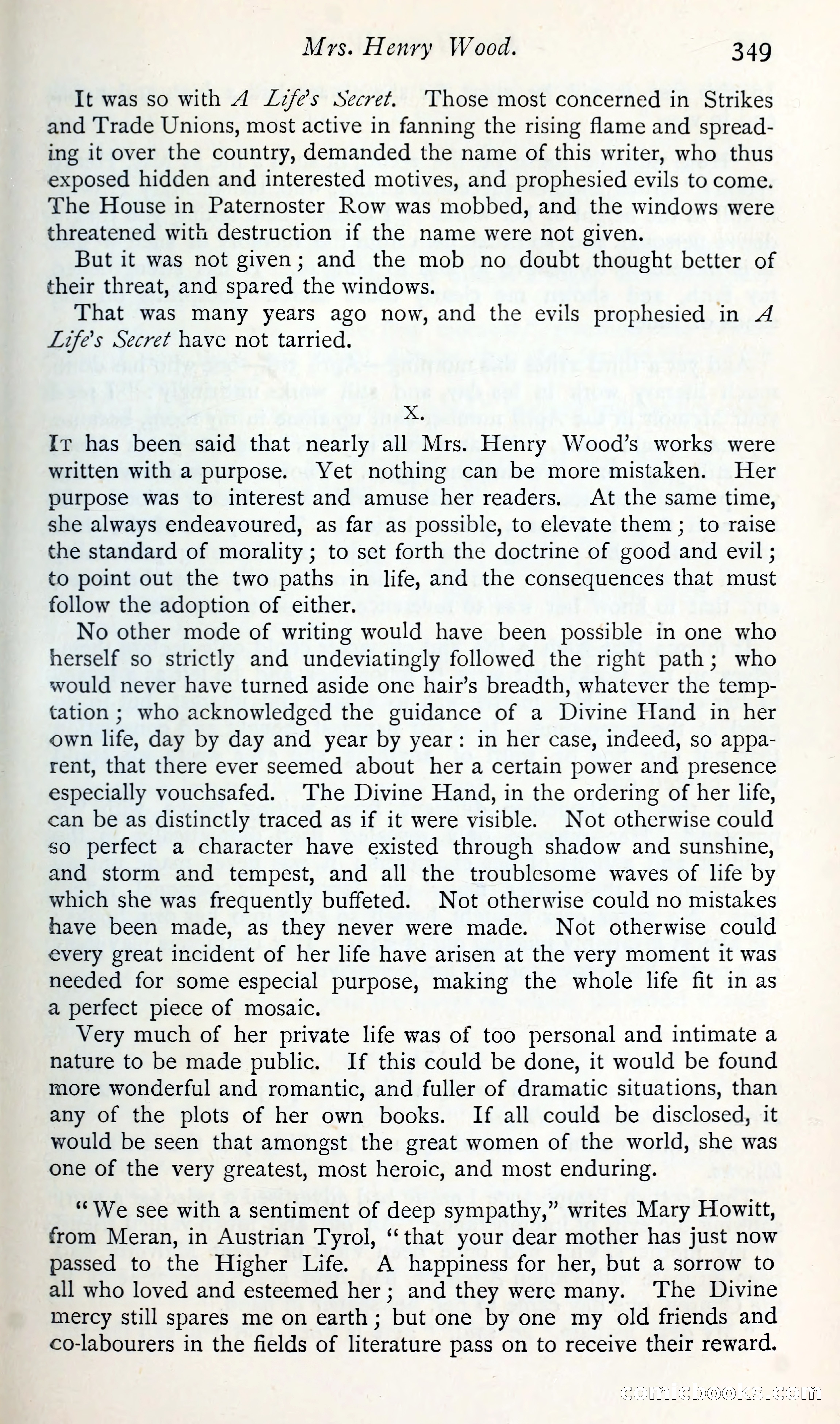
A restored page from Pulp Fiction, 1865. Page through the whole issue in the reader above.
📄 Transcribed text from this page (OCR, searchable)
Machine-transcribed from the original scan — historical spelling and the odd misread are preserved.
Mrs. Henry Wood. 349 It was so with A Lzfe’s Secret. ‘Those most concerned in Strikes and ‘Trade Unions, most active in fanning the rising flame and spread- ing it over the country, demanded the name of this writer, who thus exposed hidden and interested motives, and prophesied evils to come. The House in Paternoster Row was mobbed, and the windows were threatened witnu destruction if the name were not given. But it was not given; and the mob no doubt thought better of their threat, and spared the windows. That was many years ago now, and the evils prophesied in 4 Life’s Secret have not tarried. Xx Ir has been said that nearly all Mrs. Henry Wood’s works were written with a purpose. Yet nothing can be more mistaken. Her purpose was to interest and amuse her readers. At the same time, she always endeavoured, as far as possible, to elevate them ; to raise the standard of morality ; to set forth the doctrine of good and evil ; to point out the two paths in life, and the consequences that must follow the adoption of either. No other mode of writing would have been possible in one who herself so strictly and undeviatingly followed the nght path; who would never have turned aside one hair’s breadth, whatever the temp- tation ; who acknowledged the guidance of a Divine Hand in her own life, day by day and year by year: in her case, indeed, so appa- rent, that there ever seemed about her a certain power and presence especially vouchsafed. ‘The Divine Hand, in the ordering of her life, can be as distinctly traced as if it were visible. Not otherwise could so perfect a character have existed through shadow and sunshine, and storm and tempest, and all the troublesome waves of life by which she was frequently buffeted. Not otherwise could no mistakes have been made, as they never were made. Not otherwise could every great incident of her life have arisen at the very moment it was needed for some especial purpose, making the whole life fit in as a perfect piece of mosaic. Very much of her private life was of too personal and intimate a nature to be made public. If this could be done, it would be found more wonderful and romantic, and fuller of dramatic situations, than any of the plots of her own books. If all could be disclosed, it would be seen that amongst the great women of the world, she was one of the very greatest, most heroic, and most enduring. ‘““We see with a sentiment of deep sympathy,” writes Mary Howitt, from Meran, in Austrian Tyrol, ‘‘that your dear mother has just now passed to the Higher Life. A happiness for her, but a sorrow to all who loved and esteemed her; and they were many. ‘The Divine mercy still spares me on earth; but one by one my old friends and co-labourers in the fields of literature pass on to receive their reward. COMMICOOOKS.c©