
Pulp Fiction, 1865 · page 370 of 400
The Argosy — page 370: what you’re looking at
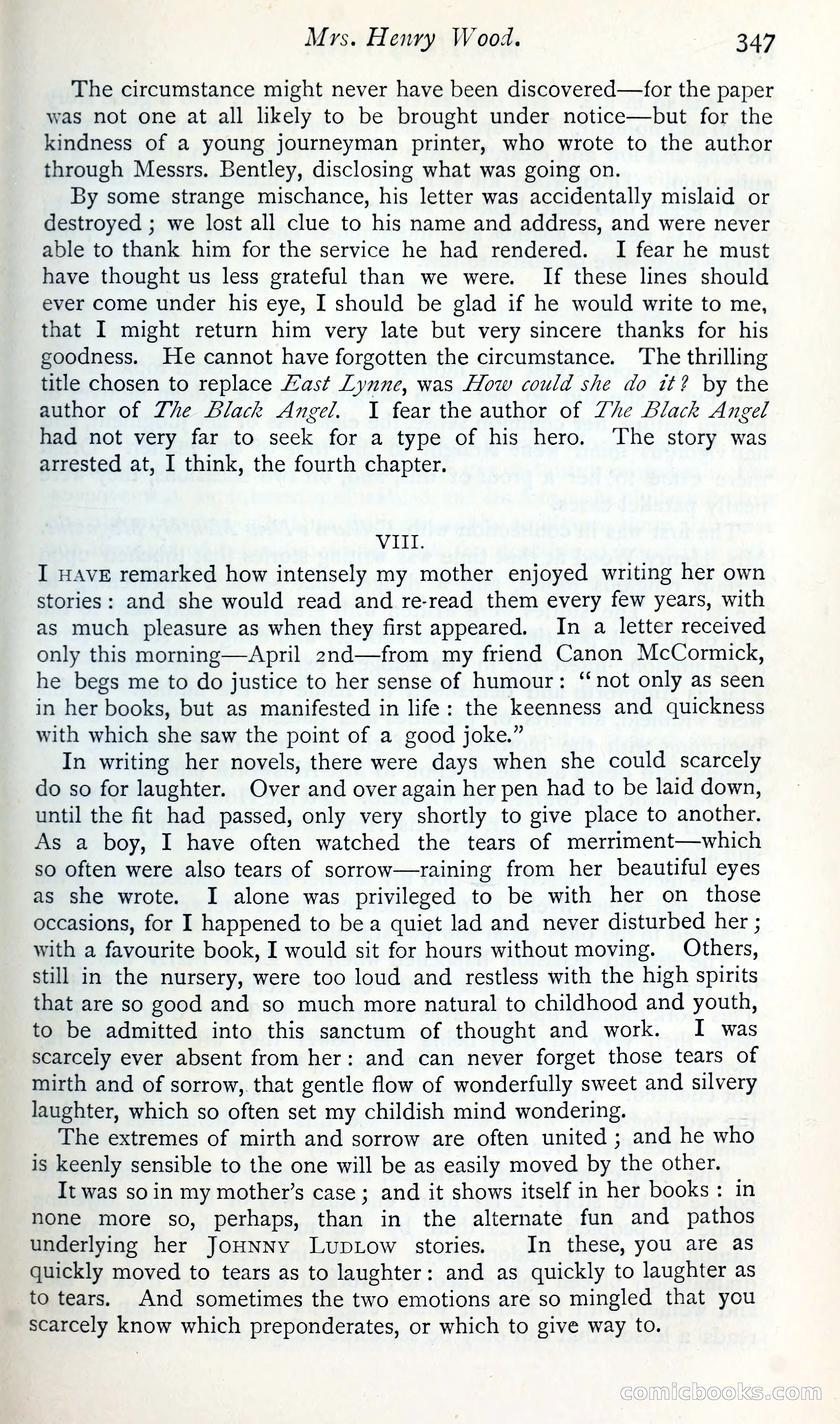
A restored page from Pulp Fiction, 1865. Page through the whole issue in the reader above.
📄 Transcribed text from this page (OCR, searchable)
Machine-transcribed from the original scan — historical spelling and the odd misread are preserved.
Mrs. Henry Wood. 347 The circumstance might never have been discovered—for the paper was not one at all likely to be brought under notice—but for the kindness of a young journeyman printer, who wrote to the author through Messrs. Bentley, disclosing what was going on. By some strange mischance, his letter was accidentally mislaid or destroyed ; we lost all clue to his name and address, and were never able to thank him for the service he had rendered. I fear he must have thought us less grateful than we were. If these lines should ever come under his eye, I should be glad if he would write to me, that I might return him very late but very sincere thanks for his goodness. He cannot have forgotten the circumstance. The thrilling title chosen to replace Hast Lynne, was How could she do it? by the author of Zhe Llack Angel. I fear the author of Zhe Llack Angel had not very far to seek for a type of his hero. The story was arrested at, I think, the fourth chapter. VIII. I HAVE remarked how intensely my mother enjoyed writing her own stories: and she would read and re-read them every few years, with as much pleasure as when they first appeared. In a letter received only this morning—April znd—from my friend Canon McCormick, he begs me to do justice to her sense of humour: “not only as seen in her books, but as manifested in life: the keenness and quickness with which she saw the point of a good joke.” In writing her novels, there were days when she could scarcely do so for laughter. Over and over again her pen had to be laid down, until the fit had passed, only very shortly to give place to another. As a boy, I have often watched the tears of merriment—which so often were also tears of sorrow—raining from her beautiful eyes as she wrote. I alone was privileged to be with her on those occasions, for I happened to bea quiet lad and never disturbed her ; with a favourite book, I would sit for hours without moving. Others, still in the nursery, were too loud and restless with the high spirits that are so good and so much more natural to childhood and youth, to be admitted into this sanctum of thought and work. I was scarcely ever absent from her: and can never forget those tears of mirth and of sorrow,. that gentle flow of wonderfully sweet and silvery laughter, which so often set my childish mind wondering. The extremes of mirth and sorrow are often united ; and he who is keenly sensible to the one will be as easily moved by the other. It was so in my mother’s case; and it shows itself in her books: in none more so, perhaps, than in the alternate fun and pathos underlying her JoHNNy LupLow stories. In these, you are as quickly moved to tears as to laughter: and as quickly to laughter as to tears. And sometimes the two emotions are so mingled that you scarcely know which preponderates, or which to give way to. cCconniclbooolks (SO