
Pulp Fiction, 1865 · page 369 of 400
The Argosy — page 369: what you’re looking at
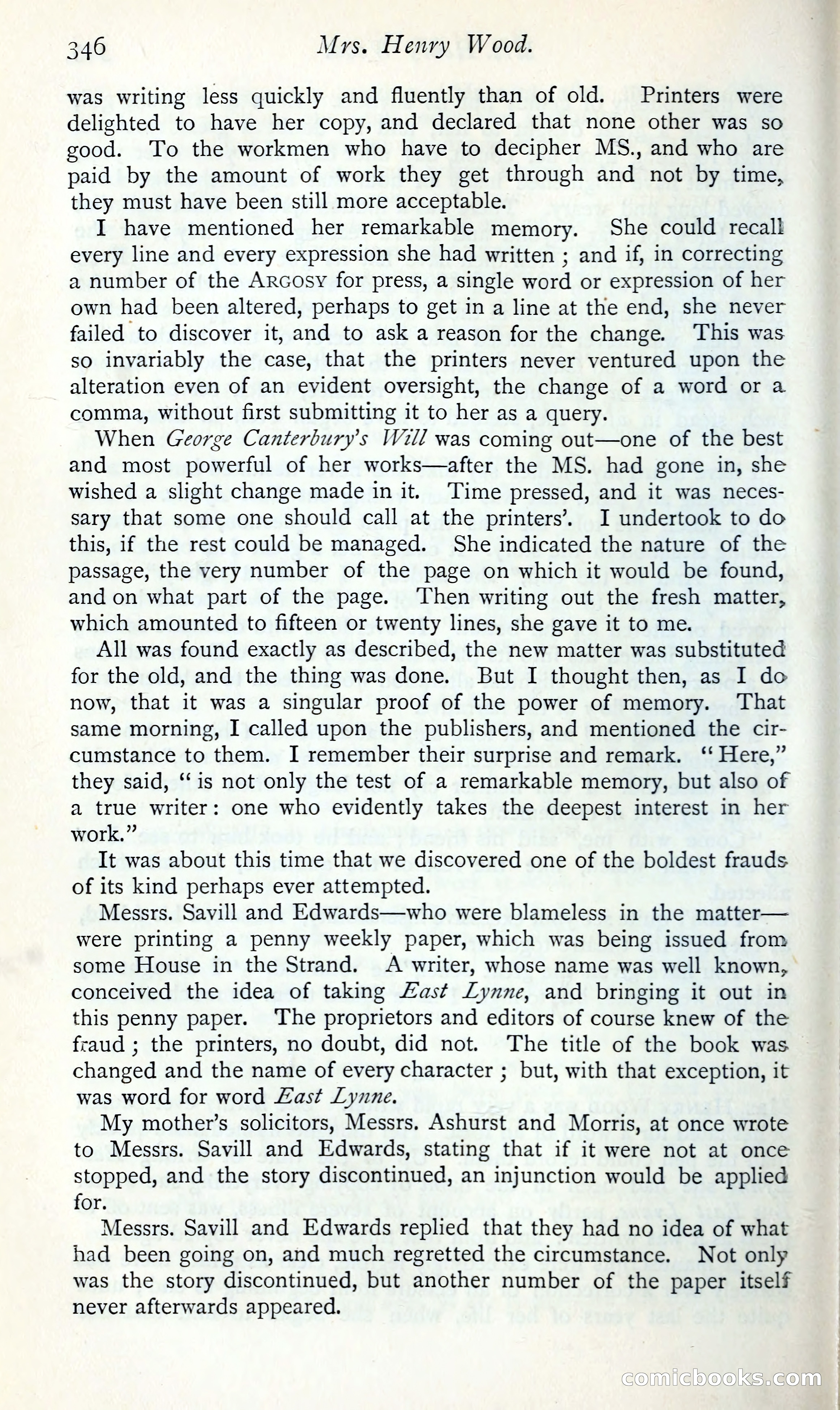
A restored page from Pulp Fiction, 1865. Page through the whole issue in the reader above.
📄 Transcribed text from this page (OCR, searchable)
Machine-transcribed from the original scan — historical spelling and the odd misread are preserved.
346 Mrs. Henry Wood. was writing less quickly and fluently than of old. Printers were delighted to have her copy, and declared that none other was so good. To the workmen who have to decipher MS., and who are paid by the amount of work they get through and not by time, they must have been still more acceptable. I have mentioned her remarkable memory. She could recall every line and every expression she had written ; and if, in correcting a number of the Arcosy for press, a single word or expression of her own had been altered, perhaps to get in a line at the end, she never failed to discover it, and to ask a reason for the change. This was so invariably the case, that the printers never ventured upon the alteration even of an evident oversight, the change of a word or a comma, without first submitting it to her as a query. When George Canterbury's Will was coming out—one of the best and most powerful of her works—after the MS. had gone in, she wished a slight change made in it. ‘Time pressed, and it was neces- sary that some one should call at the printers’. I undertook to do this, if the rest could be managed. She indicated the nature of the passage, the very number of the page on which it would be found, and on what part of the page. ‘Then writing out the fresh matter, which amounted to fifteen or twenty lines, she gave it to me. All was found exactly as described, the new matter was substituted for the old, and the thing was done. But I thought then, as I do now, that it was a singular proof of the power of memory. ‘That same morning, I called upon the publishers, and mentioned the cir- cumstance to them. I remember their surprise and remark. ‘‘ Here,” they said, ‘‘is not only the test of a remarkable memory, but also of a true writer: one who evidently takes the deepest interest in her work.” It was about this time that we discovered one of the boldest frauds of its kind perhaps ever attempted. Messrs. Savill and Edwards—who were blameless in the matter— were printing a penny weekly paper, which was being issued from some House in the Strand. <A writer, whose name was well known, conceived the idea of taking Last Lynne, and bringing it out in this penny paper. The proprietors and editors of course knew of the fraud ; the printers, no doubt, did not. The title of the book was changed and the name of every character ; but, with that exception, it was word for word Last Lynne. My mother’s solicitors, Messrs. Ashurst and Morris, at once wrote to Messrs. Savill and Edwards, stating that if it were not at once stopped, and the story discontinued, an injunction would be applied for. Messrs. Savill and Edwards replied that they had no idea of what had been going on, and much regretted the circumstance. Not only was the story discontinued, but another number of the paper itself never afterwards appeared. COMMICMDOO;KS, (Evo) my