
Pulp Fiction, 1865 · page 361 of 400
The Argosy — page 361: what you’re looking at
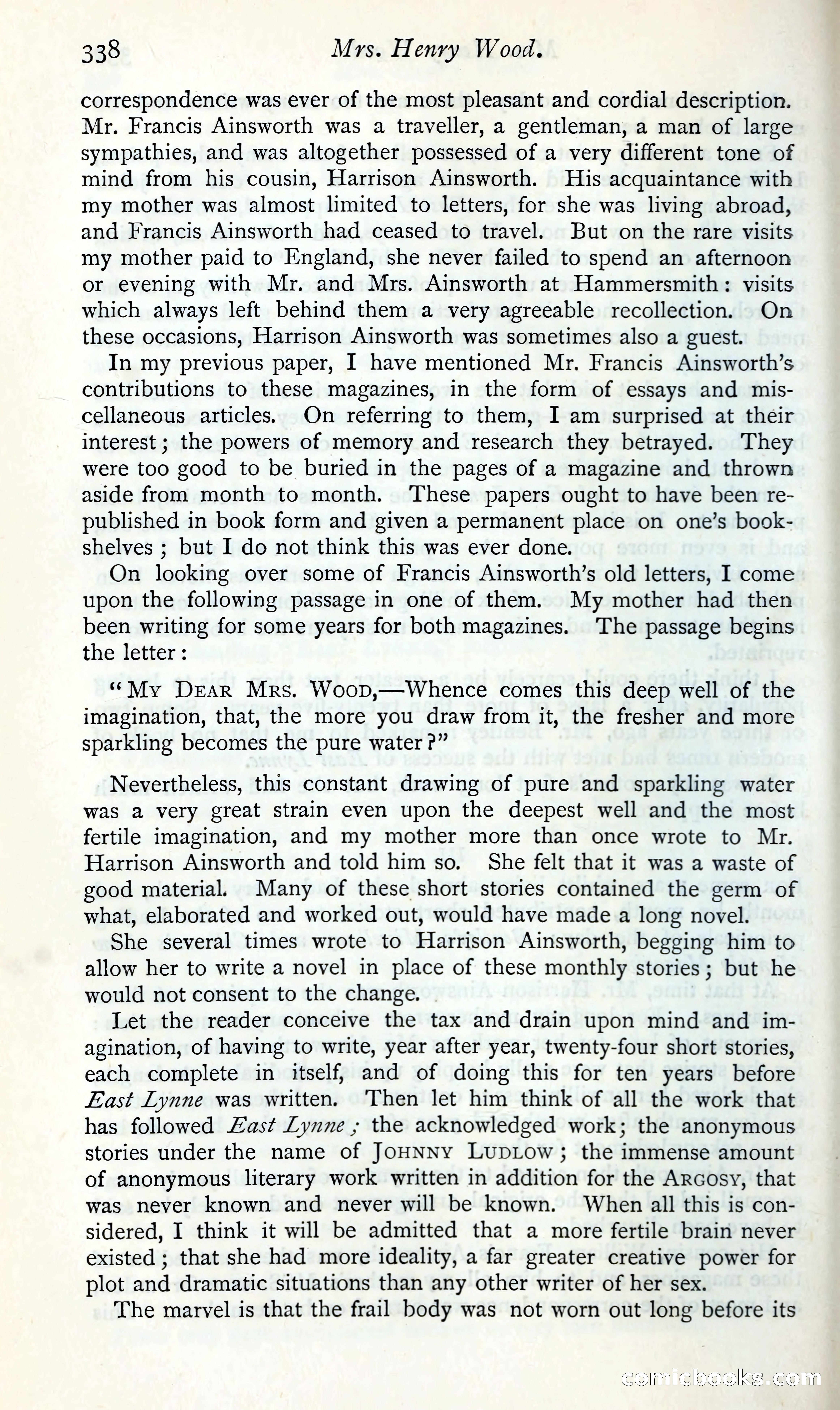
A restored page from Pulp Fiction, 1865. Page through the whole issue in the reader above.
📄 Transcribed text from this page (OCR, searchable)
Machine-transcribed from the original scan — historical spelling and the odd misread are preserved.
338 Mrs. Henry Wood. correspondence was ever of the most pleasant and cordial description. Mr. Francis Ainsworth was a traveller, a gentleman, a man of large sympathies, and was altogether possessed of a very different tone of mind from his cousin, Harrison Ainsworth. His acquaintance with my mother was almost limited to letters, for she was living abroad, and Francis Ainsworth had ceased to travel. But on the rare visits my mother paid to England, she never failed to spend an afternoon or evening with Mr. and Mrs. Ainsworth at Hammersmith: visits which always left behind them a very agreeable recollection. On these occasions, Harrison Ainsworth was sometimes also a guest. In my previous paper, I have mentioned Mr. Francis Ainsworth’s contributions to these magazines, in the form of essays and mis- cellaneous articles. On referring to them, I am surprised at their interest ; the powers of memory and research they betrayed. They were too good to be buried in the pages of a magazine and thrown aside from month to month. These papers ought to have been re- published in book form and given a permanent place on one’s book- shelves ; but I do not think this was ever done. On looking over some of Francis Ainsworth’s old letters, I come upon the following passage in one of them. My mother had then been writing for some years for both magazines. ‘The passage begins the letter : “My Dear Mrs. Woop,—Whence comes this deep well of the imagination, that, the more you draw from it, the fresher and more sparkling becomes the pure water P” Nevertheless, this constant drawing of pure and sparkling water was a very great strain even upon the deepest well and the most fertile imagination, and my mother more than once wrote to Mr. Harrison Ainsworth and told him so. She felt that it was a waste of good material. Many of these short stories contained the germ of what, elaborated and worked out, would have made a long novel. She several times wrote to Harrison Ainsworth, begging him to allow her to write a novel in place of these monthly stories; but he would not consent to the change. Let the reader conceive the tax and drain upon mind and im- agination, of having to write, year after year, twenty-four short stories, each complete in itself, and of doing this for ten years before East Lynne was written. ‘Then let him think of all the work that has followed Last Lynne ; the acknowledged work; the anonymous stories under the name of JOHNNY LUDLOW; the immense amount of anonymous literary work written in addition for the Arcosy, that was never known and never will be known. When all this is con- sidered, I think it will be admitted that a more fertile brain never existed ; that she had more ideality, a far greater creative power for plot and dramatic situations than any other writer of her sex. The marvel is that the frail body was not worn out long before its CONNICLIOOKSL.E@) m