
Pulp Fiction, 1865 · page 362 of 400
The Argosy — page 362: what you’re looking at
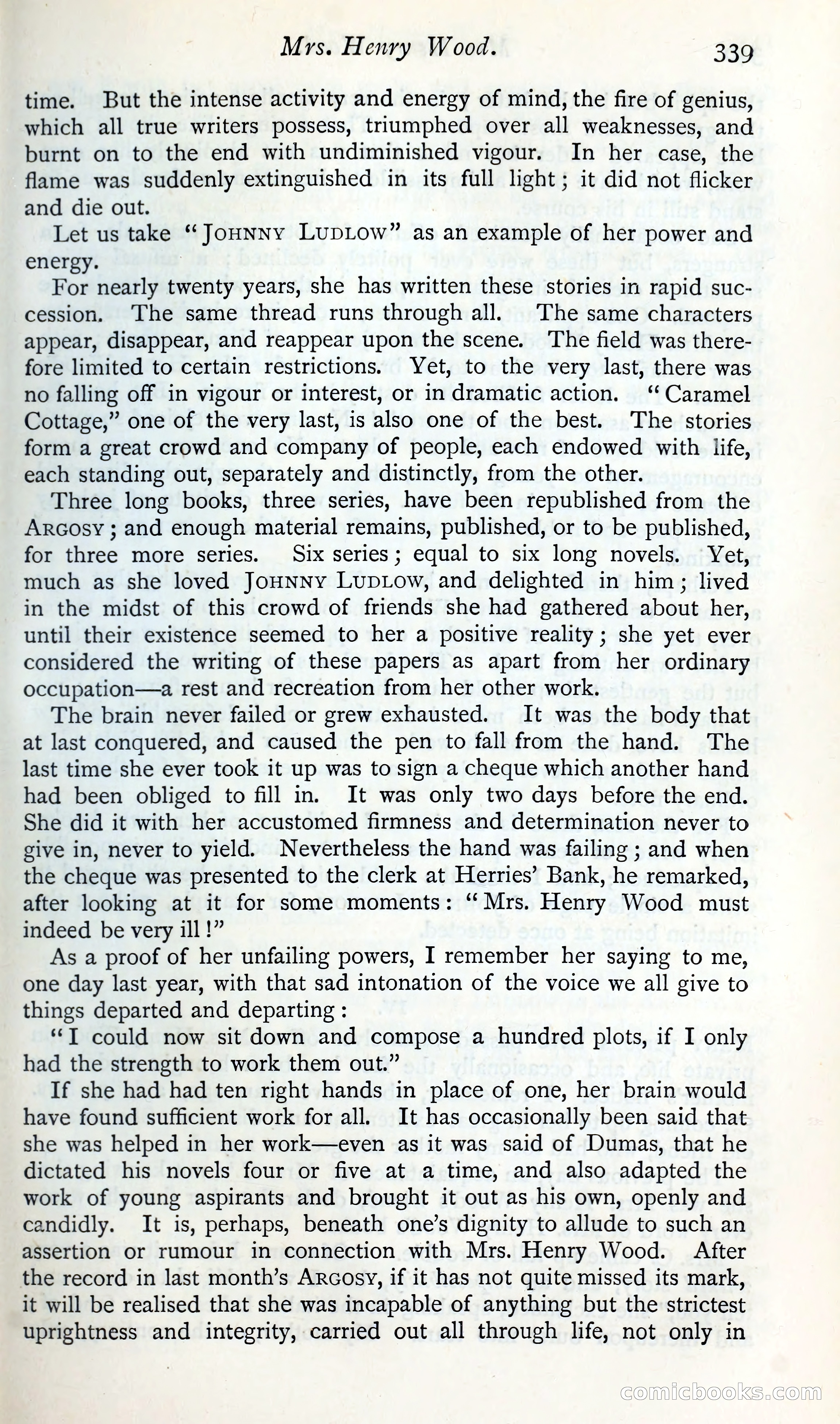
A restored page from Pulp Fiction, 1865. Page through the whole issue in the reader above.
📄 Transcribed text from this page (OCR, searchable)
Machine-transcribed from the original scan — historical spelling and the odd misread are preserved.
Mrs. Henry Wood. 339 time. But the intense activity and energy of mind, the fire of genius, which all true writers possess, triumphed over all weaknesses, and burnt on to the end with undiminished vigour. In her case, the flame was suddenly extinguished in its full light; it did not flicker and die out. Let us take ‘‘ JOHNNY LUDLOW” as an example of her power and energy. For nearly twenty years, she has written these stories in rapid suc- cession. ‘The same thread runs through all. The same characters appear, disappear, and reappear upon the scene. The field was there- fore limited to certain restrictions. Yet, to the very last, there was no falling off in vigour or interest, or in dramatic action. ‘‘ Caramel Cottage,” one of the very last, is also one of the best. The stories form a great crowd and company of people, each endowed with life, each standing out, separately and distinctly, from the other. Three long books, three series, have been republished from the ArGosy ; and enough material remains, published, or to be published, for three more series. Six series; equal to six long novels. Yet, much as she loved JOHNNY LUDLOW, and delighted in him; lived in the midst of this crowd of friends she had gathered about her, until their existence seemed to her a positive reality ; she yet ever considered the writing of these papers as apart from her ordinary occupation—a rest and recreation from her other work. The brain never failed or grew exhausted. It was the body that at last conquered, and caused the pen to fall from the hand. The last time she ever took it up was to sign a cheque which another hand had been obliged to fill in. It was only two days before the end. She did it with her accustomed firmness and determination never to give in, never to yield. Nevertheless the hand was failing ; and when the cheque was presented to the clerk at Herries’ Bank, he remarked, after looking at it for some moments: ‘Mrs. Henry Wood must indeed be very ill !” As a proof of her unfailing powers, I remember her saying to me, one day last year, with that sad intonation of the voice we all give to things departed and departing : ‘T could now sit down and compose a hundred plots, if I only had the strength to work them out.” If she had had ten right hands in place of one, her brain would have found sufficient work for all. It has occasionally been said that she was helped in her work—even as it was said of Dumas, that he dictated his novels four or five at a time, and also adapted the work of young aspirants and brought it out as his own, openly and candidly. It is, perhaps, beneath one’s dignity to allude to such an assertion or rumour in connection with Mrs. Henry Wood. After the record in last month’s Arcosy, if it has not quite missed its mark, it will be realised that she was incapable of anything but the strictest uprightness and integrity, carried out all through life, not only in conmicooolks (SO