
Pulp Fiction, 1865 · page 360 of 400
The Argosy — page 360: what you’re looking at
A restored page from Pulp Fiction, 1865. Page through the whole issue in the reader above.
📄 Transcribed text from this page (OCR, searchable)
Machine-transcribed from the original scan — historical spelling and the odd misread are preserved.
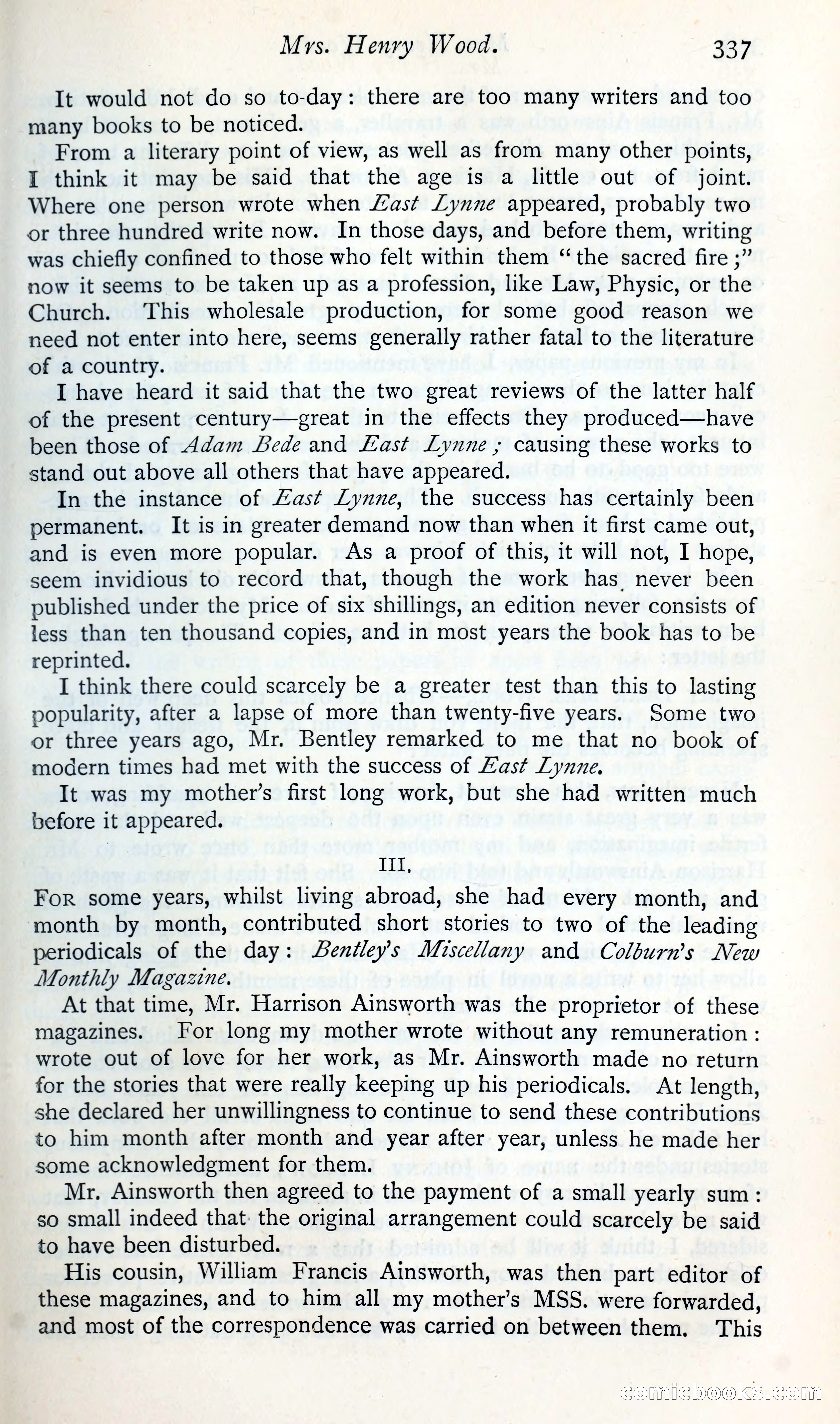
Mrs. Henry Wood. 337 It would not do so to-day: there are too many writers and too many books to be noticed. From a literary point of view, as well as from many other points, I think it may be said that the age is a little out of joint. Where one person wrote when Last Lynne appeared, probably two or three hundred write now. In those days, and before them, writing was chiefly confined to those who felt within them “the sacred fire ;” now it seems to be taken up as a profession, like Law, Physic, or the Church. This wholesale production, for some good reason we need not enter into here, seems generally rather fatal to the literature of a country. I have heard it said that the two great reviews of the latter half of the present century—great in the effects they produced—have been those of Adam Bede and Kast Lynne ; causing these works to stand out above all others that have appeared. In the instance of Hast Lynne, the success has certainly been permanent. It is in greater demand now than when it first came out, and is even more popular. As a proof of this, it will not, I hope, seem invidious to record that, though the work has never been published under the price of six shillings, an edition never consists of less than ten thousand copies, and in most years the book has to be reprinted. I think there could scarcely be a greater test than this to lasting popularity, after a lapse of more than twenty-five years. Some two or three years ago, Mr. Bentley remarked to me that no book of modern times had met with the success of Last Lynne. It was my mother’s first long work, but she had written much before it appeared. III, For some years, whilst living abroad, she had every month, and month by month, contributed short stories to two of the leading periodicals of the day: Sentley’s Miscellany and Colburn’s New Monthly Magazine. At that time, Mr. Harrison Ainsworth was the proprietor of these magazines. For long my mother wrote without any remuneration: wrote out of love for her work, as Mr. Ainsworth made no return for the stories that were really keeping up his periodicals. At length, she declared her unwillingness to continue to send these contributions to him month after month and year after year, unless he made her some acknowledgment for them. Mr. Ainsworth then agreed to the payment of a small yearly sum: so small indeed that: the original arrangement could scarcely be said to have been disturbed. His cousin, William Francis Ainsworth, was then part editor of these magazines, and to him all my mother’s MSS. were forwarded, and most of the correspondence was carried on between them. This comicbooks (SO