
Pulp Fiction, 1865 · page 285 of 400
The Argosy — page 285: what you’re looking at
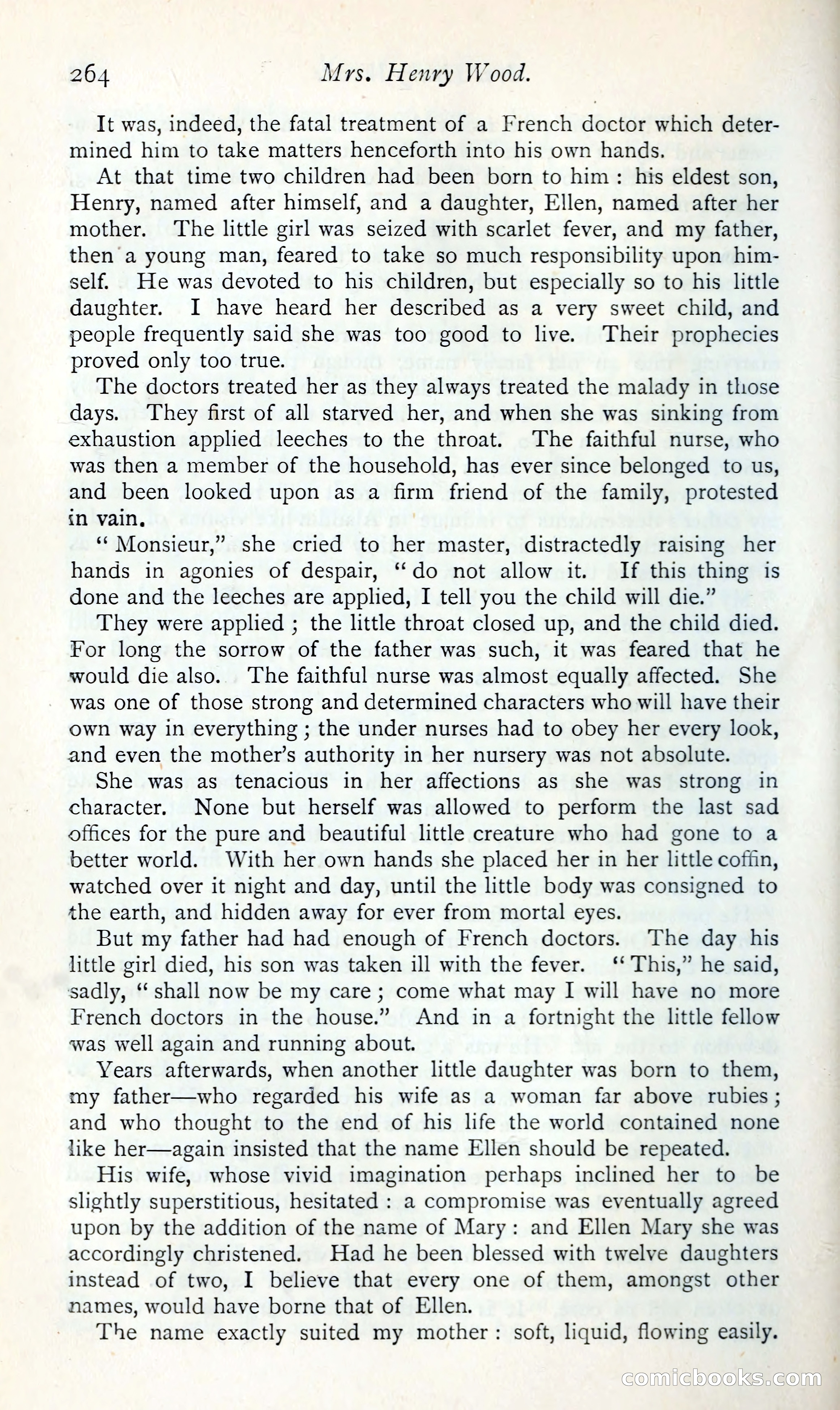
A restored page from Pulp Fiction, 1865. Page through the whole issue in the reader above.
📄 Transcribed text from this page (OCR, searchable)
Machine-transcribed from the original scan — historical spelling and the odd misread are preserved.
264 Mrs. Henry Wood. It was, indeed, the fatal treatment of a French doctor which deter- mined him to take matters henceforth into his own hands. At that time two children had been born to him: his eldest son, Henry, named after himself, and a daughter, Ellen, named after her mother. The little girl was seized with scarlet fever, and my father, then a young man, feared to take so much responsibility upon him- self. He was devoted to his children, but especially so to his little daughter. I have heard her described as a very sweet child, and people frequently said she was too good to live. Their prophecies proved only too true. The doctors treated her as they always treated the malady in those days. They first of all starved her, and when she was sinking from exhaustion applied leeches to the throat. The faithful nurse, who was then a member of the household, has ever since belonged to us, and been looked upon as a firm friend of the family, protested in vain, ‘‘ Monsieur,” she cried to her master, distractedly raising her hands in agonies of despair, “‘do not allow it. If this thing is done and the leeches are applied, I tell you the child will die.” They were applied ; the little throat closed up, and the child died. For long the sorrow of the father was such, it was feared that he would die also. ‘The faithful nurse was almost equally affected. She was one of those strong and determined characters who will have their own way in everything ; the under nurses had to obey her every look, and even the mother’s authority in her nursery was not absolute. She was as tenacious in her affections as she was strong in character. None but herself was allowed to perform the last sad offices for the pure and beautiful little creature who had gone to a better world. With her own hands she placed her in her little coffin, watched over it night and day, until the little body was consigned to the earth, and hidden away for ever from mortal eyes. But my father had had enough of French doctors. The day his little girl died, his son was taken ill with the fever. ‘‘ This,” he said, sadly, “shall now be my care; come what may I will have no more French doctors in the house.” And in a fortnight the little fellow was well again and running about. Years afterwards, when another little daughter was born to them, my father—who regarded his wife as a woman far above rubies ; and who thought to the end of his life the world contained none like her—again insisted that the name Ellen should be repeated. His wife, whose vivid imagination perhaps inclined her to be slightly superstitious, hesitated : a compromise was eventually agreed upon by the addition of the name of Mary: and Ellen Mary she was accordingly christened. Had he been blessed with twelve daughters instead of two, I believe that every one of them, amongst other names, would have borne that of Ellen. The name exactly suited my mother: soft, liquid, flowing easily. ) COMMICOOO;KS. EO)