
Pulp Fiction, 1865 · page 286 of 400
The Argosy — page 286: what you’re looking at
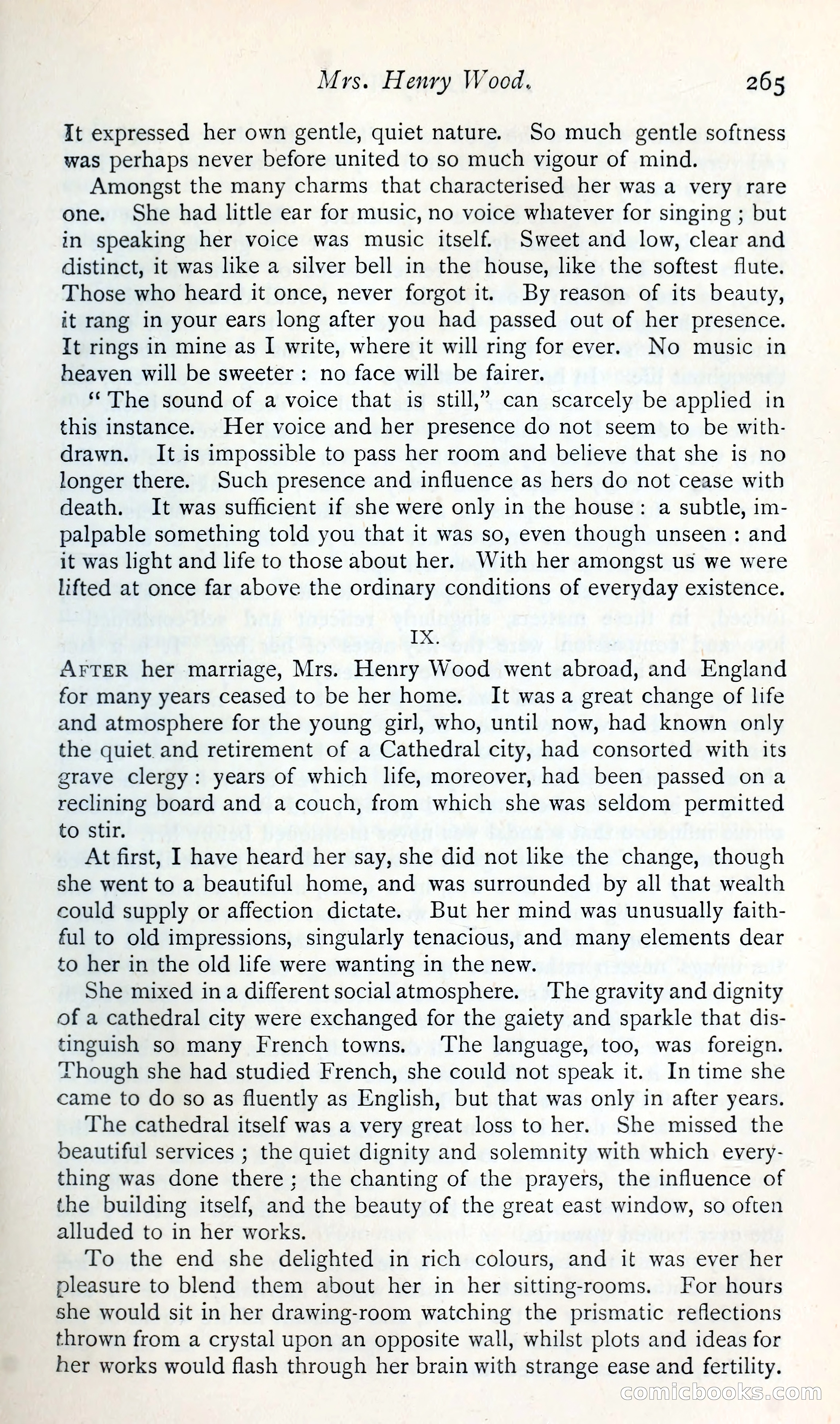
A restored page from Pulp Fiction, 1865. Page through the whole issue in the reader above.
📄 Transcribed text from this page (OCR, searchable)
Machine-transcribed from the original scan — historical spelling and the odd misread are preserved.
Mrs. Henry Wood. 265 It expressed her own gentle, quiet nature. So much gentle softness was perhaps never before united to so much vigour of mind. Amongst the many charms that characterised her was a very rare one. She had little ear for music, no voice whatever for singing ; but in speaking her voice was music itself. Sweet and low, clear and distinct, it was like a silver bell in the house, like the softest flute. Those who heard it once, never forgot it. By reason of its beauty, it rang in your ears long after you had passed out of her presence. It rings in mine as I write, where it will ring for ever. No music in heaven will be sweeter: no face will be fairer. “The sound of a voice that is still,” can scarcely be applied in this instance. Her voice and her presence do not seem to be with- drawn. It is impossible to pass her room and believe that she is no longer there. Such presence and influence as hers do not cease with death. It was sufficient if she were only in the house: a subtle, im- palpable something told you that it was so, even though unseen : and it was light and life to those about her. With her amongst us we were lifted at once far above the ordinary conditions of everyday existence. IX. AFTER her marriage, Mrs. Henry Wood went abroad, and England for many years ceased to be her home. It wasa great change of life and atmosphere for the young girl, who, until now, had known only the quiet and retirement of a Cathedral city, had consorted with its grave clergy: years of which life, moreover, had been passed ona reclining board and a couch, from which she was seldom permitted to stir. At first, I have heard her say, she did not like the change, though she went to a beautiful home, and was surrounded by all that wealth could supply or affection dictate. But her mind was unusually faith- ful to old impressions, singularly tenacious, and many elements dear to her in the old life were wanting in the new. She mixed ina different socialatmosphere. ‘The gravity and dignity of a cathedral city were exchanged for the gaiety and sparkle that dis- tinguish so many French towns. ‘The language, too, was foreign. Though she had studied French, she could not speak it. In time she came to do so as fluently as English, but that was only in after years. The cathedral itself was a very great loss to her. She missed the beautiful services ; the quiet dignity and solemnity with which every- thing was done there; the chanting of the prayers, the influence of the building itself, and the beauty of the great east window, so often alluded to in her works. To the end she delighted in rich colours, and it was ever her pleasure to blend them about her in her sitting-rooms. For hours she would sit in her drawing-room watching the prismatic reflections thrown from a crystal upon an opposite wall, whilst plots and ideas for her works would flash through her brain with strange ease and fertility. COMMICOoOoKS.c©