
Pulp Fiction, 1865 · page 284 of 400
The Argosy — page 284: what you’re looking at
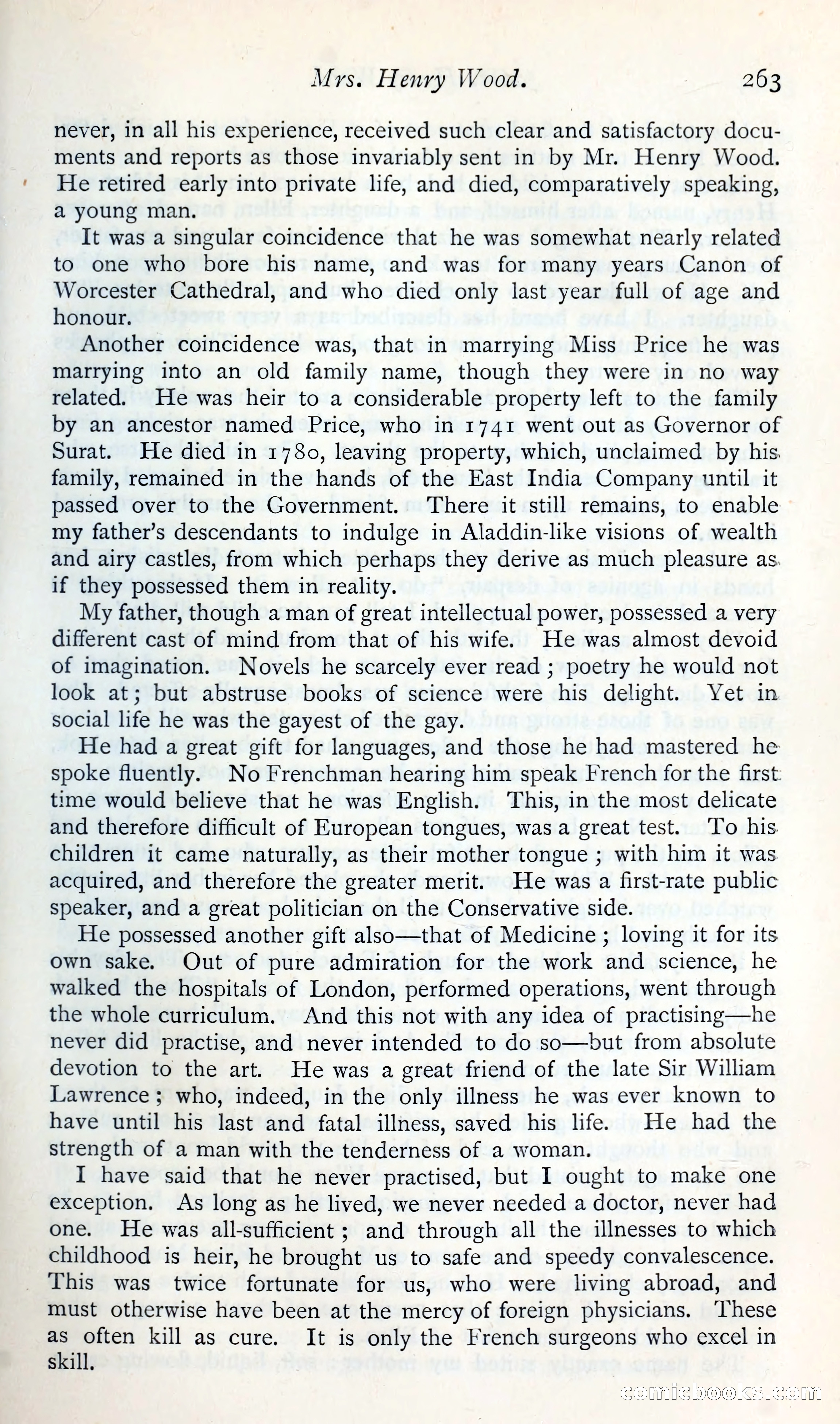
A restored page from Pulp Fiction, 1865. Page through the whole issue in the reader above.
📄 Transcribed text from this page (OCR, searchable)
Machine-transcribed from the original scan — historical spelling and the odd misread are preserved.
Mrs. Henry Wood. 263 never, in all his experience, received such clear and satisfactory docu- ments and reports as those invariably sent in by Mr. Henry Wood. He retired early into private life, and died, comparatively speaking, a young man. It was a singular coincidence that he was somewhat nearly related to one who bore his name, and was for many years Canon of Worcester Cathedral, and who died only last year full of age and honour. Another coincidence was, that in marrying Miss Price he was marrying into an old family name, though they were in no way related. He was heir to a considerable property left to the family by an ancestor named Price, who in 1741 went out as Governor of Surat. He died in 1780, leaving property, which, unclaimed by his family, remained in the hands of the East India Company until it passed over to the Government. There it still remains, to enable my father’s descendants to indulge in Aladdin-like visions of wealth and airy castles, from which perhaps they derive as much pleasure as. if they possessed them in reality. My father, though a man of great intellectual power, possessed a very different cast of mind from that of his wife. He was almost devoid of imagination. Novels he scarcely ever read ; poetry he would not look at; but abstruse books of science were his delight. Yet in social life he was the gayest of the gay. He had a great gift for languages, and those he had mastered he spoke fluently. No Frenchman hearing him speak French for the first: time would believe that he was English. This, in the most delicate and therefore difficult of European tongues, was a great test. ‘To his children it came naturally, as their mother tongue ; with him it was acquired, and therefore the greater merit. He was a first-rate public speaker, and a great politician on the Conservative side. He possessed another gift also—that of Medicine ; loving it for its own sake. Out of pure admiration for the work and science, he walked the hospitals of London, performed operations, went through the whole curriculum. And this not with any idea of practising—he never did practise, and never intended to do so—but from absolute devotion to the art. He was a great friend of the late Sir William Lawrence ; who, indeed, in the only illness he was ever known to have until his last and fatal illness, saved his life. He had the strength of a man with the tenderness of a woman. I have said that he never practised, but I ought to make one exception. As long as he lived, we never needed a doctor, never had one. He was all-sufficient; and through all the illnesses to which childhood is heir, he brought us to safe and speedy convalescence. This was twice fortunate for us, who were living abroad, and must otherwise have been at the mercy of foreign physicians. ‘These as often kill as cure. It is only the French surgeons who excel in skill, COMMICOOOKS.c©