
Pulp Fiction, 1865 · page 389 of 400
The Argosy — page 389: what you’re looking at
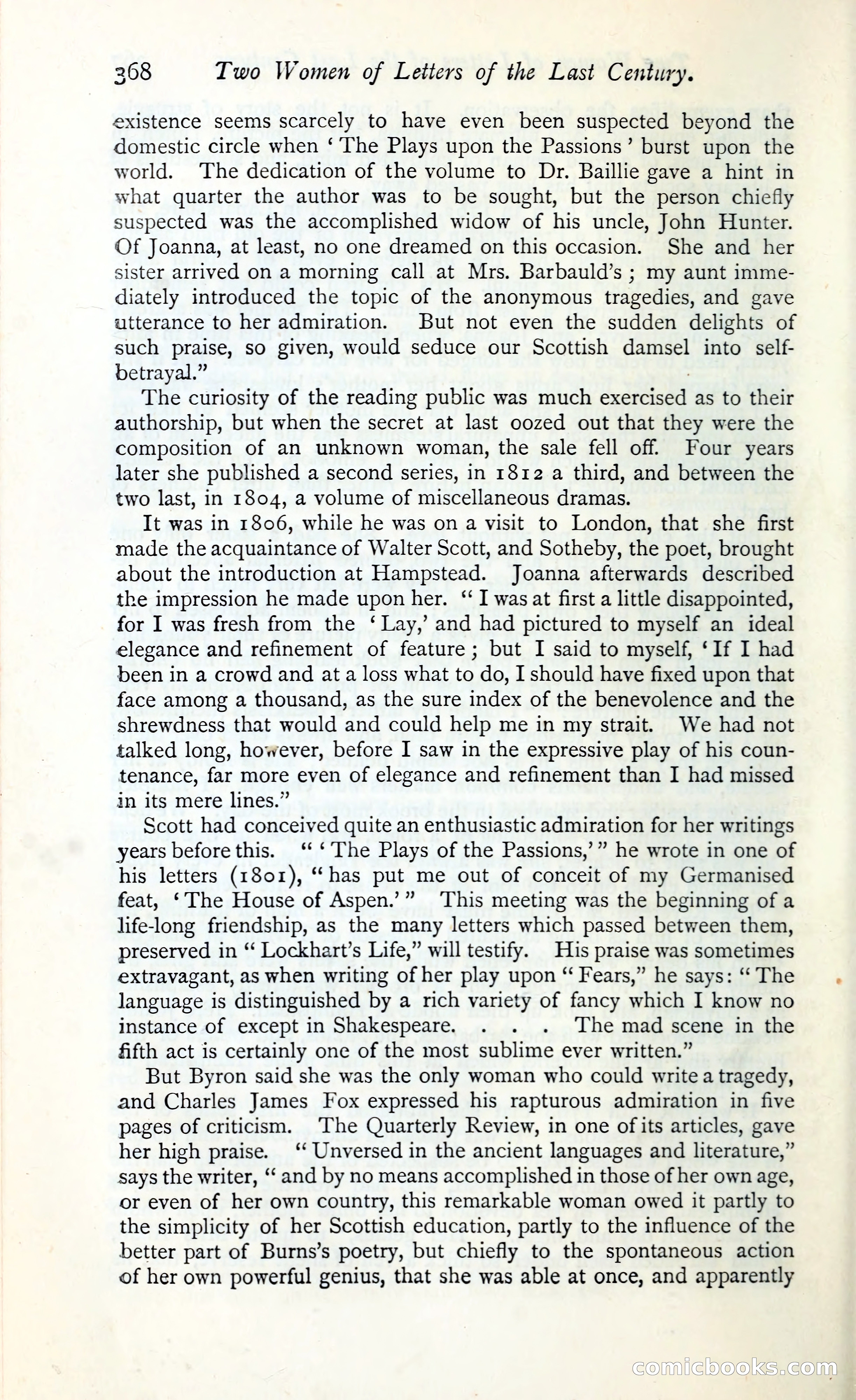
A restored page from Pulp Fiction, 1865. Page through the whole issue in the reader above.
📄 Transcribed text from this page (OCR, searchable)
Machine-transcribed from the original scan — historical spelling and the odd misread are preserved.
268 Two Women of Letters of the Last Century. existence seems scarcely to have even been suspected beyond the domestic circle when ‘ The Plays upon the Passions’ burst upon the world. The dedication of the volume to Dr. Baillie gave a hint in what quarter the author was to be sought, but the person chiefly suspected was the accomplished widow of his uncle, John Hunter. Of Joanna, at least, no one dreamed on this occasion. She and her sister arrived on a morning call at Mrs. Barbauld’s ; my aunt imme- diately introduced the topic of the anonymous tragedies, and gave utterance to her admiration. But not even the sudden delights of such praise, so given, would seduce our Scottish damsel into self- betrayal.” . The curiosity of the reading public was much exercised as to their authorship, but when the secret at last oozed out that they were the composition of an unknown woman, the sale fell off. Four years later she published a second series, in 1812 a third, and between the two last, in 1804, a volume of miscellaneous dramas. It was in 1806, while he was on a visit to London, that she first made the acquaintance of Walter Scott, and Sotheby, the poet, brought about the introduction at Hampstead. Joanna afterwards described the impression he made upon her. ‘‘ I was at first a little disappointed, for I was fresh from the ‘ Lay,’ and had pictured to myself an ideal elegance and refinement of feature; but I said to myself, ‘If I had been in a crowd and at a loss what to do, I should have fixed upon that face among a thousand, as the sure index of the benevolence and the shrewdness that would and could help me in my strait. We had not talked long, however, before I saw in the expressive play of his coun- tenance, far more even of elegance and refinement than I had missed in its mere lines.” Scott had conceived quite an enthusiastic admiration for her writings years beforethis. ‘‘ ‘The Plays of the Passions,’” he wrote in one of his letters (1801), ‘has put me out of conceit of my Germanised feat, ‘The House of Aspen.’” This meeting was the beginning of a life-long friendship, as the many letters which passed between them, preserved in ‘‘ Lockhart’s Life,” will testify. His praise was sometimes extravagant, as when writing of her play upon “‘ Fears,” he says: “‘ The language is distinguished by a rich variety of fancy which I know no instance of except in Shakespeare. . . . ‘The mad scene in the fifth act is certainly one of the most sublime ever written.” But Byron said she was the only woman who could write a tragedy, and Charles James Fox expressed his rapturous admiration in five pages of criticism. The Quarterly Review, in one of its articles, gave her high praise. ‘ Unversed in the ancient languages and literature,” says the writer, “‘ and by no means accomplished in those of her own age, or even of her own country, this remarkable woman owed it partly to the simplicity of her Scottish education, partly to the influence of the better part of Burns’s poetry, but chiefly to the spontaneous action of her own powerful genius, that she was able at once, and apparently CORNICE OOKS. EO)