
Pulp Fiction, 1865 · page 388 of 400
The Argosy — page 388: what you’re looking at
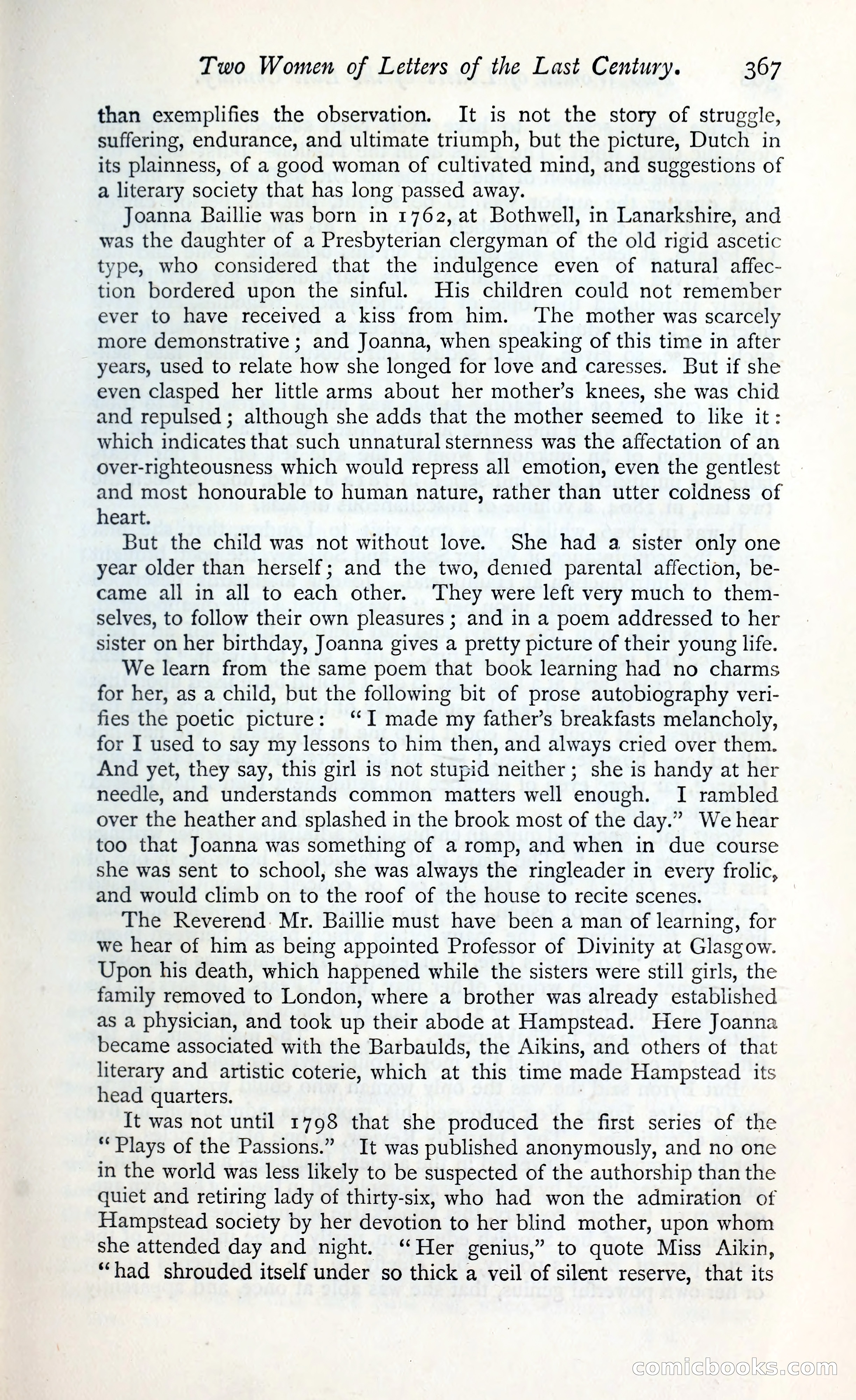
A restored page from Pulp Fiction, 1865. Page through the whole issue in the reader above.
📄 Transcribed text from this page (OCR, searchable)
Machine-transcribed from the original scan — historical spelling and the odd misread are preserved.
Two Women of Letters of the Last Century. 367 than exemplifies the observation. It is not the story of struggle, suffering, endurance, and ultimate triumph, but the picture, Dutch in its plainness, of a good woman of cultivated mind, and suggestions of a literary society that has long passed away. Joanna Baillie was born in 1762, at Bothwell, in Lanarkshire, and was the daughter of a Presbyterian clergyman of the old rigid ascetic type, who considered that the indulgence even of natural affec- tion bordered upon the sinful. His children could not remember ever to have received a kiss from him. ‘The mother was scarcely more demonstrative ; and Joanna, when speaking of this time in after years, used to relate how she longed for love and caresses. But if she even clasped her little arms about her mother’s knees, she was chid and repulsed ; although she adds that the mother seemed to like it: which indicates that such unnatural sternness was the affectation of an over-righteousness which would repress all emotion, even the gentlest and most honourable to human nature, rather than utter coldness of heart. But the child was not without love. She had a sister only one year older than herself; and the two, denied parental affection, be- came all in all to each other. They were left very much to them- selves, to follow their own pleasures ; and in a poem addressed to her sister on her birthday, Joanna gives a pretty picture of their young life. We learn from the same poem that book learning had no charms for her, as a child, but the following bit of prose autobiography veri- fies the poetic picture: ‘I made my father’s breakfasts melancholy, for I used to say my lessons to him then, and always cried over them. And yet, they say, this girl is not stupid neither; she is handy at her needle, and understands common matters well enough. I rambled over the heather and splashed in the brook most of the day.” We hear too that Joanna was something of a romp, and when in due course she was sent to school, she was always the ringleader in every frolic, and would climb on to the roof of the house to recite scenes. The Reverend. Mr. Baillie must have been a man of learning, for we hear of him as being appointed Professor of Divinity at Glasgow. Upon his death, which happened while the sisters were still girls, the family removed to London, where a brother was already established as a physician, and took up their abode at Hampstead. Here Joanna became associated with the Barbaulds, the Aikins, and others of that literary and artistic coterie, which at this time made Hampstead its head quarters. | It was not until 1798 that she produced the first series of the ‘Plays of the Passions.” It was published anonymously, and no one in the world was less likely to be suspected of the authorship than the quiet and retiring lady of thirty-six, who had won the admiration of Hampstead society by her devotion to her blind mother, upon whom she attended day and night. ‘Her genius,” to quote Miss Aikin, “had shrouded itself under so thick a veil of silent reserve, that its COMICOoOolKS ‘@ (C(O)