
Pulp Fiction, 1865 · page 387 of 400
The Argosy — page 387: what you’re looking at
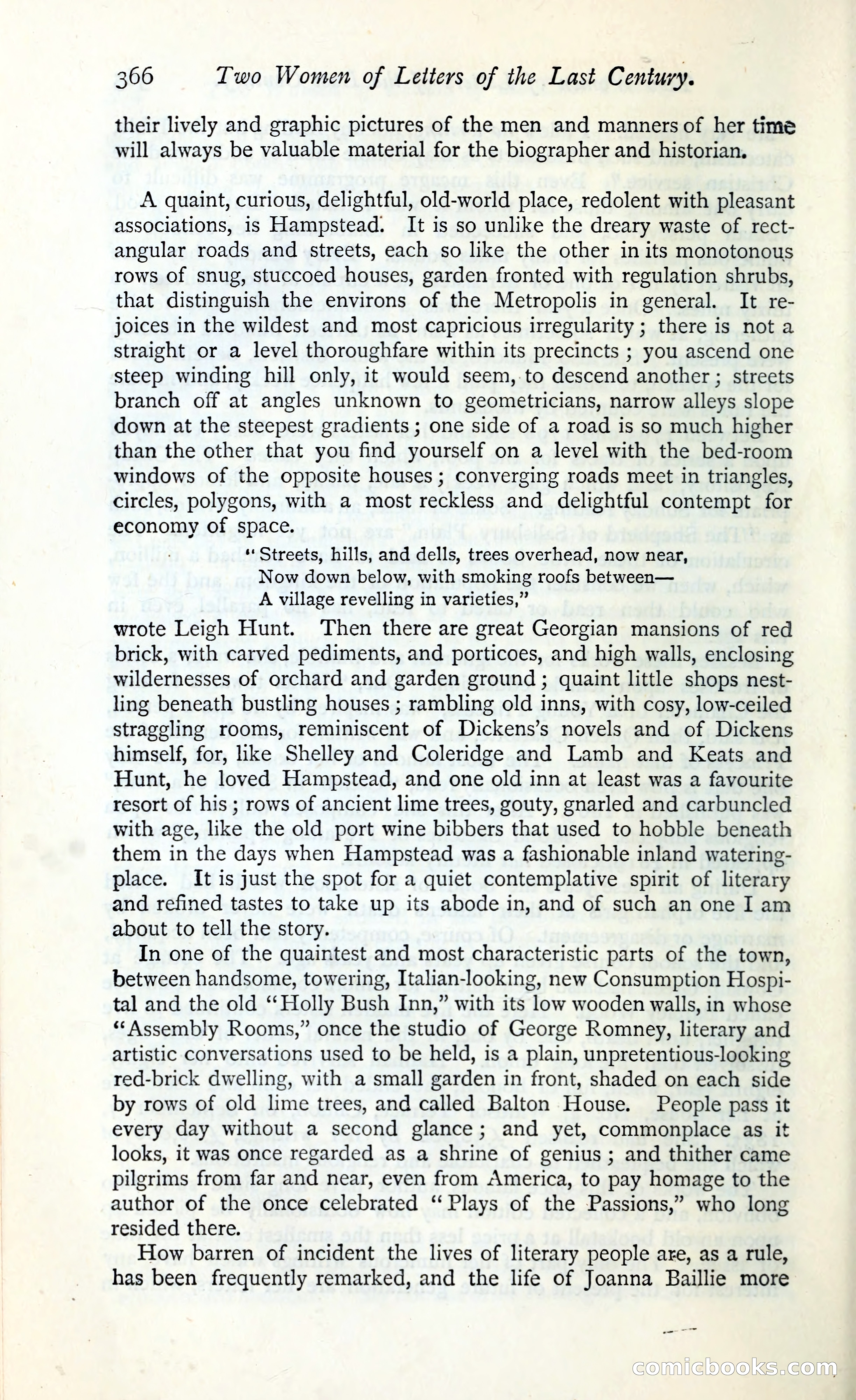
A restored page from Pulp Fiction, 1865. Page through the whole issue in the reader above.
📄 Transcribed text from this page (OCR, searchable)
Machine-transcribed from the original scan — historical spelling and the odd misread are preserved.
366 Two Women of Letters of the Last Century. their lively and graphic pictures of the men and manners of her time will always be valuable material for the biographer and historian. A quaint, curious, delightful, old-world place, redolent with pleasant associations, 1s Hampstead. It is so unlike the dreary waste of rect- angular roads and streets, each so like the other in its monotonous rows of snug, stuccoed houses, garden fronted with regulation shrubs, that distinguish the environs of the Metropolis in general. It re- joices in the wildest and most capricious irregularity ; there is not a straight or a level thoroughfare within its precincts ; you ascend one steep winding hill only, it would seem, to descend another ; streets branch off at angles unknown to geometricians, narrow alleys slope down at the steepest gradients ; one side of a road is so much higher than the other that you find yourself on a level with the bed-room windows of the opposite houses ; converging roads meet in triangles, circles, polygons, with a most reckless and delightful contempt for economy of space. ‘Streets, hills, and dells, trees overhead, now near, Now down below, with smoking roofs between— A village revelling in varieties,” wrote Leigh Hunt. Then there are great Georgian mansions of red brick, with carved pediments, and porticoes, and high walls, enclosing wildernesses of orchard and garden ground ; quaint little shops nest- ling beneath bustling houses ; rambling old inns, with cosy, low-ceiled strageling rooms, reminiscent of Dickens’s novels and of Dickens himself, for, ike Shelley and Coleridge and Lamb and Keats and Hunt, he loved Hampstead, and one old inn at least was a favourite resort of his ; rows of ancient lime trees, gouty, gnarled and carbuncled with age, like the old port wine bibbers that used to hobble beneath them in the days when Hampstead was a fashionable inland watering- place. It is just the spot for a quiet contemplative spirit of literary and refined tastes to take up its abode in, and of such an one I am about to tell the story. In one of the quaintest and most characteristic parts of the town, between handsome, towering, Italian-looking, new Consumption Hospi- tal and the old ‘‘ Holly Bush Inn,” with its low wooden walls, in whose ‘‘Assembly Rooms,” once the studio of George Romney, literary and artistic conversations used to be held, is a plain, unpretentious-looking red-brick dwelling, with a small garden in front, shaded on each side by rows of old lime trees, and called Balton House. People pass it every day without a second glance; and yet, commonplace as it looks, it was once regarded as a shrine of genius; and thither came pilgrims from far and near, even from America, to pay homage to the author of the once celebrated “Plays of the Passions,” who long resided there. How barren of incident the lives of literary people are, as a rule, has been frequently remarked, and the life of Joanna Baillie more GOMIGoOOkKs (€(@)