
Pulp Fiction, 1865 · page 386 of 400
The Argosy — page 386: what you’re looking at
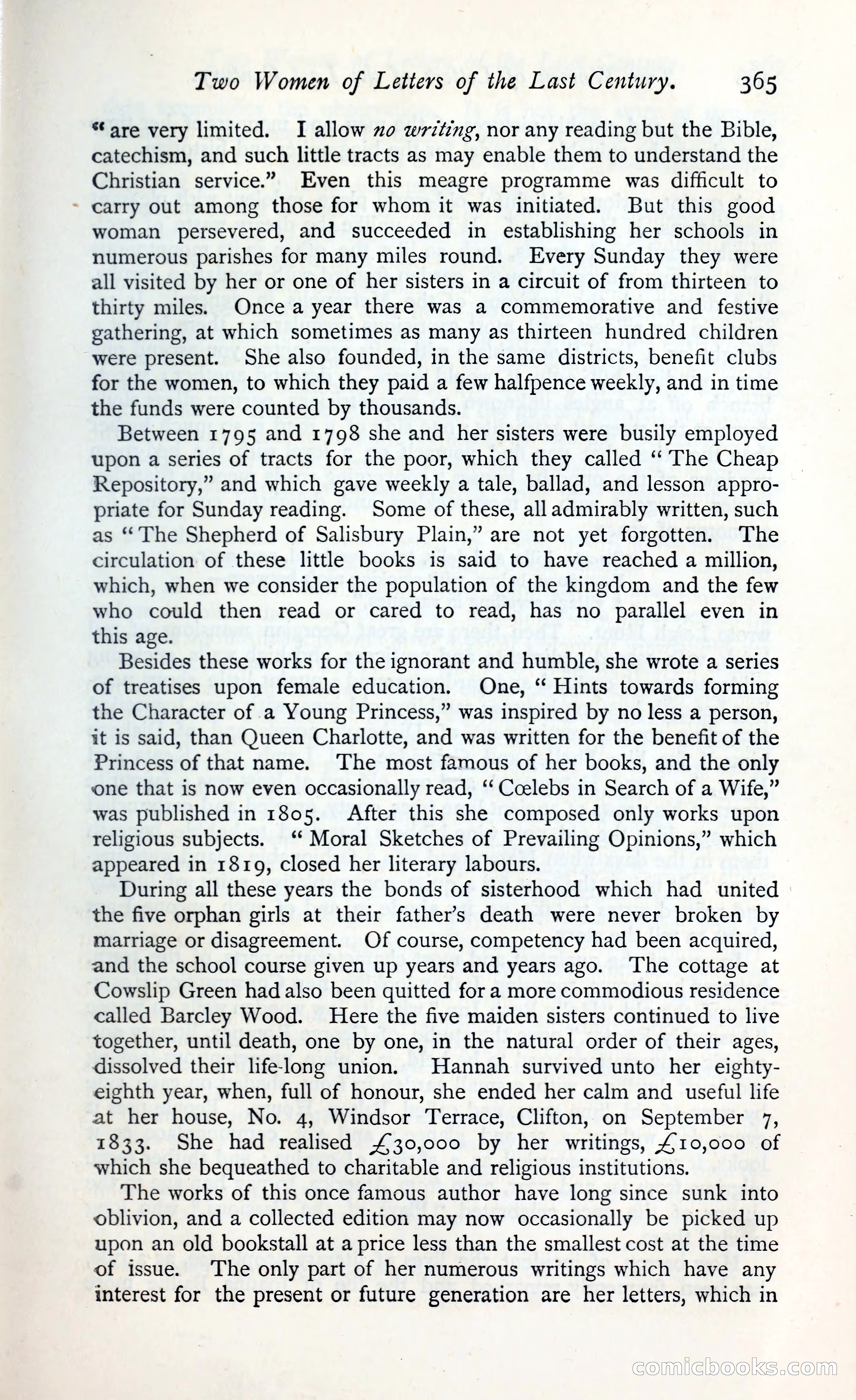
A restored page from Pulp Fiction, 1865. Page through the whole issue in the reader above.
📄 Transcribed text from this page (OCR, searchable)
Machine-transcribed from the original scan — historical spelling and the odd misread are preserved.
Two Women of Letters of the Last Century. 365 “are very limited. I allow xo writing, nor any reading but the Bible, catechism, and such little tracts as may enable them to understand the Christian service.” Even this meagre programme was difficult to ~ carry out among those for whom it was initiated. But this good woman persevered, and succeeded in establishing her schools in numerous parishes for many miles round. Every Sunday they were all visited by her or one of her sisters in a circuit of from thirteen to thirty miles. Once a year there was a commemorative and festive gathering, at which sometimes as many as thirteen hundred children were present. She also founded, in the same districts, benefit clubs for the women, to which they paid a few halfpence weekly, and in time the funds were counted by thousands. Between 1795 and 17098 she and her sisters were busily employed upon a series of tracts for the poor, which they called ‘‘ The Cheap Repository,” and which gave weekly a tale, ballad, and lesson appro- priate for Sunday reading. Some of these, all admirably written, such as “The Shepherd of Salisbury Plain,” are not yet forgotten. The circulation of these little books is said to have reached a million, which, when we consider the population of the kingdom and the few who could then read or cared to read, has no parallel even in this age. Besides these works for the ignorant and humble, she wrote a series of treatises upon female education. One, ‘‘ Hints towards forming the Character of a Young Princess,” was inspired by no less a person, it is said, than Queen Charlotte, and was written for the benefit of the Princess of that name. ‘The most famous of her books, and the only one that is now even occasionally read, ‘‘ Coelebs in Search of a Wife,” was published in 1805. After this she composed only works upon religious subjects. ‘‘ Moral Sketches of Prevailing Opinions,” which appeared in 1819, closed her literary labours. During all these years the bonds of sisterhood which had united the five orphan girls at their father’s death were never broken by matriage or disagreement. Of course, competency had been acquired, and the school course given up years and years ago. ‘The cottage at Cowslip Green had also been quitted fora more commodious residence called Barcley Wood. Here the five maiden sisters continued to live together, until death, one by one, in the natural order of their ages, dissolved their life-long union. Hannah survived unto her eighty- eighth year, when, full of honour, she ended her calm and useful life at her house, No. 4, Windsor Terrace, Clifton, on September 7, 1833. She had realised £30,000 by her writings, 410,000 of which she bequeathed to charitable and religious institutions. The works of this once famous author have long since sunk into oblivion, and a collected edition may now occasionally be picked up upon an old bookstall at a price less than the smallest cost at the time of issue. The only part of her numerous writings which have any interest for the present or future generation are her letters, which in COMICOOOKS.€