
Pulp Fiction, 1865 · page 385 of 400
The Argosy — page 385: what you’re looking at
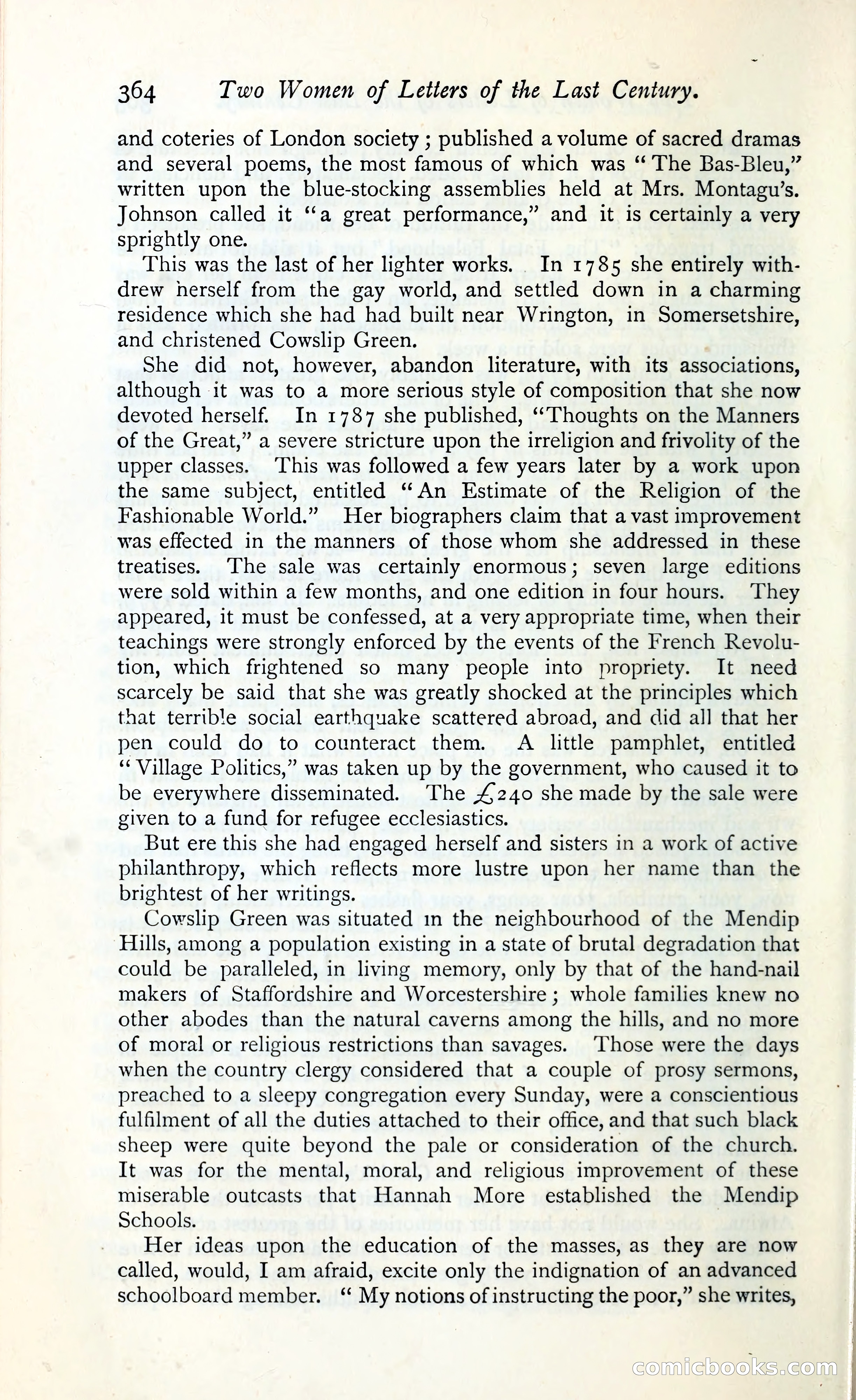
A restored page from Pulp Fiction, 1865. Page through the whole issue in the reader above.
📄 Transcribed text from this page (OCR, searchable)
Machine-transcribed from the original scan — historical spelling and the odd misread are preserved.
364 Two Women of Letters of the Last Century. and coteries of London society ; published a volume of sacred dramas and several poems, the most famous of which was ‘‘ The Bas-Bleu,” written upon the blue-stocking assemblies held at Mrs. Montagu’s. Johnson called it ‘‘a great performance,” and it is certainly a very sprightly one. This was the last of her lighter works. . In 1785 she entirely with- drew nerself from the gay world, and settled down in a charming residence which she had had built near Wrington, in Somersetshire, and christened Cowslip Green. She did not, however, abandon literature, with its associations, although it was to a more serious style of composition that she now devoted herself. In 1787 she published, ‘Thoughts on the Manners of the Great,” a severe stricture upon the irreligion and frivolity of the upper classes. This was followed a few years later by a work upon the same subject, entitled “An Estimate of the Religion of the Fashionable World.” Her biographers claim that a vast improvement was effected 1n the manners of those whom she addressed in these treatises. ‘The sale was certainly enormous; seven large editions were sold within a few months, and one edition in four hours. ‘They appeared, it must be confessed, at a very appropriate time, when their teachings were strongly enforced by the events of the French Revolu- tion, which frightened so many people into propriety. It need scarcely be said that she was greatly shocked at the principles which that terrible social earthquake scattered abroad, and did all that her pen could do to counteract them. A little pamphlet, entitled ‘Village Politics,” was taken up by the government, who caused it to be everywhere disseminated. The 4240 she made by the sale were given to a fund for refugee ecclesiastics. But ere this she had engaged herself and sisters in a work of active philanthropy, which reflects more lustre upon her name than the brightest of her writings. Cowslip Green was situated in the neighbourhood of the Mendip Hills, among a population existing in a state of brutal degradation that could be paralleled, in living memory, only by that of the hand-nail makers of Staffordshire and Worcestershire ; whole families knew no other abodes than the natural caverns among the hills, and no more of moral or religious restrictions than savages. ‘Those were the days when the country clergy considered that a couple of prosy sermons, preached to a sleepy congregation every Sunday, were a conscientious fulfilment of all the duties attached to their office, and that such black sheep were quite beyond the pale or consideration of the church. It was for the mental, moral, and religious improvement of these miserable outcasts that Hannah More established the Mendip Schools. | Her ideas upon the education of the masses, as they are now called, would, I am afraid, excite only the indignation of an advanced schoolboard member. ‘ My notions of instructing the poor,” she writes, eornicbooks.co