
Pulp Fiction, 1865 · page 382 of 400
The Argosy — page 382: what you’re looking at
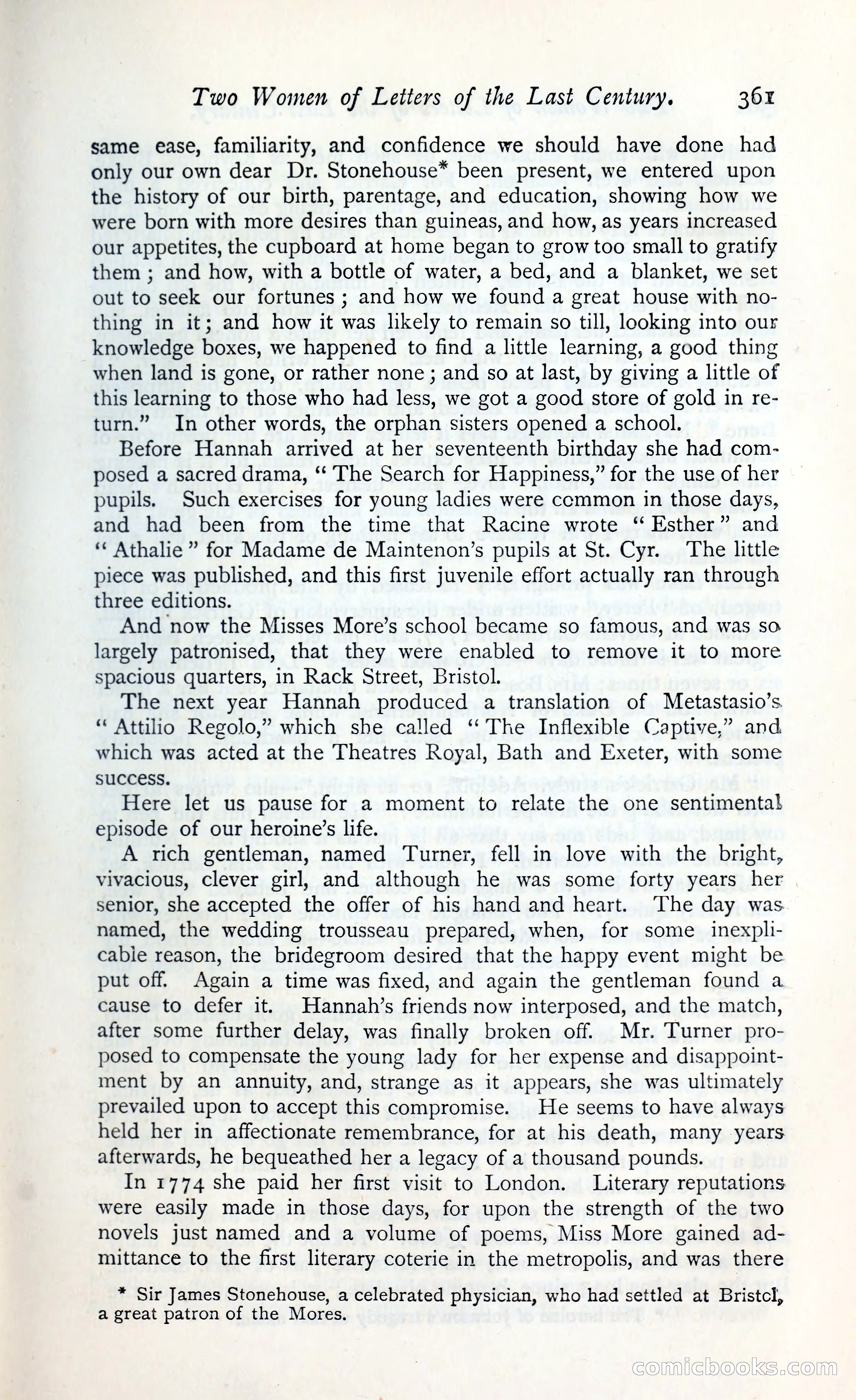
A restored page from Pulp Fiction, 1865. Page through the whole issue in the reader above.
📄 Transcribed text from this page (OCR, searchable)
Machine-transcribed from the original scan — historical spelling and the odd misread are preserved.
Two Women of Letters of the Last Century. 362 same ease, familiarity, and confidence we should have done had only our own dear Dr. Stonehouse™ been present, we entered upon the history of our birth, parentage, and education, showing how we were born with more desires than guineas, and how, as years increased our appetites, the cupboard at home began to grow too small to gratify them ; and how, with a bottle of water, a bed, and a blanket, we set out to seek our fortunes ; and how we found a great house with no- thing in it; and how it was likely to remain so till, looking into our knowledge boxes, we happened to find a little learning, a good thing when land is gone, or rather none; and so at last, by giving a little of this learning to those who had less, we got a good store of gold in re- turn.” In other words, the orphan sisters opened a school. Before Hannah arrived at her seventeenth birthday she had com- posed a sacred drama, “‘ The Search for Happiness,” for the use of her pupils. Such exercises for young ladies were common in those days, and had been from the time that Racine wrote “ Esther” and ‘* Athalie ” for Madame de Maintenon’s pupils at St. Cyr. The little piece was published, and this first juvenile effort actually ran through three editions. And now the Misses More’s school became so famous, and was so largely patronised, that they were enabled to remove it to more spacious quarters, in Rack Street, Bristol. The next year Hannah produced a translation of Metastasio’s. “ Attilio Regolo,” which she called ‘‘ The Inflexible Captive,” and which was acted at the Theatres Royal, Bath and Exeter, with some success. Here let us pause for a moment to relate the one sentimental episode of our heroine’s life. A rich gentleman, named Turner, fell in love with the bright, vivacious, clever girl, and although he was some forty years her senior, she accepted the offer of his hand and heart. The day was named, the wedding trousseau prepared, when, for some inexpli- cabie reason, the bridegroom desired that the happy event might be put off. Again a time was fixed, and again the gentleman found a cause to defer it. Hannah’s friends now interposed, and the match, after some further delay, was finally broken off. Mr. Turner pro- posed to compensate the young lady for her expense and disappoint- ment by an annuity, and, strange as it appears, she was ultimately prevailed upon to accept this compromise. He seems to have always held her in affectionate remembrance, for at his death, many years afterwards, he bequeathed her a legacy of a thousand pounds. In 1774 she paid her first visit to London. Literary reputations were easily made in those days, for upon the strength of the two novels just named and a volume of poems, Miss More gained ad- mittance to the first literary coterie in the metropolis, and was there * Sir James Stonehouse, a celebrated physician, who had settled at Bristcl, a great patron of the Mores. COMICOOoOKS.CO©