
Pulp Fiction, 1865 · page 383 of 400
The Argosy — page 383: what you’re looking at
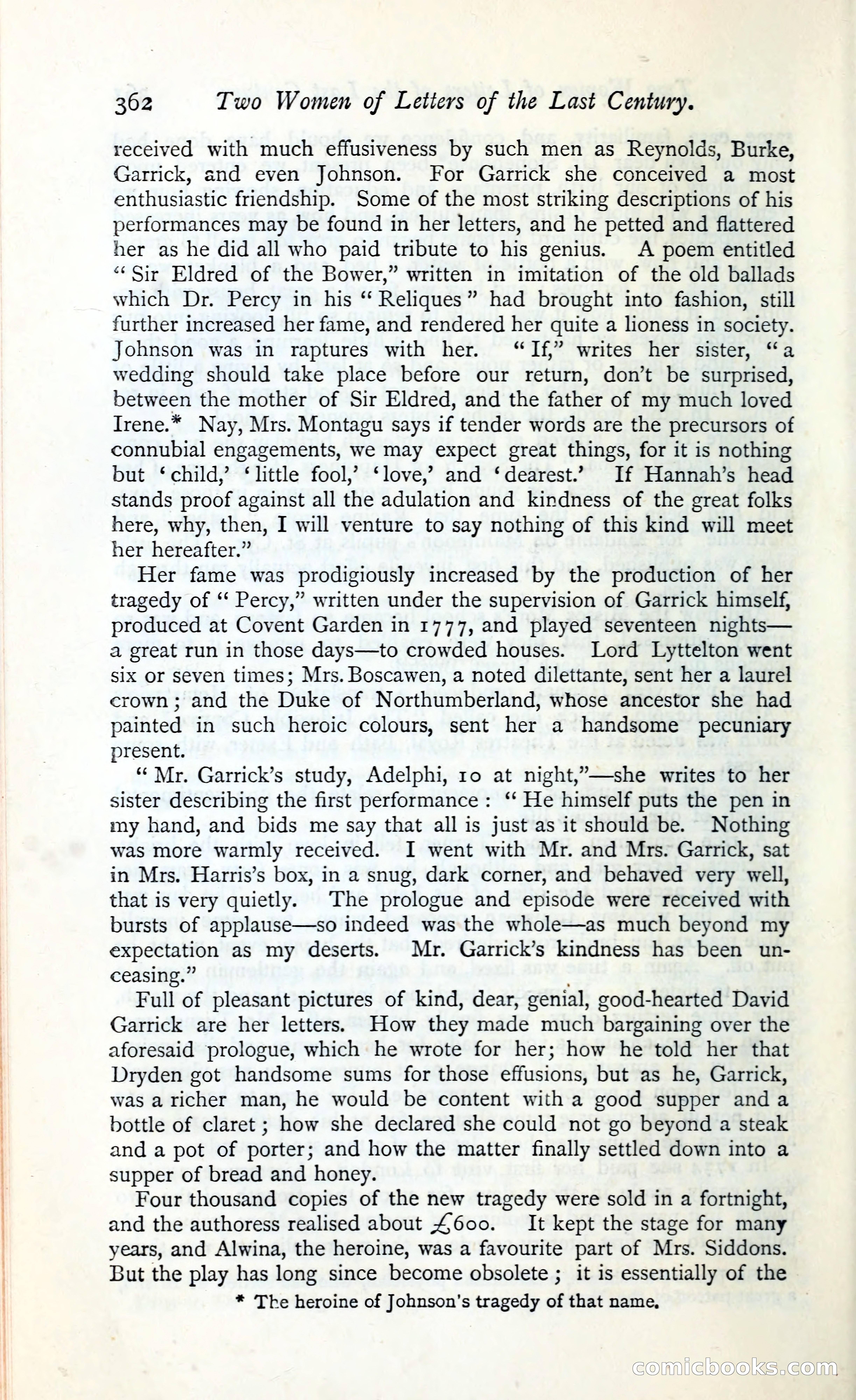
A restored page from Pulp Fiction, 1865. Page through the whole issue in the reader above.
📄 Transcribed text from this page (OCR, searchable)
Machine-transcribed from the original scan — historical spelling and the odd misread are preserved.
362 Two Women of Letters of the Last Century. received with much effusiveness by such men as Reynolds, Burke, Garrick, and even Johnson. For Garrick she conceived a most enthusiastic friendship. Some of the most striking descriptions of his performances may be found in her letters, and he petted and flattered her as he did all who paid tribute to his genius. A poem entitled ‘¢Sir Eldred of the Bower,” written in imitation of the old ballads which Dr. Percy in his ‘* Reliques” had brought into fashion, still further increased her fame, and rendered her quite a lioness in society. Johnson was in raptures with her. “If,” writes her sister, “a wedding should take place before our return, don’t be surprised, between the mother of Sir Eldred, and the father of my much loved Irene.* Nay, Mrs. Montagu says if tender words are the precursors of connubial engagements, we may expect great things, for it is nothing but ‘child,’ ‘little fool,’ ‘love,’ and ‘dearest.’ If Hannah’s head stands proof against all the adulation and kindness of the great folks here, why, then, I will venture to say nothing of this kind will meet her hereafter.” Her fame was prodigiously increased by the production of her tragedy of ‘‘ Percy,” written under the supervision of Garrick himself, produced at Covent Garden in 1777, and played seventeen nights— a great run in those days—to crowded houses. Lord Lyttelton went six or seven times; Mrs. Boscawen, a noted dilettante, sent her a laurel crown ; and the Duke of Northumberland, whose ancestor she had painted in such heroic colours, sent her a handsome pecuniary present. “ Mr. Garrick’s study, Adelphi, ro at night,’—she writes to her sister describing the first performance: ‘*‘ He himself puts the pen in my hand, and bids me say that all is just as it should be. Nothing was more warmly received. JI went with Mr. and Mrs. Garrick, sat in Mrs. Harris’s box, in a snug, dark corner, and behaved very well, that is very quietly. The prologue and episode were received with bursts of applause—so indeed was the whole—as much beyond my expectation as my deserts. Mr. Garrick’s kindness has been un- ceasing.” Full of pleasant pictures of kind, dear, genial, good-hearted David Garrick are her letters. How they made much bargaining over the aforesaid prologue, which he wrote for her; how he told her that Dryden got handsome sums for those effusions, but as he, Garrick, was a richer man, he would be content with a good supper anda bottle of claret; how she declared she could not go beyond a steak and a pot of porter; and how the matter finally settled down into a supper of bread and honey. Four thousand copies of the new tragedy were sold in a fortnight, and the authoress realised about 4600. It kept the stage for many years, and Alwina, the heroine, was a favourite part of Mrs. Siddons. But the play has long since become obsolete ; it is essentially of the * The heroine of Johnson's tragedy of that name, CORnIICEMOOOlKS (€(@)