
Pulp Fiction, 1865 · page 121 of 400
The Argosy — page 121: what you’re looking at
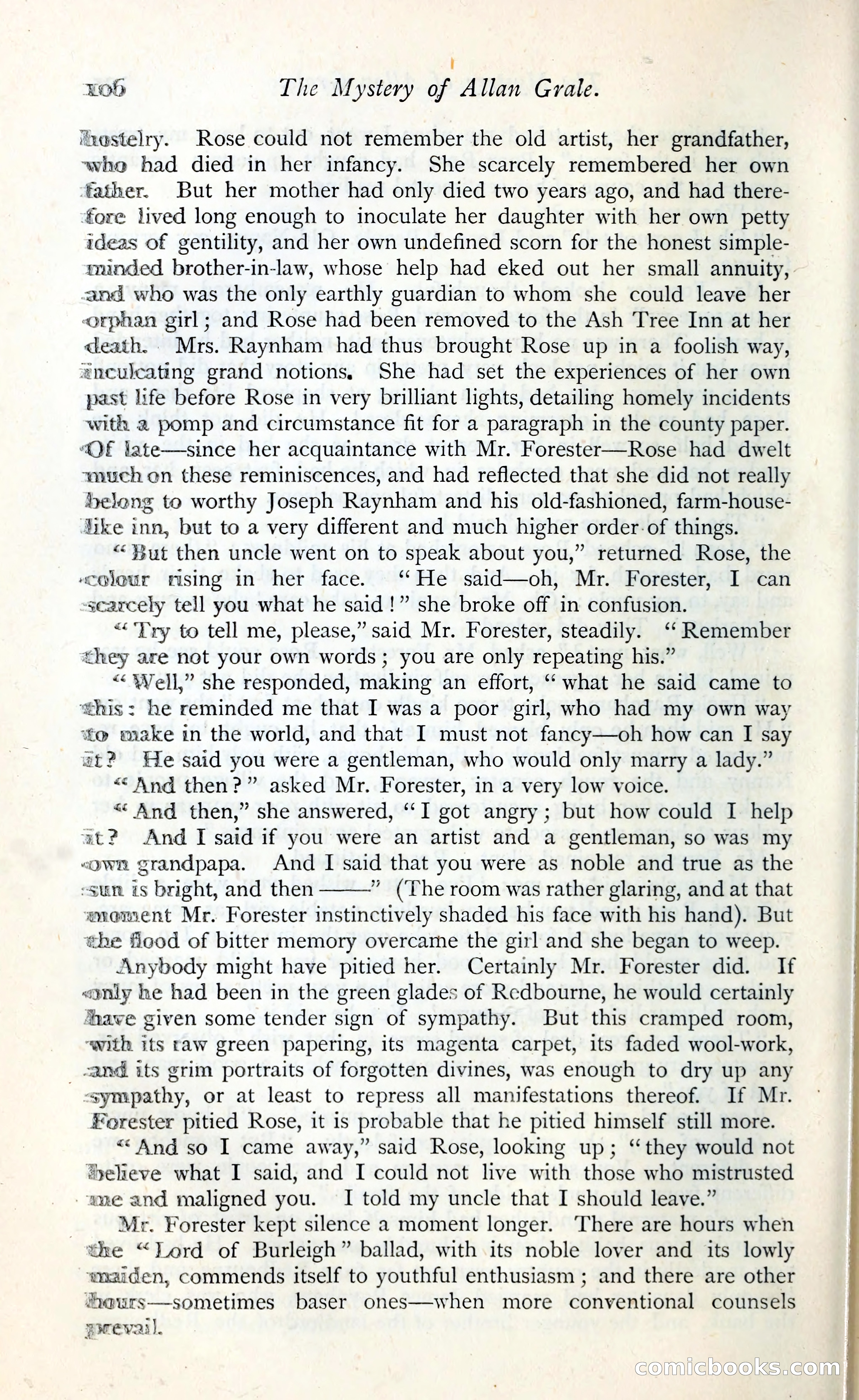
A restored page from Pulp Fiction, 1865. Page through the whole issue in the reader above.
📄 Transcribed text from this page (OCR, searchable)
Machine-transcribed from the original scan — historical spelling and the odd misread are preserved.
nOb The Mystery of Allan Grale. ‘nostelry. Rose could not remember the old artist, her grandfather, who had died in her infancy. She scarcely remembered her own father. But her mother had only died two years ago, and had there- fore lived long enough to inoculate her daughter with her own petty ideas of gentility, and her own undefined scorn for the honest simple- manded brother-in-law, whose help had eked out her small annuity, -and who was the only earthly guardian to whom she could leave her orphan girl; and Rose had been removed to the Ash Tree Inn at her cleath. Mrs. Raynham had thus brought Rose up in a foolish way, enculcating grand notions, She had set the experiences of her own past life before Rose in very brilliant lights, detailing homely incidents with 2 pomp and circumstance fit for a paragraph in the county paper. "QE late—since her acquaintance with Mr. Forester—Rose had dwelt much on these reminiscences, and had reflected that she did not really beleng to worthy Joseph Raynham and his old-fashioned, farm-house- dike inn, but to a very different and much higher order-of things. “}ut then uncle went on to speak about you,” returned Rose, the “colour msing in her face. ‘‘He said—oh, Mr. Forester, I can scarcely tell you what he said!” she broke off in confusion. “Try to tell me, please,” said Mr. Forester, steadily. ‘‘ Remember they are not your own words; you are only repeating his.” ““ Well,” she responded, making an effort, “‘ what he said came to “this: he reminded me that I was a poor girl, who had my own way “t@ make in the world, and that I must not fancy—oh how can I say at? We said you were a gentleman, who would only marry a lady.” ““ And then?” asked Mr. Forester, in a very low voice. “And then,” she answered, “I got angry; but how could I help at? And I said if you were an artist and a gentleman, so was my «own grandpapa. And I said that you were as noble and true as the gun is bright, and then ” (The room was rather glaring, and at that moment Mr. Forester instinctively shaded his face with his hand). But the fiood of bitter memory overcame the girl and she began to weep. Anybody might have pitied her. Certainly Mr. Forester did. If «nly he had been in the green glades of Re dbourne, he would certainly ‘hawe given some tender sign of sympathy. But this cramped room, with its raw green papering, its magenta carpet, its faded wool-work, _-and its grim portraits of forgotten divines, was enough to dry up any sympathy, or at least to repress all manifestations thereof. If Mr. forester pitied Rose, it is probable that he pitied himself still more. “<And so I came away,” said Rose, looking up; “they would not Syelieve what I said, and I could not live with those who mistrusted ame and maligned you. I told my uncle that I should leave.” Mr. Forester kept silence a moment longer. There are hours when the “Lord of Burleigh” ballad, with its noble lover and its lowly waziden, commends itself to youthful enthusiasm ; and there are other yoaurs—sometimes baser ones—when more conventional counsels CORNICE OOOKS EO)