
Pulp Fiction, 1865 · page 122 of 400
The Argosy — page 122: what you’re looking at
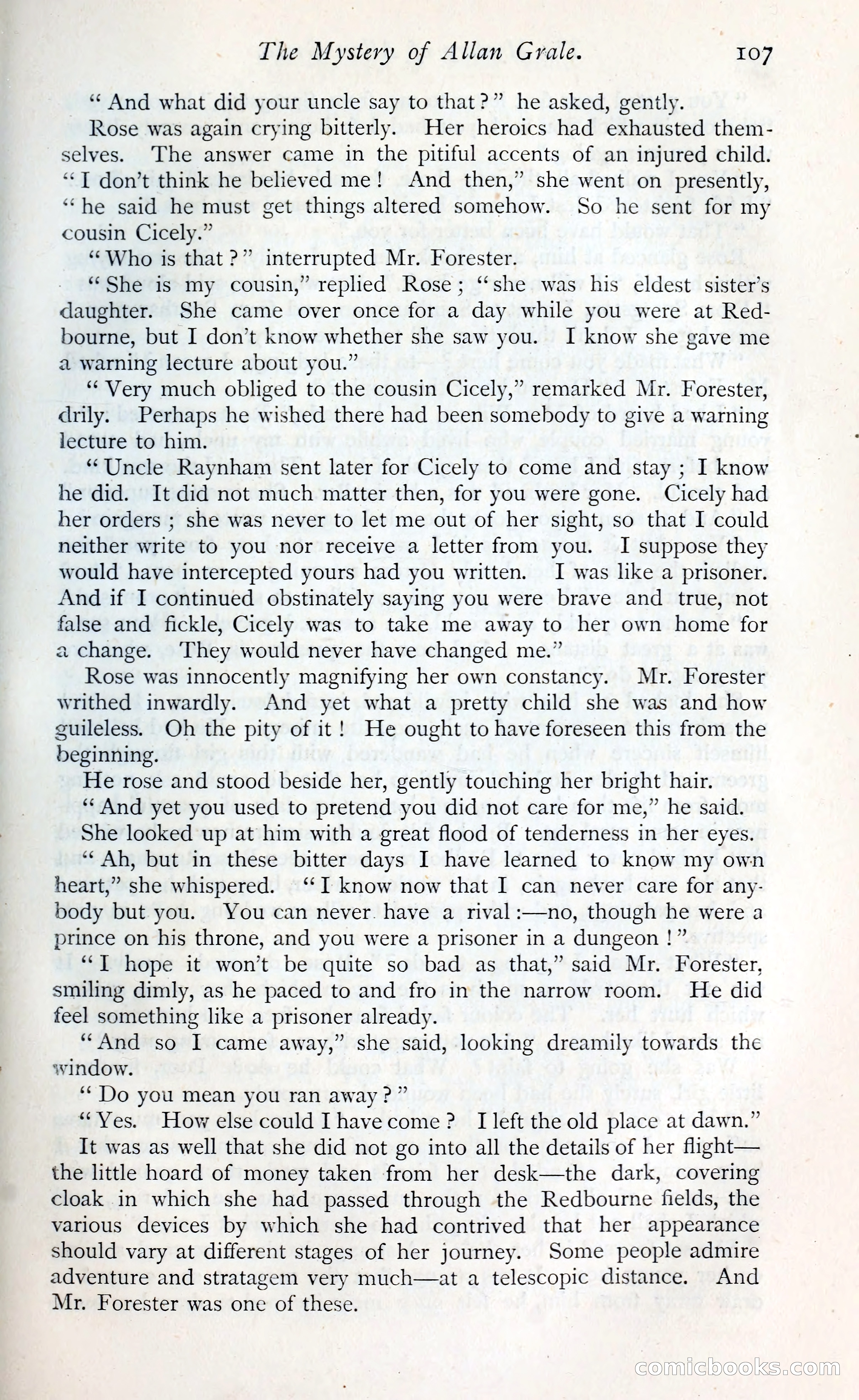
A restored page from Pulp Fiction, 1865. Page through the whole issue in the reader above.
📄 Transcribed text from this page (OCR, searchable)
Machine-transcribed from the original scan — historical spelling and the odd misread are preserved.
The Mystery of Allan Grale. 107 ‘¢ And what did your uncle say to that?” he asked, gently. Rose was again crying bitterly. Her heroics had exhausted them- selves. The answer came in the pitiful accents of an injured child. ‘‘T don’t think he believed me! And then,” she went on presently, ‘““he said he must get things altered somehow. So he sent for my cousin Cicely.” “Who is that ?” interrupted Mr. Forester. ‘She is my cousin,” replied Rose; ‘“‘she was his eldest sister’s daughter. She came over once for a day while you were at Red- bourne, but I don’t know whether she saw you. I know she gave me a warning lecture about you.” “Very much obliged to the cousin Cicely,” remarked Mr. Forester, drily. Perhaps he wished there had been somebody to give a warning lecture to him. “Uncle Raynham sent later for Cicely to come and stay ; I know he did. It did not much matter then, for you were gone. Cicely had her orders ; she was never to let me out of her sight, so that I could neither write to you nor receive a letter from you. I suppose they would have intercepted yours had you written. I was like a prisoner. And if I continued obstinately saying you were brave and true, not false and fickle, Cicely was to take me away to her own home for a change. ‘They would never have changed me.” Rose was innocently magnifying her own constancy. Mr. Forester writhed inwardly. And yet what a pretty child she was and how guileless. Oh the pity of it! He ought to have foreseen this from the beginning. | He rose and stood beside her, gently touching her bright hair. ‘And yet you used to pretend you did not care for me,” he said. She looked up at him with a great flood of tenderness in her eyes. ‘“ Ah, but in these bitter days I have learned to know my own heart,” she whispered. ‘‘I know now that I can never care for any- body but you. You can never. have a rival :—no, though he were a prince on his throne, and you were a prisoner in a dungeon !” ‘““T hope it won’t be quite so bad as that,” said Mr. Forester, smiling dimly, as he paced to and fro in the narrow room. He did feel something like a prisoner already. “And so I came away,” she said, looking dreamily towards the window. ‘* Do you mean you ran away ?” “Yes. How else could [havecome? I left the old place at dawn.” It was as well that she did not go into all the details of her flight— the little hoard of money taken from her desk—the dark, covering cloak in which she had passed through the Redbourne fields, the various devices by which she had contrived that her appearance should vary at different stages of her journey. Some people admire adventure and stratagem very much—at a telescopic distance. And Mr. Forester was one of these. OO) a COUN <S (SO) An