
Pulp Fiction, 1865 · page 83 of 399
The Argosy — page 83: what you’re looking at
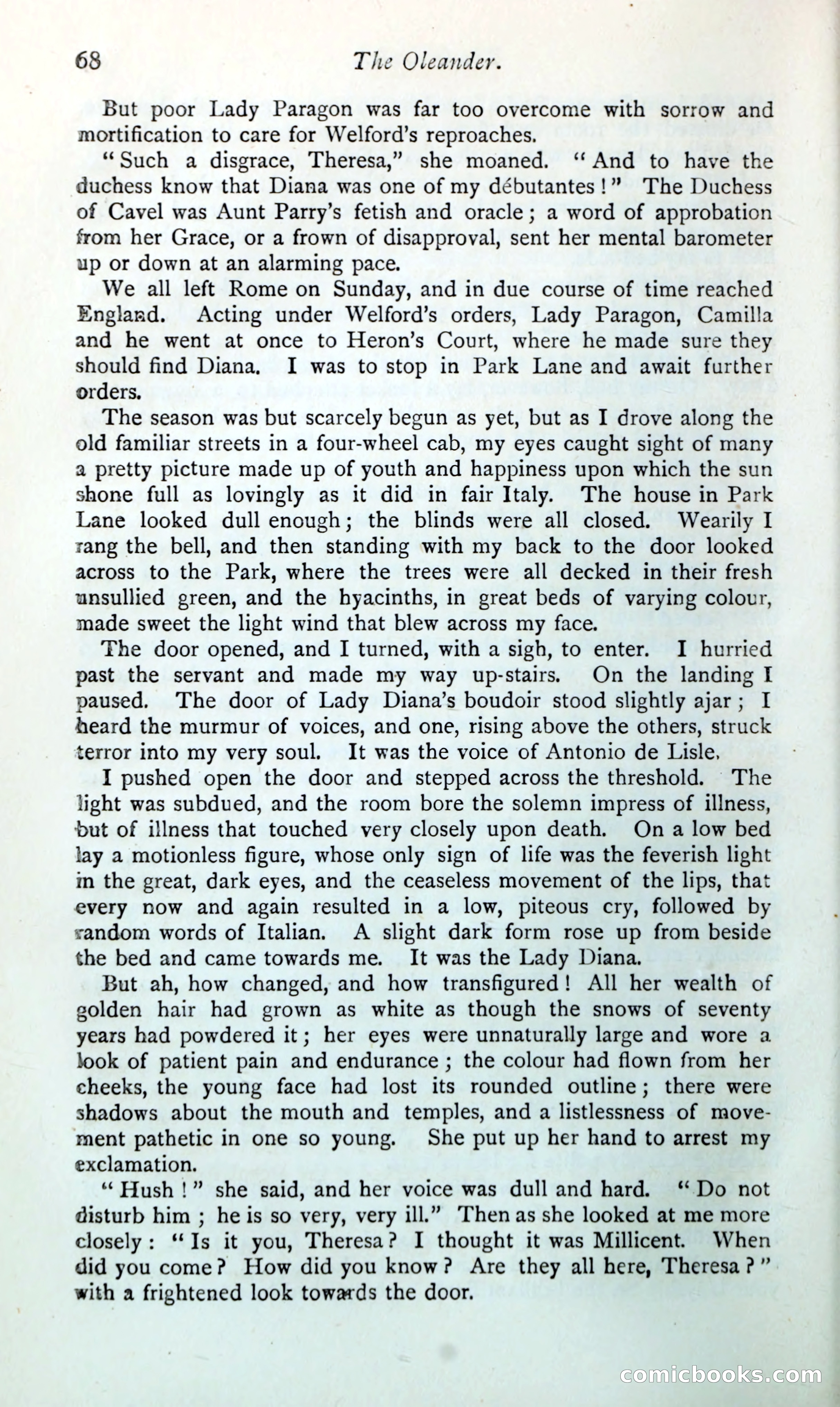
A restored page from Pulp Fiction, 1865. Page through the whole issue in the reader above.
📄 Transcribed text from this page (OCR, searchable)
Machine-transcribed from the original scan — historical spelling and the odd misread are preserved.
68 The Oleander. But poor Lady Paragon was far too overcome with sorrow and mortification to care for Welford’s reproaches, ‘Such a disgrace, Theresa,” she moaned. ‘“‘ And to have the duchess know that Diana was one of my débutantes!” The Duchess of Cavel was Aunt Parry’s fetish and oracle; a word of approbation from her Grace, or a frown of disapproval, sent her mental barometer up or down at an alarming pace. We all left Rome on Sunday, and in due course of time reached England. Acting under Welford’s orders, Lady Paragon, Camilla and he went at once to Heron’s Court, where he made sure they should find Diana, I was to stop in Park Lane and await further orders. The season was but scarcely begun as yet, but as I drove along the old familiar streets in a four-wheel cab, my eyes caught sight of many a pretty picture made up of youth and happiness upon which the sun shone full as lovingly as it did in fair Italy. The house in Park Lane looked dull enough; the blinds were all closed. Wearily I rang the bell, and then standing with my back to the door looked across to the Park, where the trees were all decked in their fresh unsullied green, and the hyacinths, in great beds of varying colour, made sweet the light wind that blew across my face. The door opened, and I turned, with a sigh, to enter. I hurried past the servant and made my way up-stairs. On the landing I paused. The door of Lady Diana’s boudoir stood slightly ajar; I heard the murmur of voices, and one, rising above the others, struck terror into my very soul. It was the voice of Antonio de Lisle, I pushed open the door and stepped across the threshold. The light was subdued, and the room bore the solemn impress of illness, but of illness that touched very closely upon death. On a low bed lay a motionless figure, whose only sign of life was the feverish light m the great, dark eyes, and the ceaseless movement of the lips, that every now and again resulted in a low, piteous cry, followed by random words of Italian. A slight dark form rose up from beside the bed and came towards me. It was the Lady Diana. But ah, how changed, and how transfigured! All her wealth of golden hair had grown as white as though the snows of seventy years had powdered it; her eyes were unnaturally large and wore a look of patient pain and endurance ; the colour had flown from her cheeks, the young face had lost its rounded outline; there were shadows about the mouth and temples, and a listlessness of move- ment pathetic in one so young. She put up her hand to arrest my exclamation. “Hush!” she said, and her voice was dull and hard. “Do not disturb him ; he is so very, very ill.” Then as she looked at me more closely: ‘‘Is it you, Theresa? I thought it was Millicent. When did you come? How did you know? Are they all here, Theresa ?” with a frightened look towards the door. Gomicbooks (E(0) m