
Pulp Fiction, 1865 · page 84 of 399
The Argosy — page 84: what you’re looking at
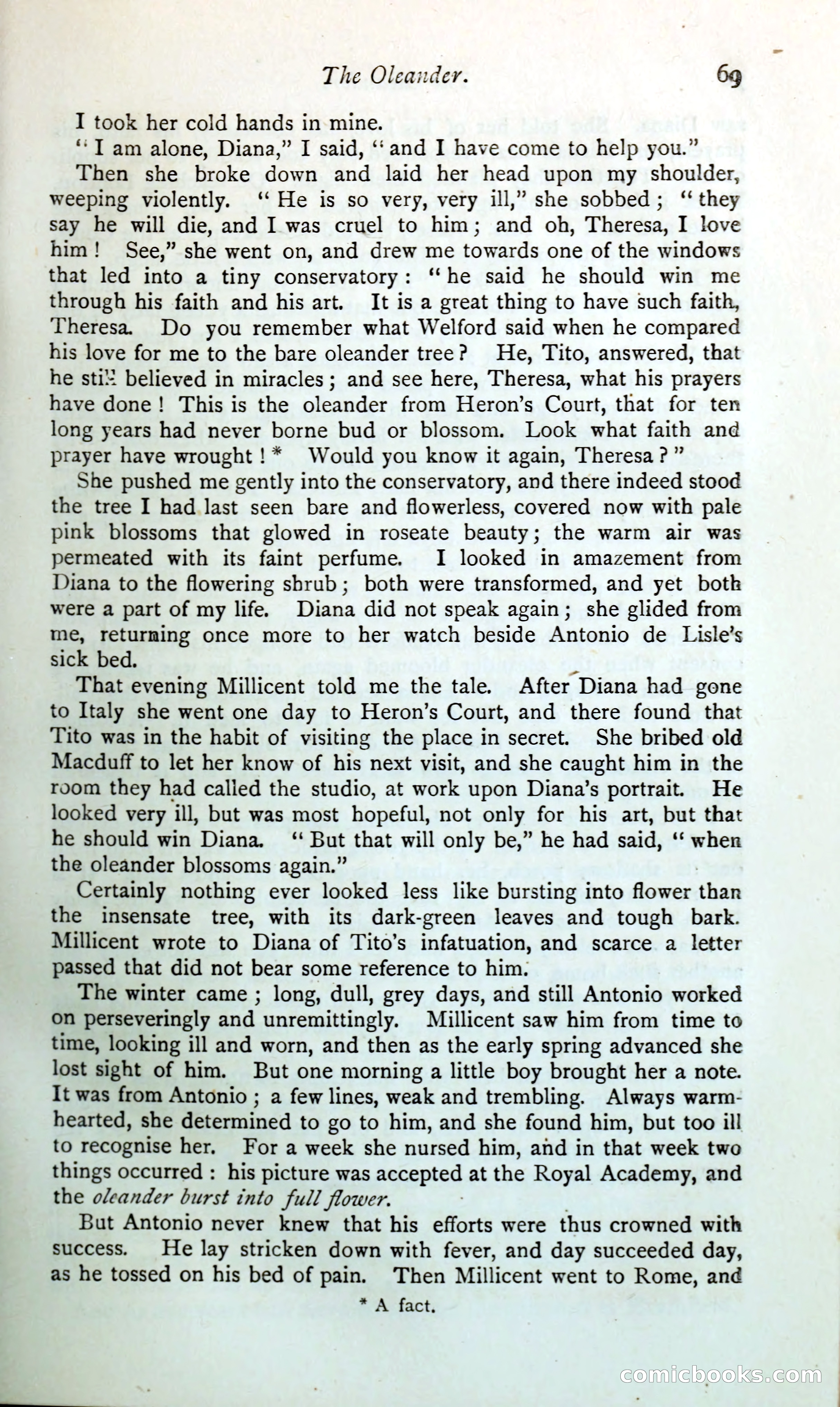
A restored page from Pulp Fiction, 1865. Page through the whole issue in the reader above.
📄 Transcribed text from this page (OCR, searchable)
Machine-transcribed from the original scan — historical spelling and the odd misread are preserved.
The Oleander. 69 I took her cold hands in mine. ‘‘T am alone, Diana,” I said, ‘‘and I have come to help you.” Then she broke down and laid her head upon my shoulder, weeping violently. ‘‘ He is so very, very ill,” she sobbed; ‘“‘ they say he will die, and I was cruel to him; and oh, Theresa, I love him! See,” she went on, and drew me towards one of the windows that led into a tiny conservatory: ‘“‘he said he should win me through his faith and his art. It is a great thing to have such faith, Theresa. Do you remember what Welford said when he compared his love for me to the bare oleander tree? He, Tito, answered, that he sti: believed in miracles; and see here, Theresa, what his prayers have done! This is the oleander from Heron’s Court, that for ten long years had never borne bud or blossom. Look what faith and prayer have wrought!* Would you know it again, Theresa?” She pushed me gently into the conservatory, and there indeed stood the tree I had last seen bare and flowerless, covered now with pale pink blossoms that glowed in roseate beauty; the warm air was permeated with its faint perfume. I looked in amazement from Diana to the flowering shrub; both were transformed, and yet both were a part of my life. Diana did not speak again; she glided from me, returming once more to her watch beside Antonio de Lisle’s sick bed. ; That evening Millicent told me the tale. After Diana had gone to Italy she went one day to Heron’s Court, and there found that Tito was in the habit of visiting the place in secret. She bribed old Macduff to let her know of his next visit, and she caught him in the room they had called the studio, at work upon Diana’s portrait. He looked very ill, but was most hopeful, not only for his art, but that he should win Diana. ‘“ But that will only be,” he had said, ‘‘ when the oleander blossoms again.” Certainly nothing ever looked less like bursting into flower than the insensate tree, with its dark-green leaves and tough bark. Millicent wrote to Diana of Tito’s infatuation, and scarce a letter passed that did not bear some reference to him. The winter came ; long, dull, grey days, and still Antonio worked on perseveringly and unremittingly. Millicent saw him from time to time, looking ill and worn, and then as the early spring advanced she lost sight of him. But one morning a little boy brought her a note. It was from Antonio ; a few lines, weak and trembling. Always warm- hearted, she determined to go to him, and she found him, but too ill to recognise her. For a week she nursed him, and in that week two things occurred : his picture was accepted at the Royal Academy, and the oleander burst into full flower. But Antonio never knew that his efforts were thus crowned with success. He lay stricken down with fever, and day succeeded day, as he tossed on his bed of pain. Then Millicent went to Rome, and * A fact. (E(©) COMMIELOO© AA .