
Pulp Fiction, 1865 · page 82 of 399
The Argosy — page 82: what you’re looking at
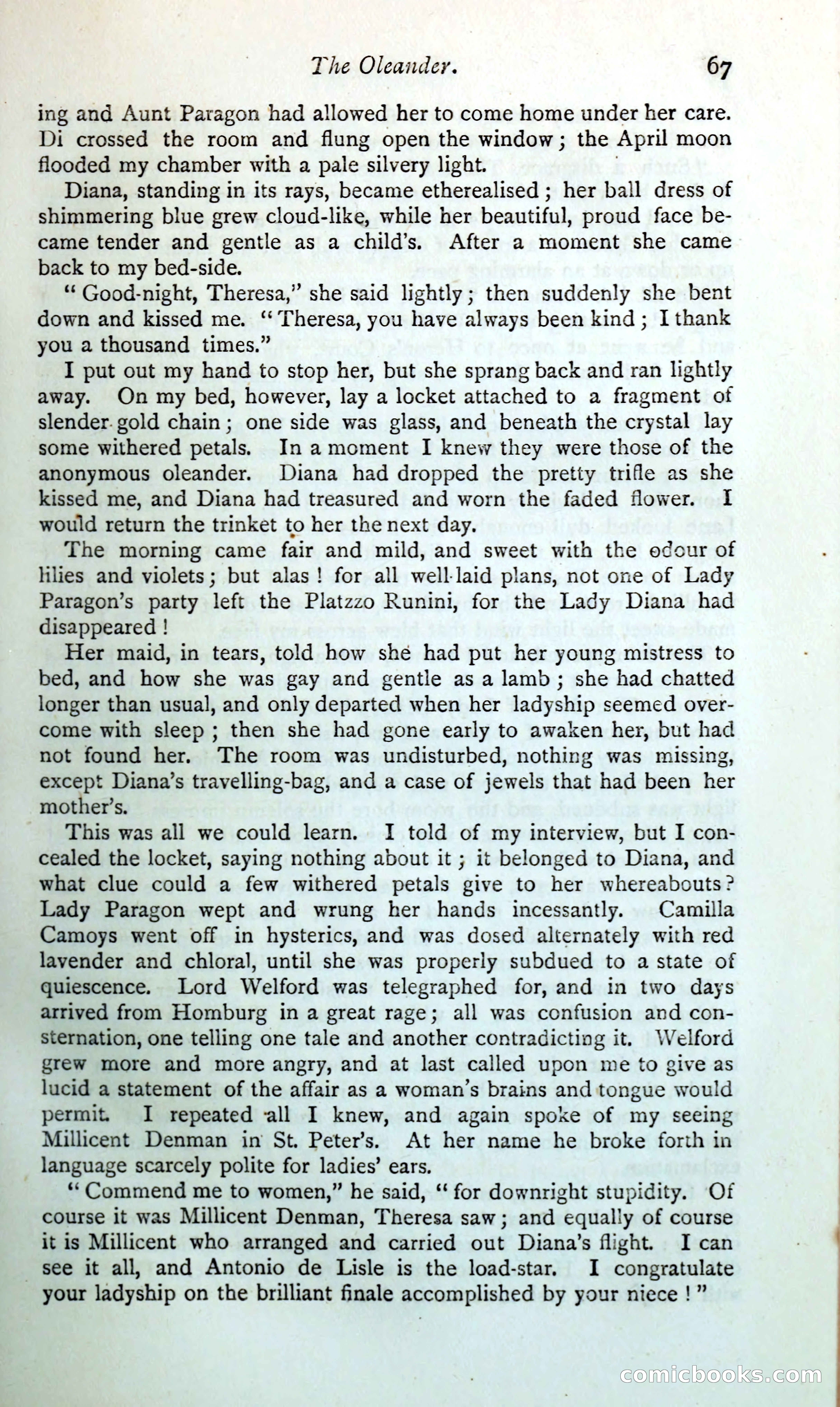
A restored page from Pulp Fiction, 1865. Page through the whole issue in the reader above.
📄 Transcribed text from this page (OCR, searchable)
Machine-transcribed from the original scan — historical spelling and the odd misread are preserved.
The Oleander. 67 ing and Aunt Paragon had allowed her to come home under her care. Di crossed the room and flung open the window; the April moon flooded my chamber with a pale silvery light. | Diana, standing in its rays, became etherealised ; her ball dress of shimmering blue grew cloud-like, while her beautiful, proud face be- came tender and gentle as a child’s. After a moment she came back to my bed-side. ** Good-night, Theresa,” she said lightly; then suddenly she bent down and kissed me. ‘‘ Theresa, you have always been kind; I thank you a thousand times.” I put out my hand to stop her, but she sprang back and ran lightly away. On my bed, however, lay a locket attached to a fragment of slender. gold chain; one side was glass, and beneath the crystal lay some withered petals. In amoment I knew they were those of the anonymous oleander. Diana had dropped the pretty trifle as she kissed me, and Diana had treasured and worn the faded flower. I would return the trinket to her the next day. The morning came fair and mild, and sweet with the odour of hlies and violets; but alas! for all well-laid plans, not one of Lady Paragon’s party left the Platzzo Runini, for the Lady Diana had disappeared ! Her maid, in tears, told how she had put her young mistress to bed, and how she was gay and gentle as a lamb; she had chatted longer than usual, and only departed when her ladyship seemed over- come with sleep ; then she had gone early to awaken her, but had not found her. The room was undisturbed, nothing was missing, except Diana’s travelling-bag, and a case of jewels that had been her mother’s. This was all we could learn. I told of my interview, but I con- cealed the locket, saying nothing about it ; it belonged to Diana, and what clue could a few withered petals give to her whereabouts? Lady Paragon wept and wrung her hands incessantly. Camilla Camoys went off in hysterics, and was dosed alternately with red lavender and chloral, until she was properly subdued to a state of quiescence. Lord Welford was telegraphed for, and in two days arrived from Homburg in a great rage; all was confusion and con- sternation, one telling one tale and another contradicting it. Welford grew more and more angry, and at last called upon me to give as lucid a statement of the affair as a woman’s brains and tongue would permit. I repeated all I knew, and again spoke of my seeing Millicent Denman in St. Peter’s. At her name he broke forth in _ language scarcely polite for ladies’ ears. ‘**Commend me to women,” he said, ‘‘ for downright stupidity. Of course it was Millicent Denman, Theresa saw; and equally of course it is Millicent who arranged and carried out Diana’s flight. I can see it all, and Antonio de Lisle is the load-star. I congratulate your ladyship on the brilliant finale accomplished by your niece !” Gomichboo (E(@) m