
Pulp Fiction, 1865 · page 336 of 399
The Argosy — page 336: what you’re looking at
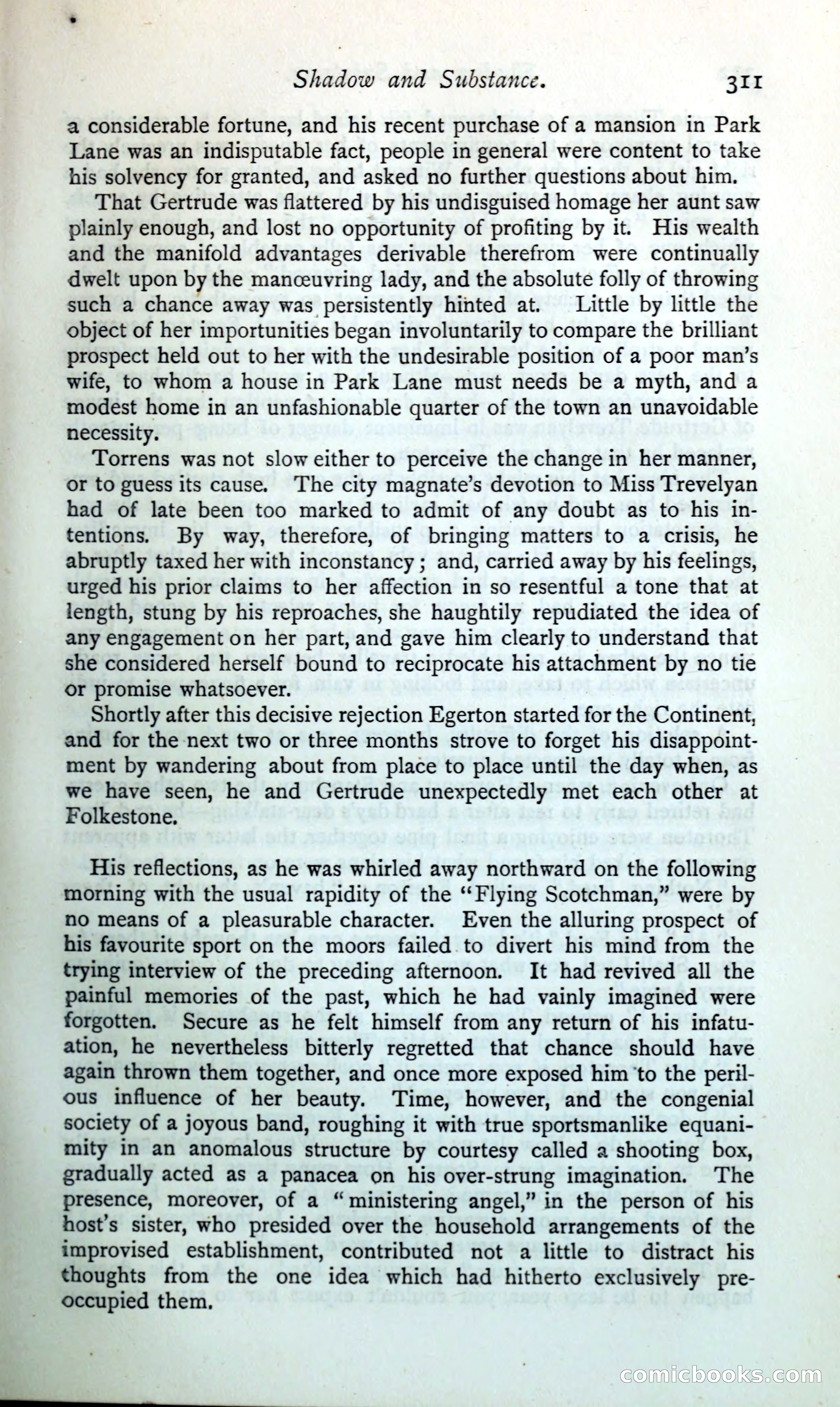
A restored page from Pulp Fiction, 1865. Page through the whole issue in the reader above.
📄 Transcribed text from this page (OCR, searchable)
Machine-transcribed from the original scan — historical spelling and the odd misread are preserved.
Shadow and Substance. 311 a considerable fortune, and his recent purchase of a mansion in Park Lane was an indisputable fact, people in general were content to take his solvency for granted, and asked no further questions about him. That Gertrude was flattered by his undisguised homage her aunt saw plainly enough, and lost no opportunity of profiting by it. His wealth and the manifold advantages derivable therefrom were continually dwelt upon by the manceuvring lady, and the absolute folly of throwing such a chance away was persistently hinted at. Little by little the object of her importunities began involuntarily to compare the brilliant prospect held out to her with the undesirable position of a poor man’s wife, to whom a house in Park Lane must needs be a myth, and a modest home in an unfashionable quarter of the town an unavoidable necessity. Torrens was not slow either to perceive the change in her manner, or to guess its cause. The city magnate’s devotion to Miss Trevelyan had of late been too marked to admit of any doubt as to his in- tentions. By way, therefore, of bringing matters to a crisis, he abruptly taxed her with inconstancy ; and, carried away by his feelings, urged his prior claims to her affection in so resentful a tone that at length, stung by his reproaches, she haughtily repudiated the idea of any engagement on her part, and gave him clearly to understand that she considered herself bound to reciprocate his attachment by no tie or promise whatsoever. Shortly after this decisive rejection Egerton started for the Continent, and for the next two or three months strove to forget his disappoint- ment by wandering about from place to place until the day when, as we have seen, he and Gertrude unexpectedly met each other at Folkestone. His reflections, as he was whirled away northward on the following morning with the usual rapidity of the ‘‘Flying Scotchman,” were by no means of a pleasurable character. Even the alluring prospect of his favourite sport on the moors failed.to divert his mind from the trying interview of the preceding afternoon. It had revived all the painful memories of the past, which he had vainly imagined were forgotten. Secure as he felt himself from any return of his infatu- ation, he nevertheless bitterly regretted that chance should have again thrown them together, and once more exposed him ‘to the peril- ous influence of her beauty. ‘Time, however, and the congenial society of a joyous band, roughing it with true sportsmanlike equani- mity in an anomalous structure by courtesy called a shooting box, gradually acted as a panacea on his over-strung imagination. The presence, moreover, of a “ministering angel,” in the person of his host’s sister, who presided over the household arrangements of the improvised establishment, contributed not a little to distract his thoughts from the one idea which had hitherto exclusively pre- occupied them. EONNIE OOS (E@) m