
Pulp Fiction, 1865 · page 335 of 399
The Argosy — page 335: what you’re looking at
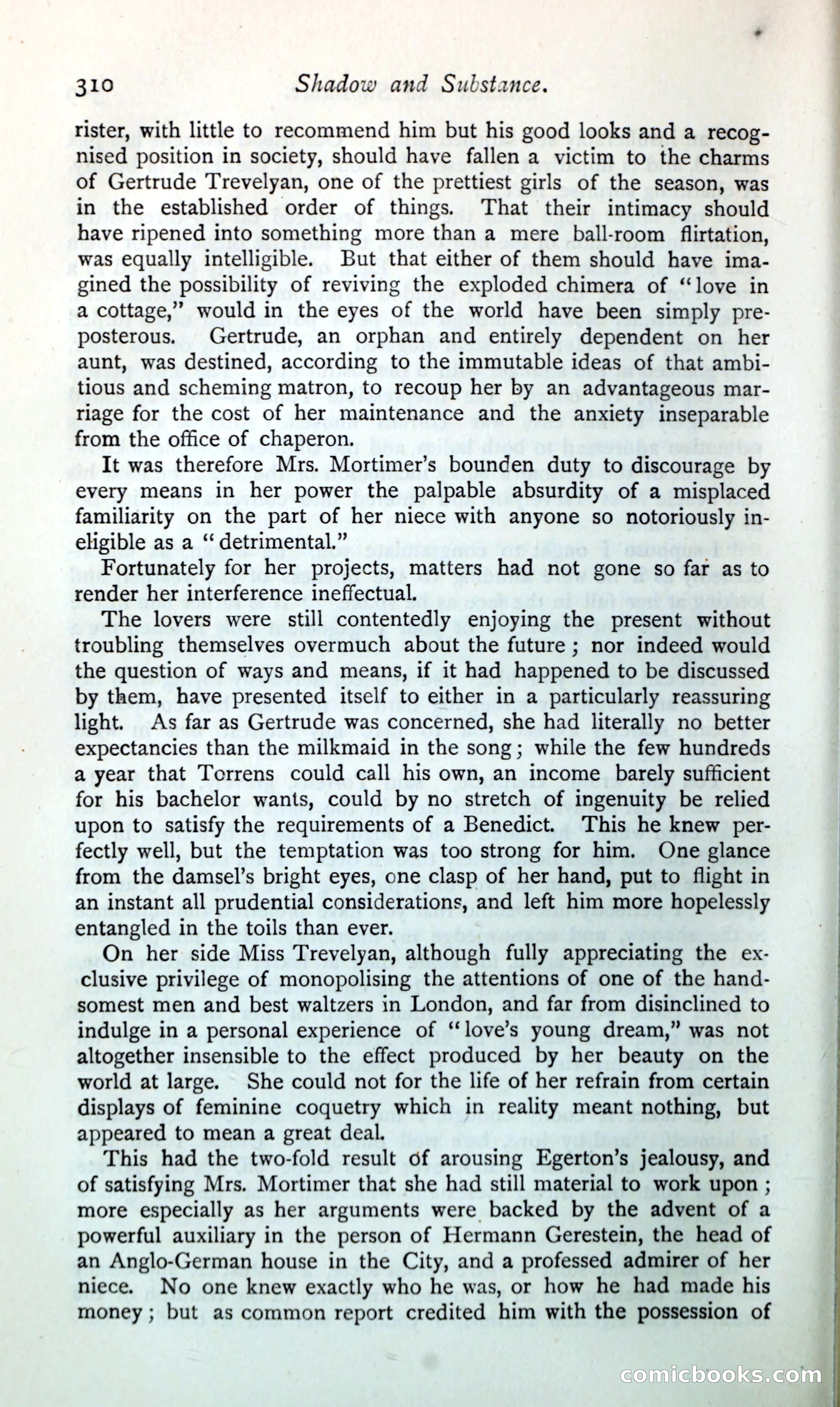
A restored page from Pulp Fiction, 1865. Page through the whole issue in the reader above.
📄 Transcribed text from this page (OCR, searchable)
Machine-transcribed from the original scan — historical spelling and the odd misread are preserved.
310 Shadow and Substance. rister, with little to recommend him but his good looks and a recog- nised position in society, should have fallen a victim to the charms of Gertrude Trevelyan, one of the prettiest girls of the season, was in the established order of things. That their intimacy should have ripened into something more than a mere ball-room flirtation, was equally intelligible. But that either of them should have ima- gined the possibility of reviving the exploded chimera of “love in a cottage,” would in the eyes of the world have been simply pre- posterous. Gertrude, an orphan and entirely dependent on her aunt, was destined, according to the immutable ideas of that ambi- tious and scheming matron, to recoup her by an advantageous mar- riage for the cost of her maintenance and the anxiety inseparable from the office of chaperon. It was therefore Mrs. Mortimer’s bounden duty to discourage by every means in her power the palpable absurdity of a misplaced familiarity on the part of her niece with anyone so notoriously in- eligible as a ‘‘ detrimental.” Fortunately for her projects, matters had not gone so far as to render her interference ineffectual. The lovers were still contentedly enjoying the present without troubling themselves overmuch about the future ; nor indeed would the question of ways and means, if it had happened to be discussed by them, have presented itself to either in a particularly reassuring light. As far as Gertrude was concerned, she had literally no better expectancies than the milkmaid in the song; while the few hundreds a year that Torrens could call his own, an income barely sufficient for his bachelor wants, could by no stretch of ingenuity be relied upon to satisfy the requirements of a Benedict. This he knew per- fectly well, but the temptation was too strong for him. One glance from the damsel’s bright eyes, one clasp of her hand, put to flight in an instant all prudential considerations, and left him more hopelessly entangled in the toils than ever. On her side Miss Trevelyan, although fully appreciating the ex- clusive privilege of monopolising the attentions of one of the hand- somest men and best waltzers in London, and far from disinclined to indulge in a personal experience of ‘‘love’s young dream,” was not altogether insensible to the effect produced by her beauty on the world at large. She could not for the life of her refrain from certain displays of feminine coquetry which in reality meant nothing, but appeared to mean a great deal. This had the two-fold result of arousing Egerton’s jealousy, and of satisfying Mrs. Mortimer that she had still material to work upon ; more especially as her arguments were backed by the advent of a powerful auxiliary in the person of Hermann Gerestein, the head of an Anglo-German house in the City, and a professed admirer of her niece. No one knew exactly who he was, or how he had made his money ; but as common report credited him with the possession of Gomicbooks (eoy m