
Pulp Fiction, 1865 · page 337 of 399
The Argosy — page 337: what you’re looking at
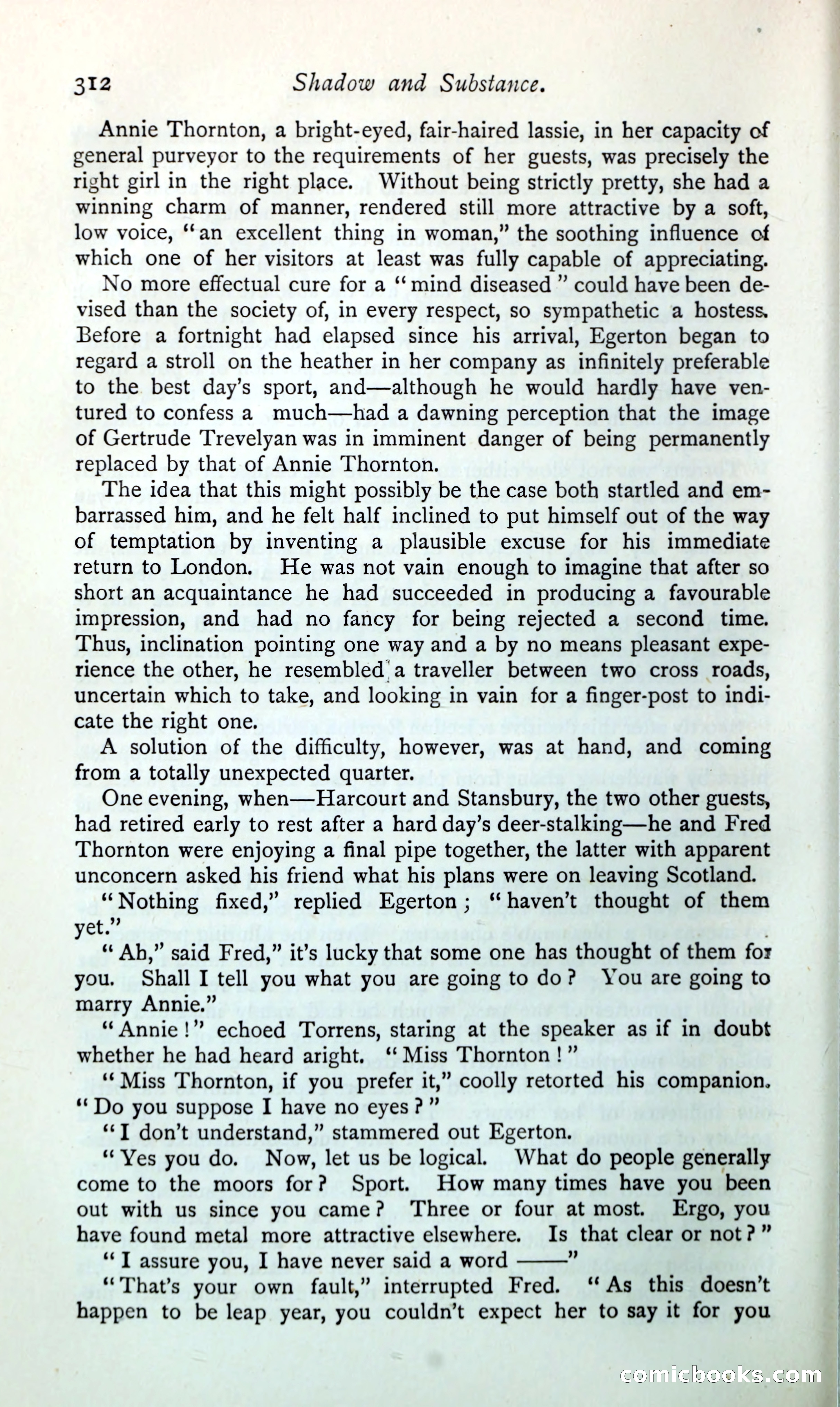
A restored page from Pulp Fiction, 1865. Page through the whole issue in the reader above.
📄 Transcribed text from this page (OCR, searchable)
Machine-transcribed from the original scan — historical spelling and the odd misread are preserved.
312 Shadow and Substance. Annie Thornton, a bright-eyed, fair-haired lassie, in her capacity of general purveyor to the requirements of her guests, was precisely the right girl in the right place. Without being strictly pretty, she had a winning charm of manner, rendered still more attractive by a soft, low voice, ‘fan excellent thing in woman,” the soothing influence of which one of her visitors at least was fully capable of appreciating. No more effectual cure for a ‘‘mind diseased ” could have been de- vised than the society of, in every respect, so sympathetic a hostess. Before a fortnight had elapsed since his arrival, Egerton began to regard a stroll on the heather in her company as infinitely preferable to the best day’s sport, and—although he would hardly have ven- tured to confess a much—had a dawning perception that the image of Gertrude Trevelyan was in imminent danger of being permanently replaced by that of Annie Thornton. The idea that this might possibly be the case both startled and em- barrassed him, and he felt half inclined to put himself out of the way of temptation by inventing a plausible excuse for his immediate return to London. He was not vain enough to imagine that after so short an acquaintance he had succeeded in producing a favourable impression, and had no fancy for being rejected a second time. Thus, inclination pointing one way and a by no means pleasant expe- rience the other, he resembled a traveller between two cross roads, uncertain which to take, and looking in vain for a finger-post to indi- cate the right one. A solution of the difficulty, however, was at hand, and coming from a totally unexpected quarter. One evening, when—Harcourt and Stansbury, the two other guests, had retired early to rest after a hard day’s deer-stalking—he and Fred Thornton were enjoying a final pipe together, the latter with apparent unconcern asked his friend what his plans were on leaving Scotland. ‘Nothing fixed,” replied Egerton; ‘“ haven’t thought of them yet.” “ Ab,” said Fred,” it’s lucky that some one has thought of them for you. Shall I tell you what you are going to do? You are going to marry Annie.” “Annie!” echoed Torrens, staring at the speaker as if in doubt whether he had heard aright. ‘‘ Miss Thornton!” ‘‘ Miss Thornton, if you prefer it,” coolly retorted his companion. “Do you suppose I have no eyes?” **T don’t understand,” stammered out Egerton. “Yes you do. Now, let us be logical. What do people generally come to the moors for? Sport. How many times have you been out with us since you came? Three or four at most. Ergo, you have found metal more attractive elsewhere. Is that clear or not?” ‘“‘T assure you, I have never said a word r “That’s your own fault,” interrupted Fred. ‘As this doesn’t happen to be leap year, you couldn’t expect her to say it for you Gomicbooks.Go