
Pulp Fiction, 1865 · page 295 of 399
The Argosy — page 295: what you’re looking at
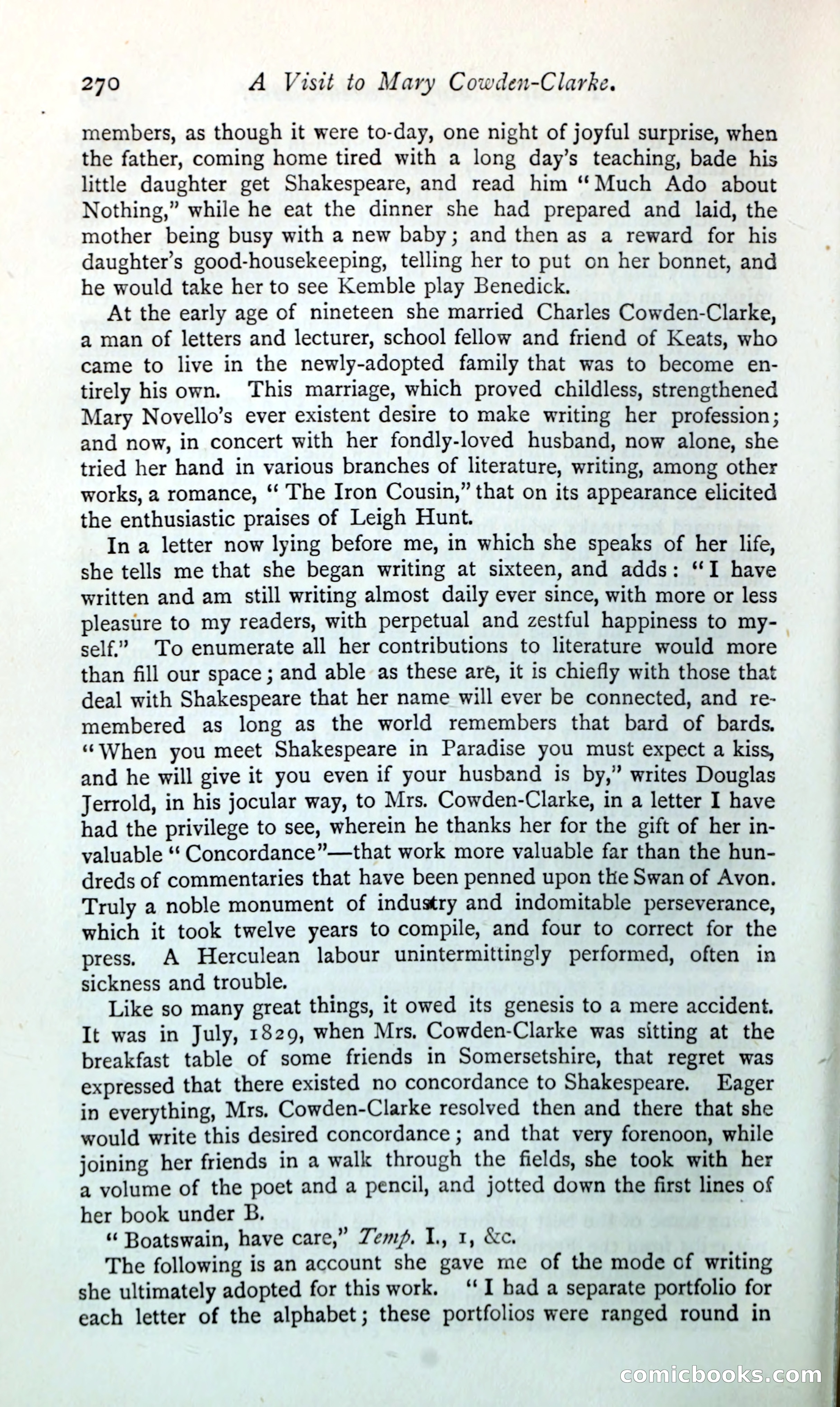
A restored page from Pulp Fiction, 1865. Page through the whole issue in the reader above.
📄 Transcribed text from this page (OCR, searchable)
Machine-transcribed from the original scan — historical spelling and the odd misread are preserved.
270 A Visit to Mary Cowden-Clarke. members, as though it were to-day, one night of joyful surprise, when the father, coming home tired with a long day’s teaching, bade his little daughter get Shakespeare, and read him ‘Much Ado about Nothing,” while he eat the dinner she had prepared and laid, the mother being busy with a new baby; and then as a reward for his daughter’s good-housekeeping, telling her to put on her bonnet, and he would take her to see Kemble play Benedick. At the early age of nineteen she married Charles Cowden-Clarke, a man of letters and lecturer, school fellow and friend of Keats, who came to live in the newly-adopted family that was to become en- tirely his own. This marriage, which proved childless, strengthened Mary Novello’s ever existent desire to make writing her profession; and now, in concert with her fondly-loved husband, now alone, she tried her hand in various branches of literature, writing, among other works, a romance, ‘‘ The Iron Cousin,” that on its appearance elicited the enthusiastic praises of Leigh Hunt. In a letter now lying before me, in which she speaks of her life, she tells me that she began writing at sixteen, and adds: “I have written and am still writing almost daily ever since, with more or less pleasure to my readers, with perpetual and zestful happiness to my- self.’ To enumerate all her contributions to literature would more than fill our space ; and able as these are, it is chiefly with those that deal with Shakespeare that her name will ever be connected, and re- membered as long as the world remembers that bard of bards. ‘When you meet Shakespeare in Paradise you must expect a kiss, and he will give it you even if your husband is by,” writes Douglas Jerrold, in his jocular way, to Mrs. Cowden-Clarke, in a letter I have had the privilege to see, wherein he thanks her for the gift of her in- valuable ** Concordance”—that work more valuable far than the hun- dreds of commentaries that have been penned upon the Swan of Avon. Truly a noble monument of industry and indomitable perseverance, which it took twelve years to compile, and four to correct for the press. A Herculean labour unintermittingly performed, often in sickness and trouble. Like so many great things, it owed its genesis to a mere accident. It was in July, 1829, when Mrs, Cowden-Clarke was sitting at the breakfast table of some friends in Somersetshire, that regret was expressed that there existed no concordance to Shakespeare. Eager in everything, Mrs. Cowden-Clarke resolved then and there that she would write this desired concordance ; and that very forenoon, while joining her friends in a walk through the fields, she took with her a volume of the poet and a pencil, and jotted down the first lines of her book under B. | “Boatswain, have care,” Zemp. I, 1, &c. The following is an account she gave me of the mode of writing she ultimately adopted for this work. ‘‘I bad a separate portfolio for each letter of the alphabet; these portfolios were ranged round in GEomicbooks.co i