
Pulp Fiction, 1865 · page 294 of 399
The Argosy — page 294: what you’re looking at
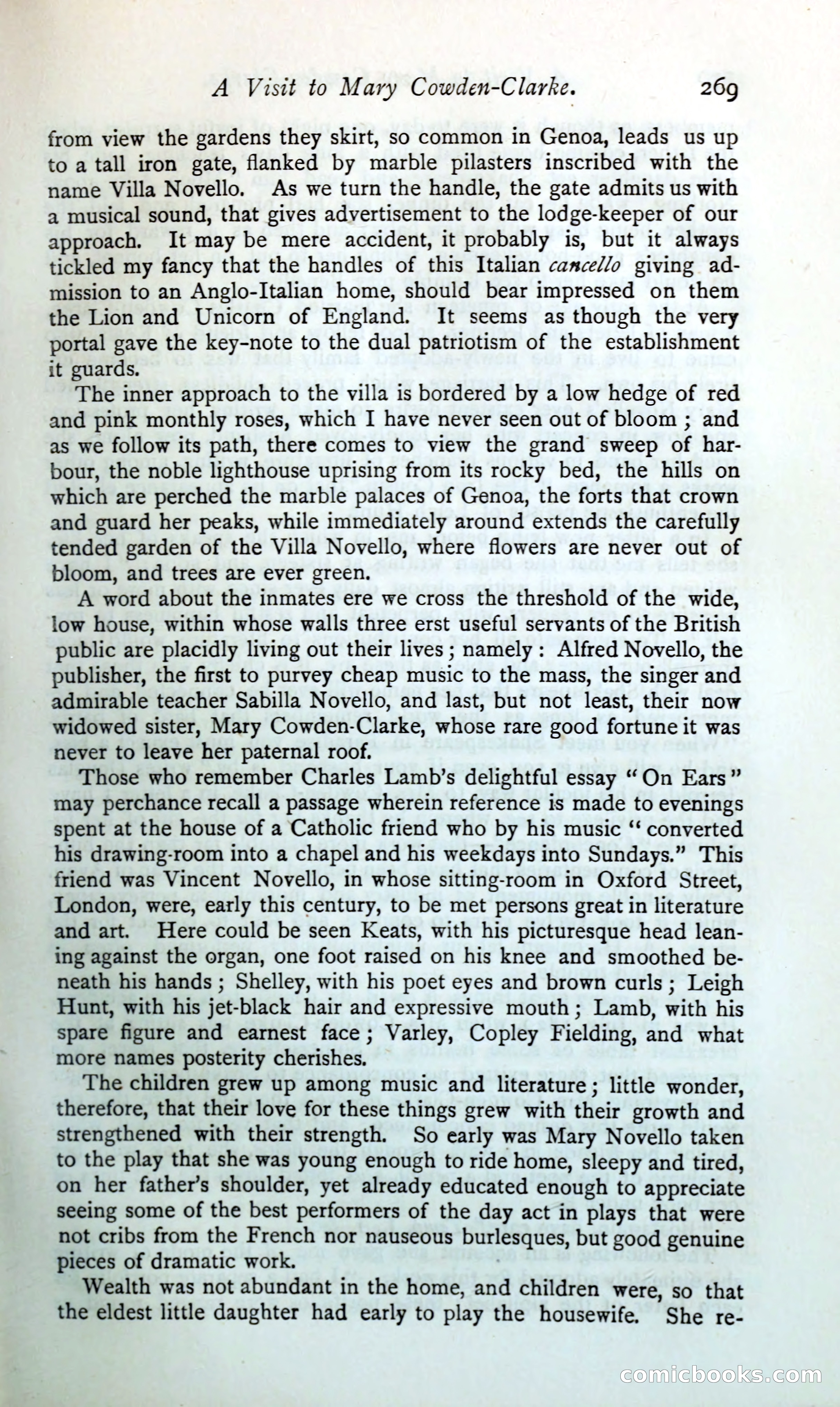
A restored page from Pulp Fiction, 1865. Page through the whole issue in the reader above.
📄 Transcribed text from this page (OCR, searchable)
Machine-transcribed from the original scan — historical spelling and the odd misread are preserved.
A Visit to Mary Cowden-Clarke. 269 from view the gardens they skirt, so common in Genoa, leads us up to a tall iron gate, flanked by marble pilasters inscribed with the name Villa Novello. As we turn the handle, the gate admits us with a musical sound, that gives advertisement to the lodge-keeper of our approach. It may be mere accident, it probably is, but it always tickled my fancy that the handles of this Italian cance//o giving ad- mission to an Anglo-Italian home, should bear impressed on them the Lion and Unicorn of England. It seems as though the very portal gave the key-note to the dual patriotism of the establishment it guards. The inner approach to the villa is bordered by a low hedge of red and pink monthly roses, which I have never seen out of bloom ; and as we follow its path, there comes to view the grand sweep of har- bour, the noble lighthouse uprising from its rocky bed, the hills on which are perched the marble palaces of Genoa, the forts that crown and guard her peaks, while immediately around extends the carefully tended garden of the Villa Novello, where flowers are never out of bloom, and trees are ever green. A word about the inmates ere we cross the threshold of the wide, low house, within whose walls three erst useful servants of the British public are placidly living out their lives; namely: Alfred Novello, the publisher, the first to purvey cheap music to the mass, the singer and admirable teacher Sabilla Novello, and last, but not least, their now widowed sister, Mary Cowden-Clarke, whose rare good fortune it was never to leave her paternal roof. Those who remember Charles Lamb’s delightful essay “On Ears ” may perchance recall a passage wherein reference is made to evenings spent at the house of a Catholic friend who by his music ‘‘ converted his drawing-room into a chapel and his weekdays into Sundays.” This friend was Vincent Novello, in whose sitting-room in Oxford Street, London, were, early this century, to be met persons great in literature and art. Here could be seen Keats, with his picturesque head lean- ing against the organ, one foot raised on his knee and smoothed be- neath his hands ; Shelley, with his poet eyes and brown curls; Leigh Hunt, with his jet-black hair and expressive mouth; Lamb, with his spare figure and earnest face; Varley, Copley Fielding, and what more names posterity cherishes. The children grew up among music and literature; little wonder, therefore, that their love for these things grew with their growth and strengthened with their strength. So early was Mary Novello taken to the play that she was young enough to ride home, sleepy and tired, on her father’s shoulder, yet already educated enough to appreciate seeing some of the best performers of the day act in plays that were not cribs from the French nor nauseous burlesques, but good genuine pieces of dramatic work. . Wealth was not abundant in the home, and children were, so that the eldest little daughter had early to play the housewife. She re- EONNIE HOOKS (E@) m