
Pulp Fiction, 1865 · page 296 of 399
The Argosy — page 296: what you’re looking at
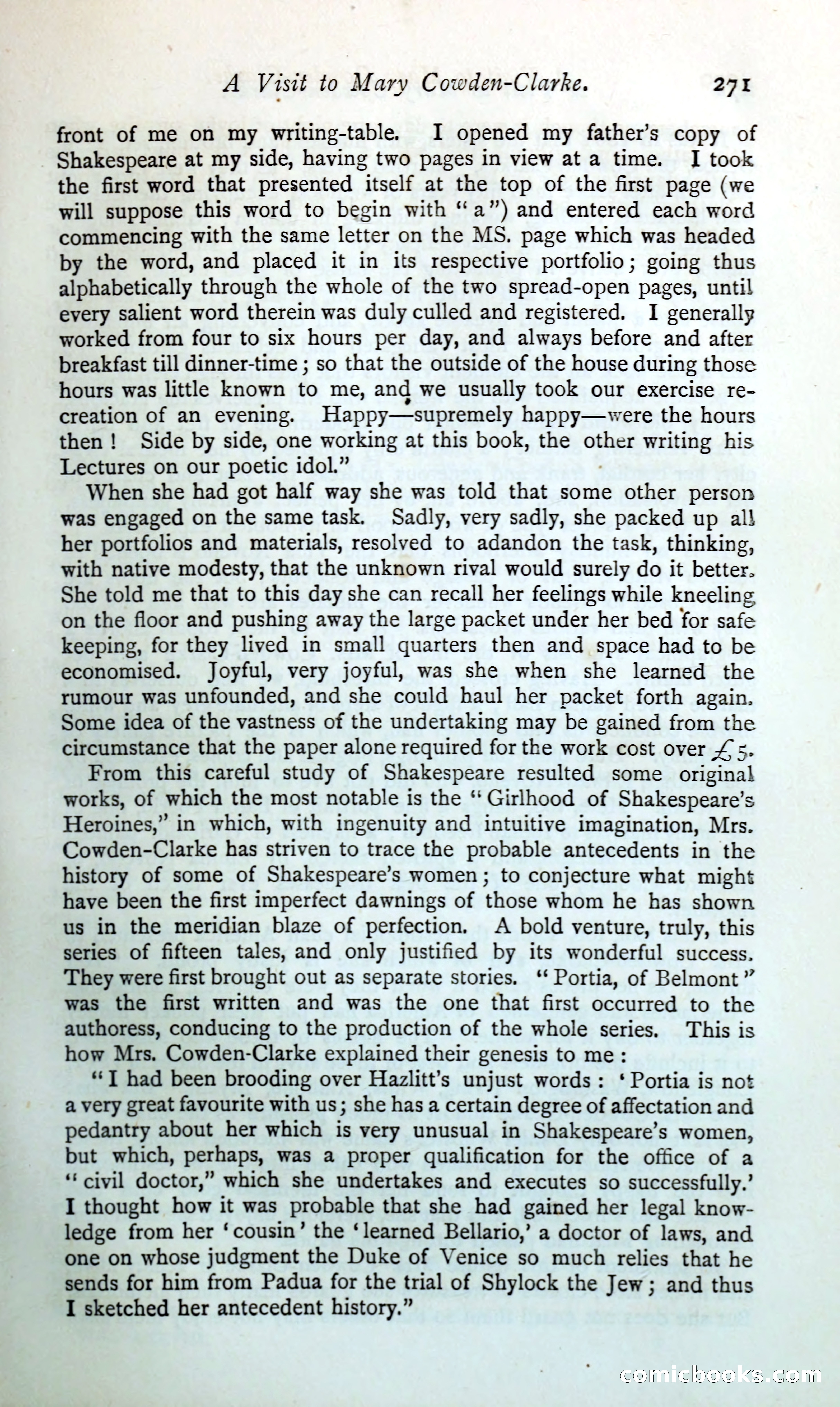
A restored page from Pulp Fiction, 1865. Page through the whole issue in the reader above.
📄 Transcribed text from this page (OCR, searchable)
Machine-transcribed from the original scan — historical spelling and the odd misread are preserved.
A Visit to Mary Cowden-Clarke. 271 front of me on my writing-table. I opened my father’s copy of Shakespeare at my side, having two pages in view ata time. I took the first word that presented itself at the top of the first page (we will suppose this word to begin with “‘a”) and entered each word commencing with the same letter on the MS. page which was headed by the word, and placed it in its respective portfolio; going thus alphabetically through the whole of the two spread-open pages, until every salient word therein was duly culled and registered. I generally worked from four to six hours per day, and always before and after breakfast till dinner-time ; so that the outside of the house during those hours was little known to me, and we usually took our exercise re- creation of an evening. Happy—supremely happy—were the hours then! Side by side, one working at this book, the other writing his Lectures on our poetic idol.” When she had got half way she was told that some other person was engaged on the same task. Sadly, very sadly, she packed up al! her portfolios and materials, resolved to adandon the task, thinking, with native modesty, that the unknown rival would surely do it better. She told me that to this day she can recall her feelings while kneeling on the floor and pushing away the large packet under her bed for safe keeping, for they lived in small quarters then and space had to be economised. Joyful, very joyful, was she when she learned the rumour was unfounded, and she could haul her packet forth again. Some idea of the vastness of the undertaking may be gained from the circumstance that the paper alone required for the work cost over £ 5. From this careful study of Shakespeare resulted some original works, of which the most notable is the ‘‘ Girlhood of Shakespeare’s Heroines,” in which, with ingenuity and intuitive imagination, Mrs. Cowden-Clarke has striven to trace the probable antecedents in the history of some of Shakespeare’s women; to conjecture what might have been the first imperfect dawnings of those whom he has shown us in the meridian blaze of perfection. A bold venture, truly, this series of fifteen tales, and only justified by its wonderful success. They were first brought out as separate stories. ‘‘ Portia, of Belmont” was the first written and was the one that first occurred to the authoress, conducing to the production of the whole series. This is how Mrs. Cowden-Clarke explained their genesis to me: **T had been brooding over Hazlitt’s unjust words: ‘ Portia is not a very great favourite with us; she has a certain degree of affectation and pedantry about her which is very unusual in Shakespeare’s women, but which, perhaps, was a proper qualification for the office of a ‘‘ civil doctor,” which she undertakes and executes so successfully.’ I thought how it was probable that she had gained her legal know- ledge from her ‘cousin’ the ‘learned Bellario,’ a doctor of laws, and one on whose judgment the Duke of Venice so much relies that he sends for him from Padua for the trial of Shylock the Jew; and thus I sketched her antecedent history.” EONNIE OOO KS (E(©) m