
Pulp Fiction, 1865 · page 129 of 399
The Argosy — page 129: what you’re looking at
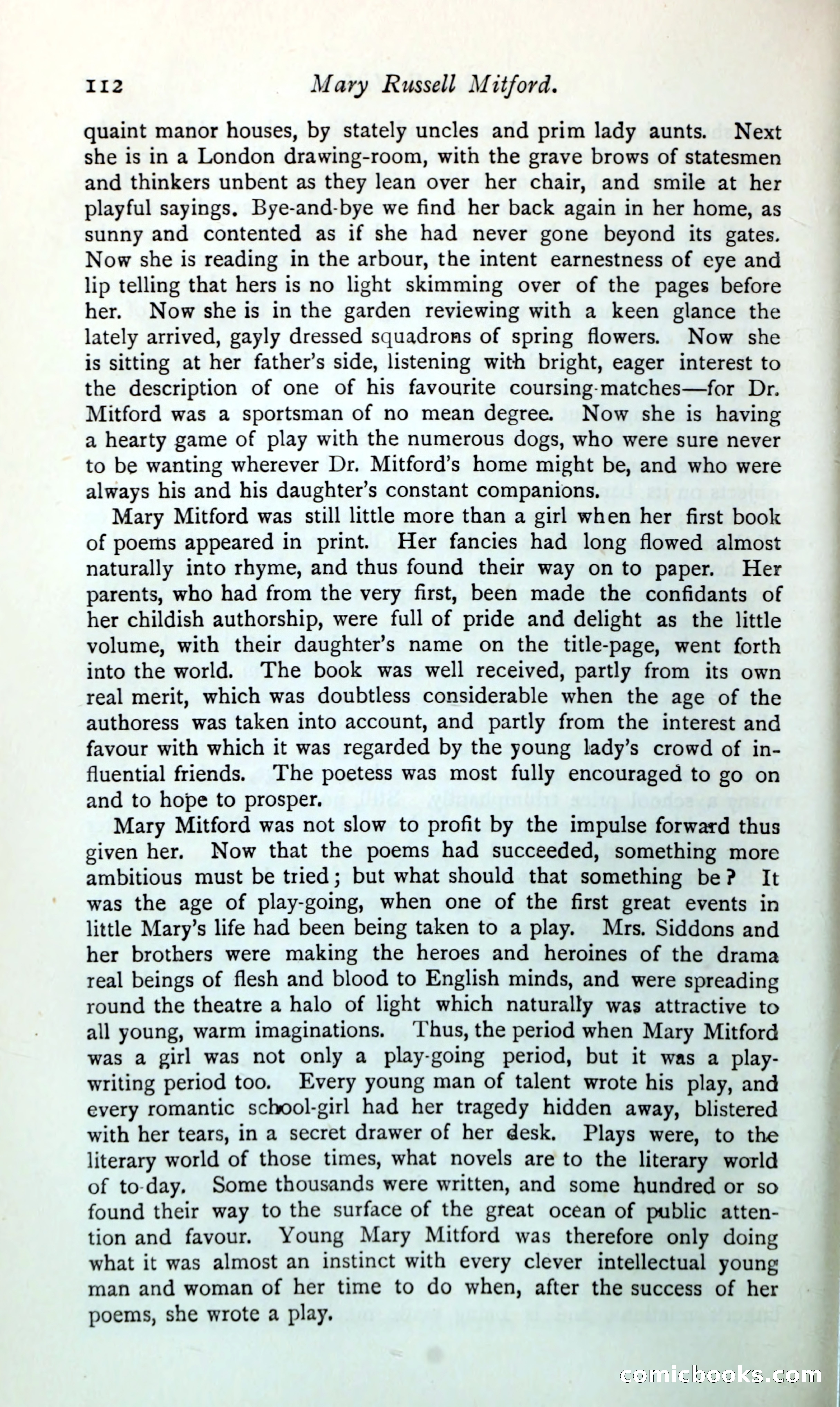
A restored page from Pulp Fiction, 1865. Page through the whole issue in the reader above.
📄 Transcribed text from this page (OCR, searchable)
Machine-transcribed from the original scan — historical spelling and the odd misread are preserved.
I12 Mary Russell Mitford. quaint manor houses, by stately uncles and prim lady aunts. Next she is in a London drawing-room, with the grave brows of statesmen and thinkers unbent as they lean over her chair, and smile at her playful sayings. Bye-and-bye we find her back again in her home, as sunny and contented as if she had never gone beyond its gates. Now she is reading in the arbour, the intent earnestness of eye and lip telling that hers is no light skimming over of the pages before her. Now she is in the garden reviewing with a keen glance the lately arrived, gayly dressed squadrons of spring flowers. Now she is sitting at her father’s side, listening with bright, eager interest to the description of one of his favourite coursing-matches—for Dr. Mitford was a sportsman of no mean degree. Now she is having a hearty game of play with the numerous dogs, who were sure never to be wanting wherever Dr. Mitford’s home might be, and who were always his and his daughter’s constant companions. Mary Mitford was still little more than a girl when her first book of poems appeared in print. Her fancies had long flowed almost naturally into rhyme, and thus found their way onto paper. Her parents, who had from the very first, been made the confidants of her childish authorship, were full of pride and delight as the little volume, with their daughter’s name on the title-page, went forth into the world. The book was well received, partly from its own real merit, which was doubtless considerable when the age of the authoress was taken into account, and partly from the interest and favour with which it was regarded by the young lady’s crowd of in- fluential friends. The poetess was most fully encouraged to go on and to hope to prosper. Mary Mitford was not slow to profit by the impulse forward thus given her. Now that the poems had succeeded, something more ambitious must be tried; but what should that something be? It was the age of play-going, when one of the first great events in little Mary’s life had been being taken to a play. Mrs. Siddons and her brothers were making the heroes and heroines of the drama real beings of flesh and blood to English minds, and were spreading round the theatre a halo of light which naturally was attractive to all young, warm imaginations. ‘Thus, the period when Mary Mitford was a girl was not only a play-going period, but it was a play- writing period too. Every young man of talent wrote his play, and every romantic school-girl had her tragedy hidden away, blistered with her tears, in a secret drawer of her desk. Plays were, to the literary world of those times, what novels are to the literary world of to-day. Some thousands were written, and some hundred or so found their way to the surface of the great ocean of public atten- tion and favour. Young Mary Mitford was therefore only doing what it was almost an instinct with every clever intellectual young man and woman of her time to do when, after the success of her poems, she wrote a play. Gomicbooks.co m = ee ee VQ