
Pulp Fiction, 1865 · page 128 of 399
The Argosy — page 128: what you’re looking at
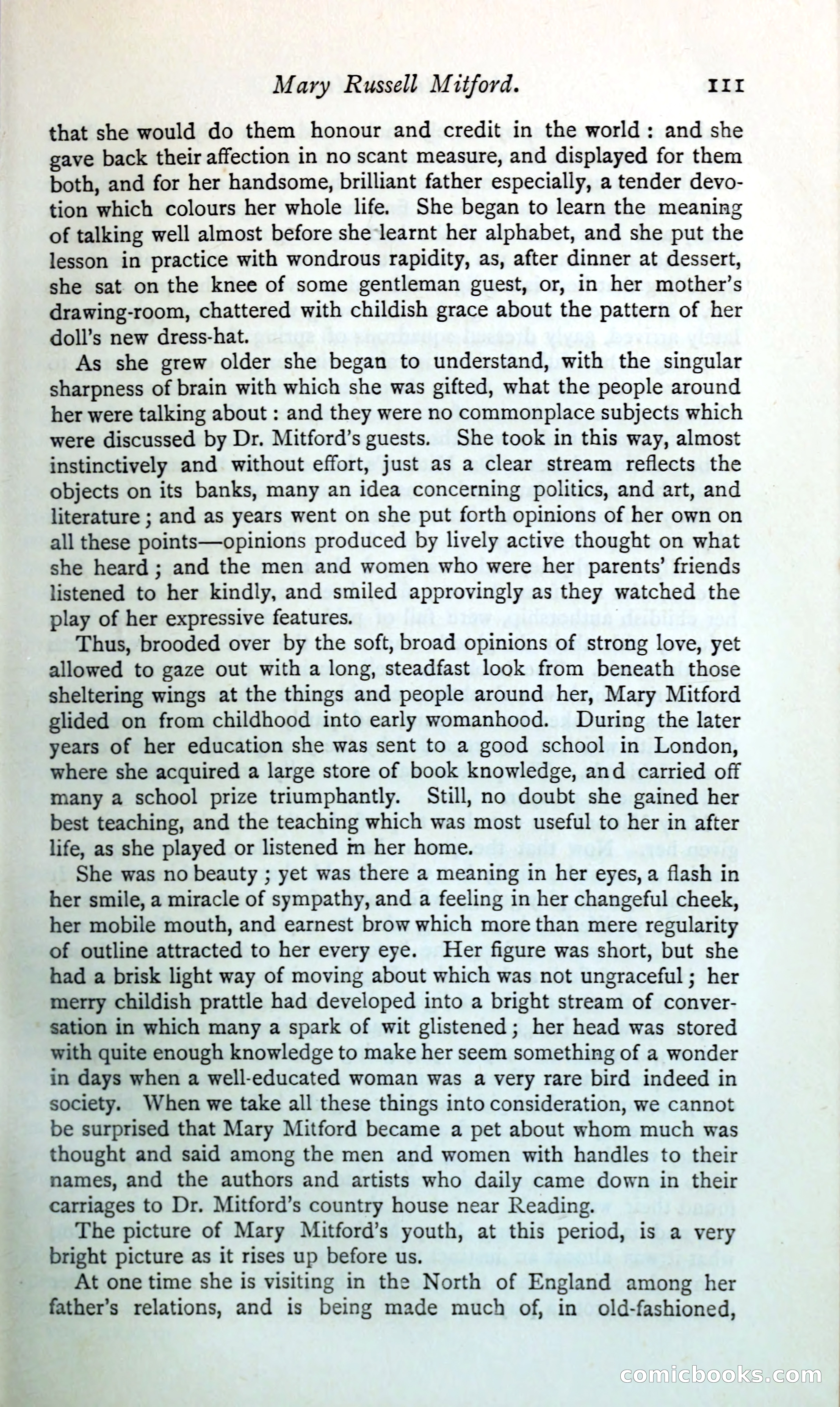
A restored page from Pulp Fiction, 1865. Page through the whole issue in the reader above.
📄 Transcribed text from this page (OCR, searchable)
Machine-transcribed from the original scan — historical spelling and the odd misread are preserved.
Mary Russell Mitford. III that she would do them honour and credit in the world: and she gave back their affection in no scant measure, and displayed for them both, and for her handsome, brilliant father especially, a tender devo- tion which colours her whole life. She began to learn the meaning of talking well almost before she learnt her alphabet, and she put the lesson in practice with wondrous rapidity, as, after dinner at dessert, she sat on the knee of some gentleman guest, or, in her mother’s drawing-room, chattered with childish grace about the pattern of her doll’s new dress-hat. As she grew older she began to understand, with the singular sharpness of brain with which she was gifted, what the people around her were talking about : and they were no commonplace subjects which were discussed by Dr. Mitford’s guests. She took in this way, almost instinctively and without effort, just as a clear stream reflects the objects on its banks, many an idea concerning politics, and art, and literature ; and as years went on she put forth opinions of her own on all these points—opinions produced by lively active thought on what she heard ; and the men and women who were her parents’ friends listened to her kindly, and smiled approvingly as they watched the play of her expressive features. Thus, brooded over by the soft, broad opinions of strong love, yet allowed to gaze out with a long, steadfast look from beneath those sheltering wings at the things and people around her, Mary Mitford glided on from childhood into early womanhood. During the later years of her education she was sent to a good school in London, where she acquired a large store of book knowledge, and carried off many a school prize triumphantly. Still, no doubt she gained her best teaching, and the teaching which was most useful to her in after life, as she played or listened m her home. She was no beauty ; yet was there a meaning in her eyes, a flash in her smile, a miracle of sympathy, and a feeling in her changeful cheek, her mobile mouth, and earnest brow which more than mere regularity of outline attracted to her every eye. Her figure was short, but she had a brisk light way of moving about which was not ungraceful; her merry childish prattle had developed into a bright stream of conver- sation in which many a spark of wit glistened; her head was stored with quite enough knowledge to make her seem something of a wonder in days when a well-educated woman was a very rare bird indeed in society. When we take all these things into consideration, we cannot be surprised that Mary Mitford became a pet about whom much was thought and said among the men and women with handles to their names, and the authors and artists who daily came down in their carriages to Dr. Mitford’s country house near Reading. The picture of Mary Mitford’s youth, at this period, is a very bright picture as it rises up before us. At one time she is visiting in the North of England among her father’s relations, and is being made much of, in old-fashioned, Gomichboo (E(©) Nh