
Pulp Fiction, 1865 · page 54 of 400
The Argosy — page 54: what you’re looking at
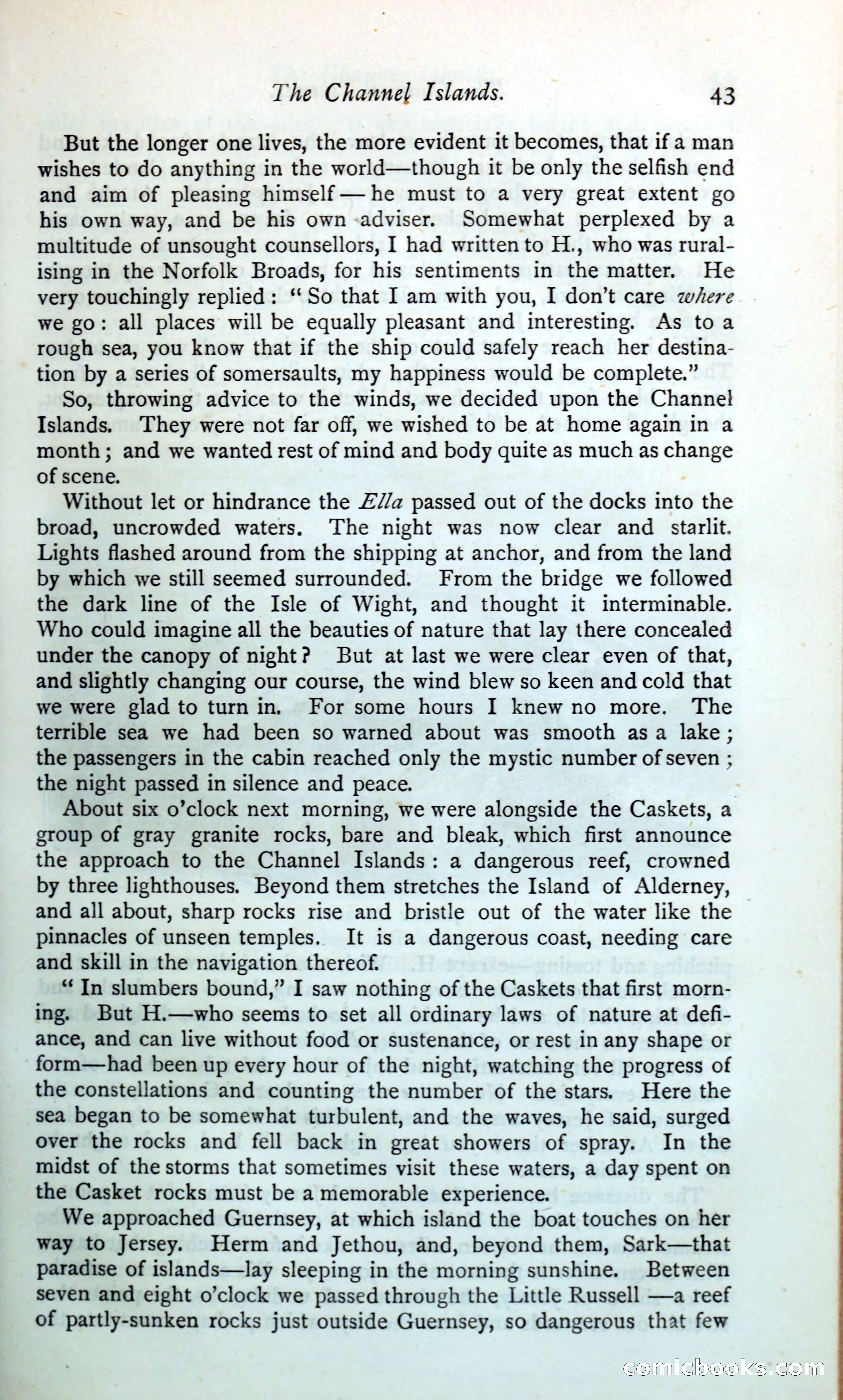
A restored page from Pulp Fiction, 1865. Page through the whole issue in the reader above.
📄 Transcribed text from this page (OCR, searchable)
Machine-transcribed from the original scan — historical spelling and the odd misread are preserved.
The Channel Islands. A3 But the longer one lives, the more evident it becomes, that if a man wishes to do anything in the world—though it be only the selfish end and aim of pleasing himself he must to a very great extent go his own way, and be his own adviser. Somewhat perplexed by a multitude of unsought counsellors, I had written to H., who was rural- ising in the Norfolk Broads, for his sentiments in the matter. He very touchingly replied: ‘‘So that I am with you, I don’t care where we go: all places will be equally pleasant and interesting. As toa rough sea, you know that if the ship could safely reach her destina- tion by a series of somersaults, my happiness would be complete.” So, throwing advice to the winds, we decided upon the Channel Islands. They were not far off, we wished to be at home again in a month; and we wanted rest of mind and body quite as much as change of scene. Without let or hindrance the £//a passed out of the docks into the broad, uncrowded waters. ‘The night was now clear and _ starlit. Lights flashed around from the shipping at anchor, and from the land by which we still seemed surrounded. From the bridge we followed the dark line of the Isle of Wight, and thought it interminable. Who could imagine all the beauties of nature that lay there concealed under the canopy of night? But at last we were clear even of that, and slightly changing our course, the wind blew so keen and cold that we were glad to turnin. For some hours I knewno more. The terrible sea we had been so warned about was smooth asa lake; the passengers in the cabin reached only the mystic number of seven ; the night passed in silence and peace. About six o’clock next morning, we were alongside the Caskets, a group of gray granite rocks, bare and bleak, which first announce the approach to the Channel Islands: a dangerous reef, crowned by three lighthouses. Beyond them stretches the Island of Alderney, and all about, sharp rocks rise and bristle out of the water like the pinnacles of unseen temples. It is a dangerous coast, needing care and skill in the navigation thereof. ‘In slumbers bound,” I saw nothing of the Caskets that first morn- ing. But H.—who seems to set all ordinary laws of nature at defi- ance, and can live without food or sustenance, or rest in any shape or form—had been up every hour of the night, watching the progress of the constellations and counting the number of the stars. Here the sea began to be somewhat turbulent, and the waves, he said, surged over the rocks and fell back in great showers of spray. In the midst of the storms that sometimes visit these waters, a day spent on the Casket rocks must be a memorable experience. We approached Guernsey, at which island the boat touches on her way to Jersey. Herm and Jethou, and, beyond them, Sark—that paradise of islands—lay sleeping in the morning sunshine. Between seven and eight o’clock we passed through the Little Russell —a reef of partly-sunken rocks just outside Guernsey, so dangerous that few Gomichboo cS (E@) m