
Pulp Fiction, 1865 · page 398 of 400
The Argosy — page 398: what you’re looking at
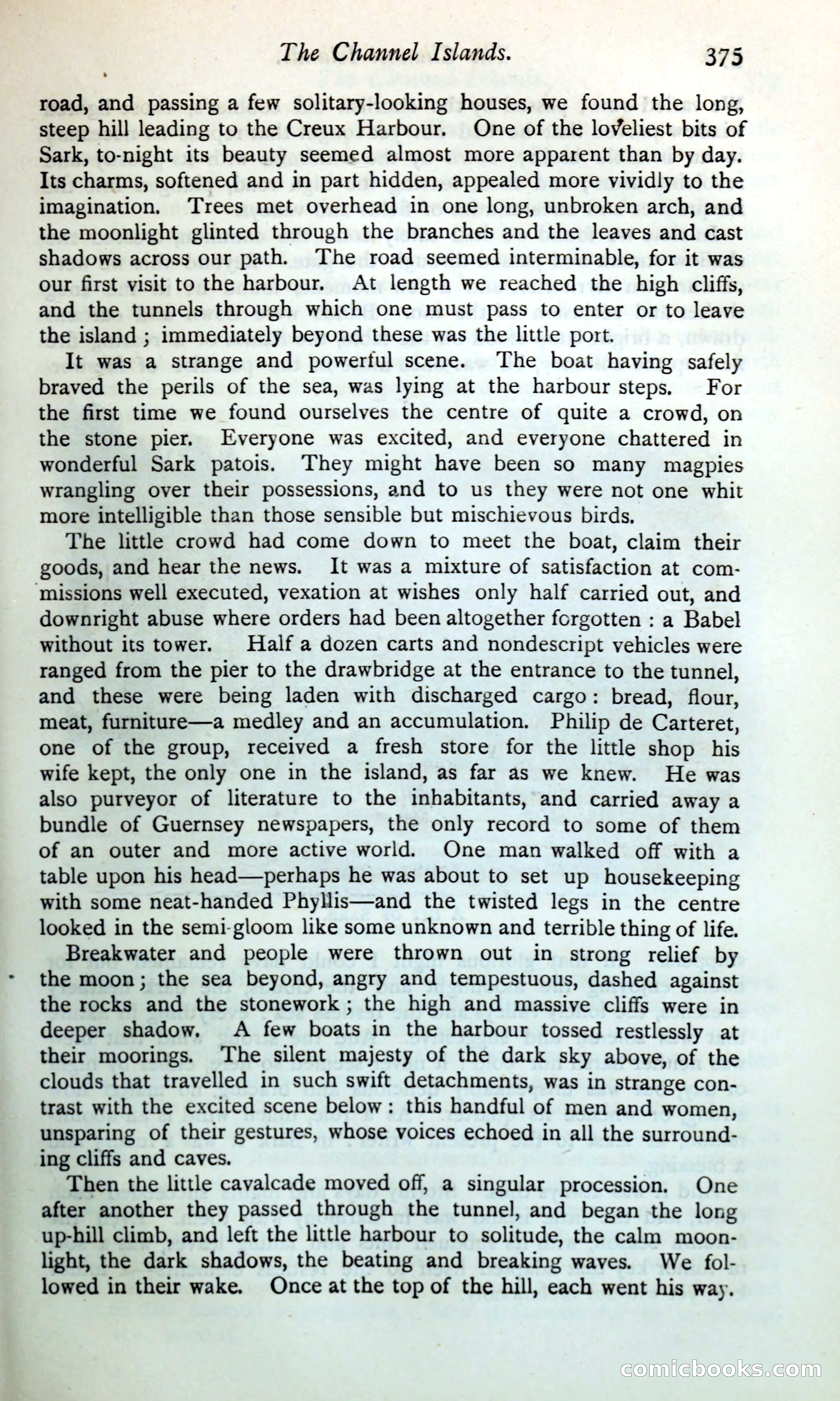
A restored page from Pulp Fiction, 1865. Page through the whole issue in the reader above.
📄 Transcribed text from this page (OCR, searchable)
Machine-transcribed from the original scan — historical spelling and the odd misread are preserved.
The Channel Islands. 375 road, and passing a few solitary-looking houses, we found the long, steep hill leading to the Creux Harbour. One of the loveliest bits of Sark, to-night its beauty seemed almost more apparent than by day. Its charms, softened and in part hidden, appealed more vividly to the imagination. ‘Trees met overhead in one long, unbroken arch, and the moonlight glinted through the branches and the leaves and cast shadows across our path. The road seemed interminable, for it was our first visit to the harbour. At length we reached the high cliffs, and the tunnels through which one must pass to enter or to leave the island ; immediately beyond these was the little port. It was a strange and powerful scene. The boat having safely braved the perils of the sea, was lying at the harbour steps. For the first time we found ourselves the centre of quite a crowd, on the stone pier. Everyone was excited, and everyone chattered in wonderful Sark patois. ‘They might have been so many magpies wrangling over their possessions, and to us they were not one whit more intelligible than those sensible but mischievous birds, The little crowd had come down to meet the boat, claim their goods, and hear the news. It was a mixture of satisfaction at com- missions well executed, vexation at wishes only half carried out, and downright abuse where orders had been altogether forgotten : a Babel without its tower. Half a dozen carts and nondescript vehicles were ranged from the pier to the drawbridge at the entrance to the tunnel, and these were being laden with discharged cargo: bread, flour, meat, furniture—a medley and an accumulation. Philip de Carteret, one of the group, received a fresh store for the little shop his wife kept, the only one in the island, as far as we knew. He was also purveyor of literature to the inhabitants, and carried away a bundle of Guernsey newspapers, the only record to some of them of an outer and more active world. One man walked off with a table upon his head—perhaps he was about to set up housekeeping with some neat-handed Phyllis—and the twisted legs in the centre looked in the semi-gloom like some unknown and terrible thing of life. Breakwater and people were thrown out in strong relief by the moon; the sea beyond, angry and tempestuous, dashed against the rocks and the stonework; the high and massive cliffs were in deeper shadow. A few boats in the harbour tossed restlessly at their moorings. ‘The silent majesty of the dark sky above, of the clouds that travelled in such swift detachments, was in strange con- trast with the excited scene below: this handful of men and women, unsparing of their gestures, whose voices echoed in all the surround- ing cliffs and caves. Then the little cavalcade moved off, a singular procession. One after another they passed through the tunnel, and began the long up-hill climb, and left the little harbour to solitude, the calm moon- light, the dark shadows, the beating and breaking waves. We fol- lowed in their wake. Once at the top of the hill, each went his way. EONNIEL OO KS (EO)