
Pulp Fiction, 1865 · page 397 of 400
The Argosy — page 397: what you’re looking at
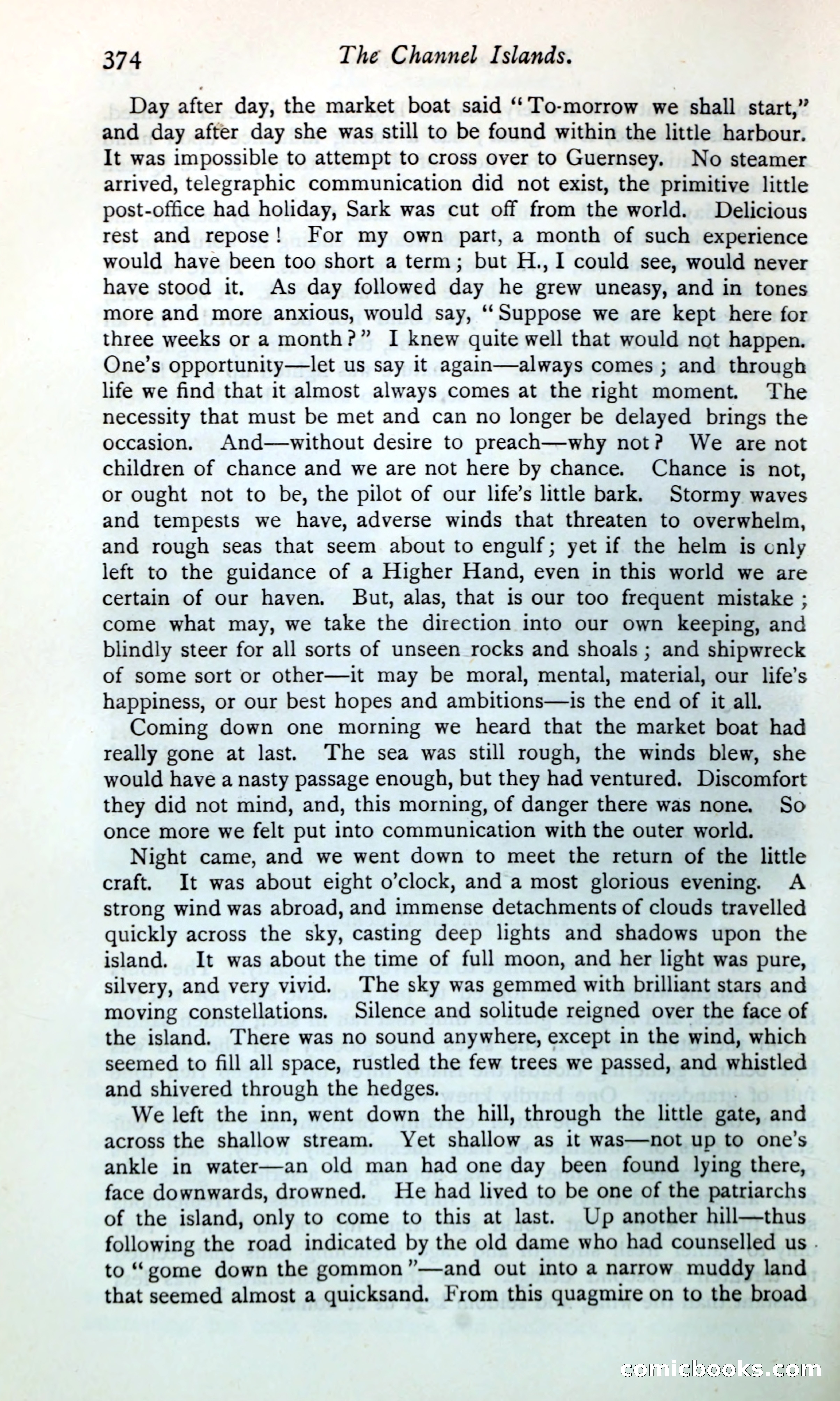
A restored page from Pulp Fiction, 1865. Page through the whole issue in the reader above.
📄 Transcribed text from this page (OCR, searchable)
Machine-transcribed from the original scan — historical spelling and the odd misread are preserved.
374 The Channel Islands. Day after day, the market boat said ‘‘To-morrow we shall start,” and day after day she was still to be found within the little harbour. It was impossible to attempt to cross over to Guernsey. No steamer arrived, telegraphic communication did not exist, the primitive little post-office had holiday, Sark was cut off from the world. Delicious rest and repose! For my own part, a month of such experience would have been too short a term; but H., I could see, would never have stood it. As day followed day he grew uneasy, and in tones more and more anxious, would say, ‘‘Suppose we are kept here for three weeks or a month?” I knew quite well that would not happen. One’s opportunity—let us say it again—always comes ; and through life we find that it almost always comes at the right moment. The necessity that must be met and can no longer be delayed brings the occasion. And—without desire to preach—why not? We are not children of chance and we are not here by chance. Chance is not, or ought not to be, the pilot of our life’s little bark. Stormy waves and tempests we have, adverse winds that threaten to overwhelm, and rough seas that seem about to engulf; yet if the helm is only left to the guidance of a Higher Hand, even in this world we are certain of our haven. But, alas, that is our too frequent mistake ; come what may, we take the direction into our own keeping, and blindly steer for all sorts of unseen rocks and shoals ; and shipwreck of some sort or other—it may be moral, mental, material, our life’s happiness, or our best hopes and ambitions—is the end of it all. Coming down one morning we heard that the market boat had really gone at last. The sea was still rough, the winds blew, she would have a nasty passage enough, but they had ventured. Discomfort they did not mind, and, this morning, of danger there was none. So once more we felt put into communication with the outer world. Night came, and we went down to meet the return of the little craft. It was about eight o’clock, and a most glorious evening. A strong wind was abroad, and immense detachments of clouds travelled quickly across the sky, casting deep lights and shadows upon the island. It was about the time of full moon, and her light was pure, silvery, and very vivid. The sky was gemmed with brilliant stars and moving constellations. Silence and solitude reigned over the face of the island. There was no sound anywhere, except in the wind, which seemed to fill all space, rustled the few trees we passed, and whistled and shivered through the hedges. We left the inn, went down the hill, through the little gate, and across the shallow stream. Yet shallow as it was—not up to one’s ankle in water—an old man had one day been found lying there, face downwards, drowned. He had lived to be one of the patriarchs of the island, only to come to this at last. Up another hill—thus following the road indicated by the old dame who had counselled us . to “gome down the gommon”—and out into a narrow muddy land that seemed almost a quicksand. From this quagmire on to the broad Eomichbooks.com