
Pulp Fiction, 1865 · page 209 of 400
The Argosy — page 209: what you’re looking at
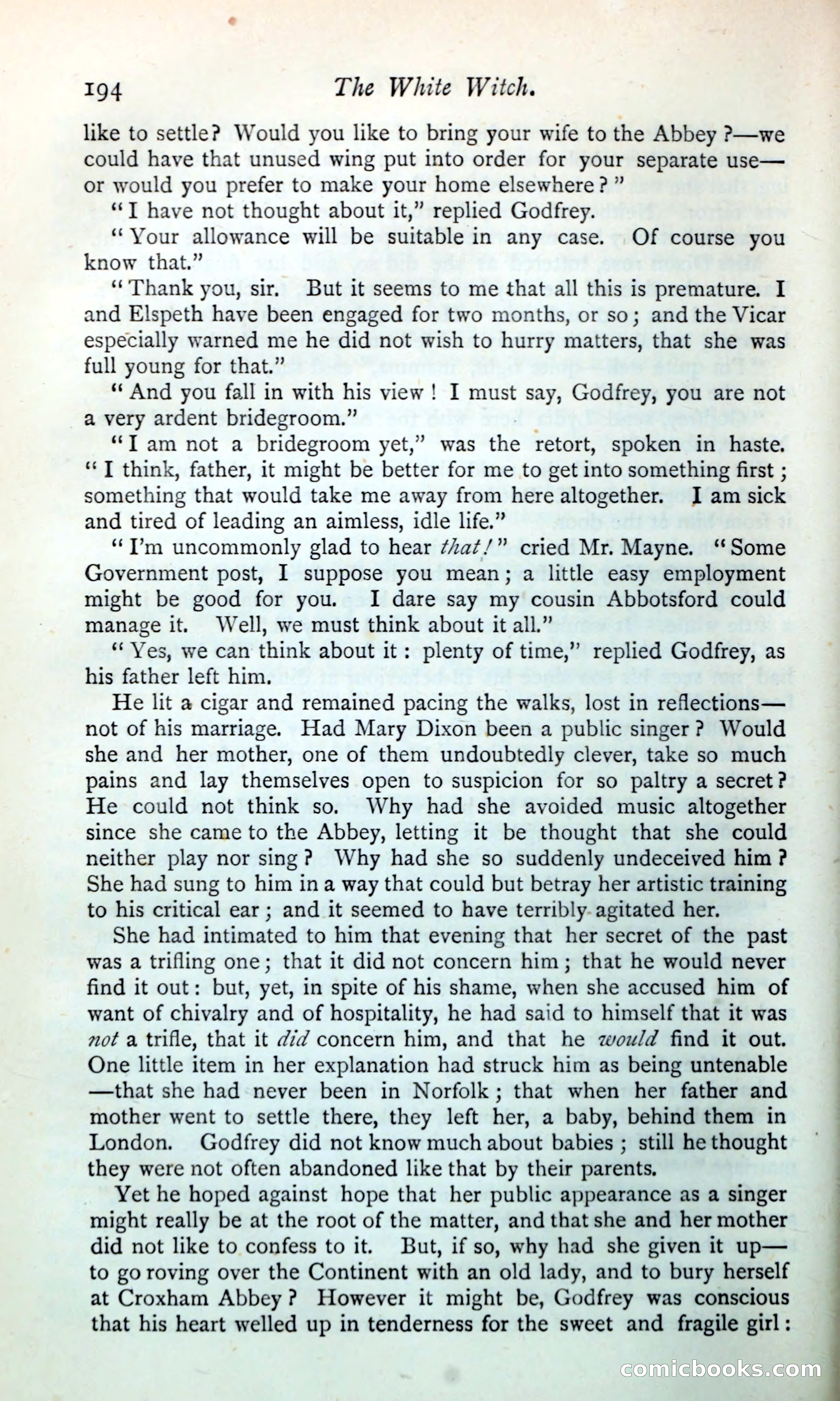
A restored page from Pulp Fiction, 1865. Page through the whole issue in the reader above.
📄 Transcribed text from this page (OCR, searchable)
Machine-transcribed from the original scan — historical spelling and the odd misread are preserved.
194 The White Witch. like to settle? Would you like to bring your wife to the Abbey ?—we could have that unused wing put into order for your separate use— or would you prefer to make your home elsewhere ? ” “T have not thought about it,” replied Godfrey. “Your allowance will be suitable in any case. Of course you know that.” “Thank you, sir. But it seems to me that all this is premature. I and Elspeth have been engaged for two months, or so; and the Vicar especially warned me he did not wish to hurry matters, that she was full young for that.” ** And you fall in with his view! I must say, Godfrey, you are not a very ardent bridegroom.” ““T am not a bridegroom yet,” was the retort, spoken in haste. ‘‘T think, father, it might be better for me to get into something first ; something that would take me away from here altogether. J am sick and tired of leading an aimless, idle life.” “T’m uncommonly glad to hear ¢#a¢/” cried Mr. Mayne. “Some Government post, I suppose you mean; a little easy employment might be good for you. I dare say my cousin Abbotsford could manage it. Well, we must think about it all.” * Yes, we can think about it: plenty of time,” replied Godfrey, as his father left him. He lit a cigar and remained pacing the walks, lost in reflections— not of his marriage. Had Mary Dixon been a public singer? Would she and her mother, one of them undoubtedly clever, take so much pains and lay themselves open to suspicion for so paltry a secret? He could not think so. Why had she avoided music altogether since she came to the Abbey, letting it be thought that she could neither play nor sing? Why had she so suddenly undeceived him ? : She had sung to him ina way that could but betray her artistic training to his critical ear ; and it seemed to have terribly- agitated her. She had intimated to him that evening that her secret of the past was a trifling one; that it did not concern him; that he would never find it out: but, yet, in spite of his shame, when she accused him of want of chivalry and of hospitality, he had said to himself that it was not a trifle, that it d77 concern him, and that he zwoz/d find it out. One little item in her explanation had struck him as being untenable —that she had never been in Norfolk; that when her father and mother went to settle there, they left her, a baby, behind them in London. Godfrey did not know much about babies ; still he thought they were not often abandoned like that by their parents. Yet he hoped against hope that her public appearance as a singer might really be at the root of the matter, and that she and her mother did not like to confess to it. But, if so, why had she given it up— to go roving over the Continent with an old lady, and to bury herself at Croxham Abbey ? However it might be, Godfrey was conscious that his heart welled up in tenderness for the sweet and fragile girl: Eomichooks.co