
Pulp Fiction, 1865 · page 208 of 400
The Argosy — page 208: what you’re looking at
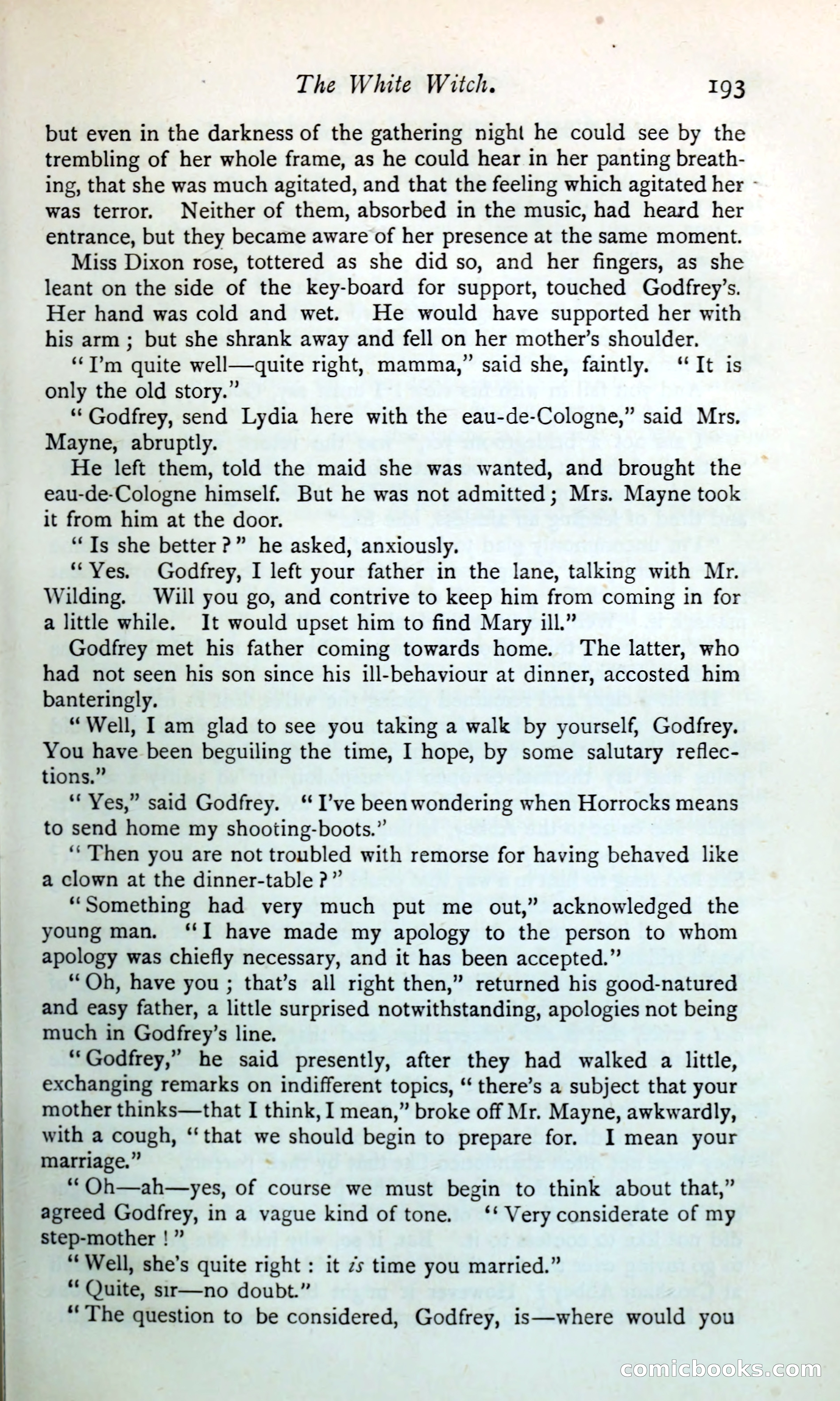
A restored page from Pulp Fiction, 1865. Page through the whole issue in the reader above.
📄 Transcribed text from this page (OCR, searchable)
Machine-transcribed from the original scan — historical spelling and the odd misread are preserved.
The White Witch. 193 but even in the darkness of the gathering night he could see by the trembling of her whole frame, as he could hear in her panting breath- ing, that she was much agitated, and that the feeling which agitated her - was terror. Neither of them, absorbed in the music, had heard her entrance, but they became aware of her presence at the same moment. Miss Dixon rose, tottered as she did so, and her fingers, as she leant on the side of the key-board for support, touched Godfrey’s. Her hand was cold and wet. He would have supported her with his arm ; but she shrank away and fell on her mother’s shoulder. ‘‘T’m quite well—dquite right, mamma,” said she, faintly. ‘It is only the old story.” “Godfrey, send Lydia here with the eau-de-Cologne,” said Mrs. Mayne, abruptly. He left them, told the maid she was wanted, and brought the eau-de-Cologne himself. But he was not admitted; Mrs. Mayne took it from him at the door. “Ts she better?” he asked, anxiously. “Yes. Godfrey, I left your father in the lane, talking with Mr. Wilding. Will you go, and contrive to keep him from coming in for a little while. It would upset him to find Mary ill.” Godfrey met his father coming towards home. The latter, who had not seen his son since his ill-behaviour at dinner, accosted him banteringly. “Well, I am glad to see you taking a walk by yourself, Godfrey. You have been beguiling the time, I hope, by some salutary reflec- tions.” “Yes,” said Godfrey. ‘ I’ve beenwondering when Horrocks means to send home my shooting-boots.” ‘Then you are not troubled with remorse for having behaved like a clown at the dinner-table ?” “Something had very much put me out,” acknowledged the young man. ‘‘I have made my apology to the person to whom apology was chiefly necessary, and it has been accepted.” “Oh, have you ; that’s all right then,” returned his good-natured and easy father, a little surprised notwithstanding, apologies not being much in Godfrey’s line. “Godfrey,” he said presently, after they had walked a little, exchanging remarks on indifferent topics, “ there’s a subject that your mother thinks—that I think, I mean,” broke off Mr. Mayne, awkwardly, with a cough, ‘‘that we should begin to prepare for. I mean your marriage.” “* Oh—ah—yes, of | course we must begin to think about that,” agreed Godfrey, in a vague kind of tone. ‘‘ Very considerate of my step-mother ! ” “Well, she’s quite right : it zs time you married.” “‘ Quite, sir—no doubt.” “The question to be considered, Godfrey, is—where would you CONIC) SS) (EO)