
Pulp Fiction, 1865 · page 170 of 400
The Argosy — page 170: what you’re looking at
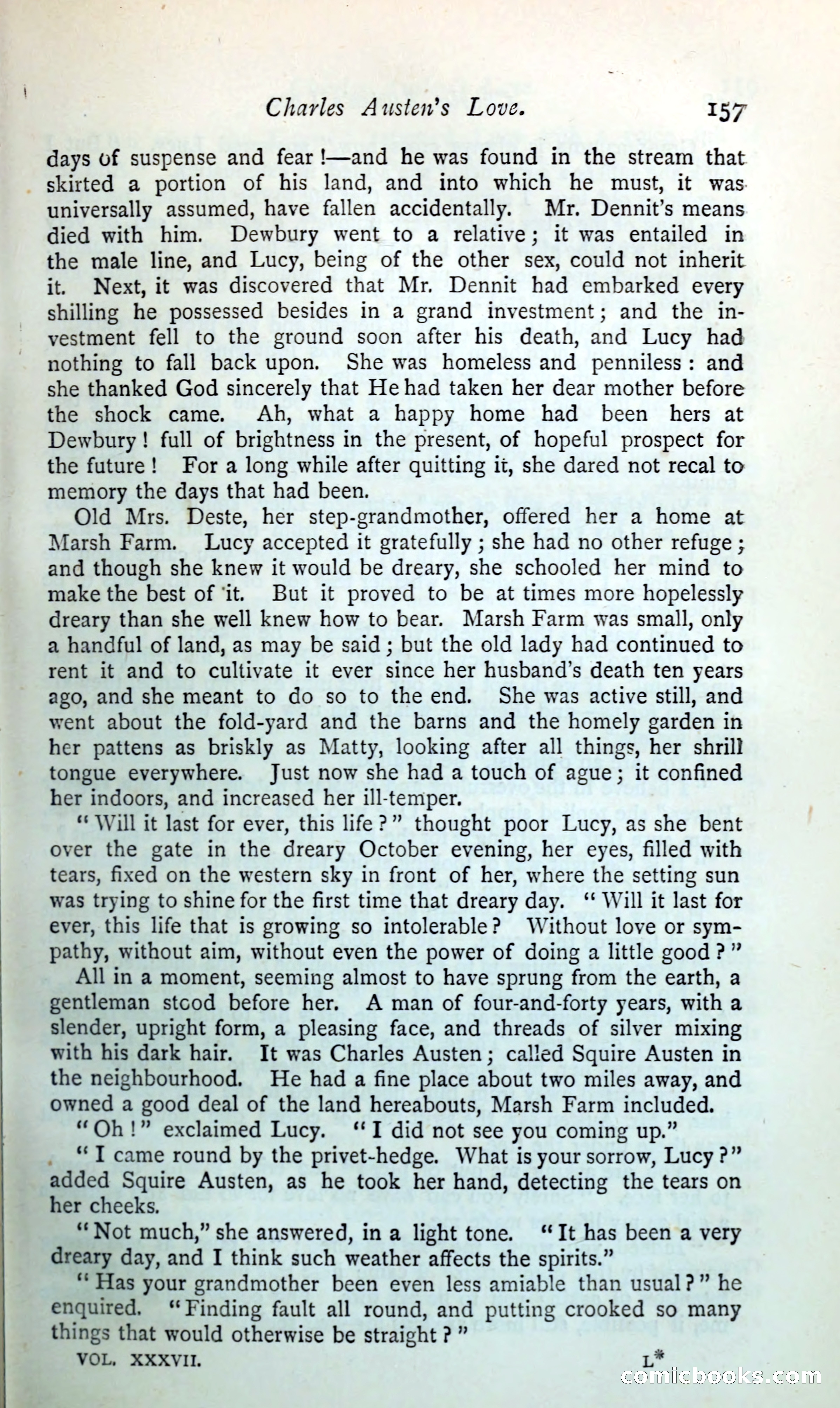
A restored page from Pulp Fiction, 1865. Page through the whole issue in the reader above.
📄 Transcribed text from this page (OCR, searchable)
Machine-transcribed from the original scan — historical spelling and the odd misread are preserved.
Charles Austen’s Love. 157 days of suspense and fear !—and he was found in the stream that _ skirted a portion of his land, and into which he must, it was. universally assumed, have fallen accidentally. Mr. Dennit’s means died with him. Dewbury went to a relative; it was entailed in the male line, and Lucy, being of the other sex, could not inherit it. Next, it was discovered that Mr. Dennit had embarked every shilling he possessed besides in a grand investment; and the in- vestment fell to the ground soon after his death, and Lucy had nothing to fall back upon. She was homeless and penniless: and she thanked God sincerely that He had taken her dear mother before the shock came. Ah, what a happy home had been hers at Dewbury ! full of brightness in the present, of hopeful prospect for the future! For a long while after quitting it, she dared not recal to memory the days that had been. Old Mrs. Deste, her step-grandmother, offered her a home at Marsh Farm. Lucy accepted it gratefully ; she had no other refuge ; and though she knew it would be dreary, she schooled her mind to make the best of ‘it. But it proved to be at times more hopelessly dreary than she well knew how to bear. Marsh Farm was small, only a handful of land, as may be said; but the old lady had continued to rent it and to cultivate it ever since her husband’s death ten years ago, and she meant to do so to the end. She was active still, and went about the fold-yard and the barns and the homely garden in her pattens as briskly as Matty, looking after all things, her shrill tongue everywhere. Just now she had a touch of ague; it confined her indoors, and increased her ill-temper. Will it last for ever, this life?” thought poor Lucy, as she bent over the gate in the dreary October evening, her eyes, filled with tears, fixed on the western sky in front of her, where the setting sun was trying to shine for the first time that dreary day. ‘ Will it last for ever, this life that is growing so intolerable? Without love or sym- pathy, without aim, without even the power of doing a little good ?” All in a moment, seeming almost to have sprung from the earth, a gentleman stcod before her. A man of four-and-forty years, with a slender, upright form, a pleasing face, and threads of silver mixing with his dark hair. It was Charles Austen; called Squire Austen in the neighbourhood. He had a fine place about two miles away, and owned a good deal of the land hereabouts, Marsh Farm included. “Oh!” exclaimed Lucy. ‘I did not see you coming up.” “IT came round by the privet-hedge. What is your sorrow, Lucy ?” added Squire Austen, as he took her hand, detecting the tears on her cheeks, “Not much,” she answered, in a light tone. ‘It has been a very dreary day, and I think such weather affects the spirits.” “ Has your grandmother been even less amiable than usual?” he enquired, “Finding fault all round, and putting crooked so many things that would otherwise be straight ? ” VOL, XXXVII. hy (OMANI NOVO KS (E(@) m