
Pulp Fiction, 1865 · page 132 of 400
The Argosy — page 132: what you’re looking at
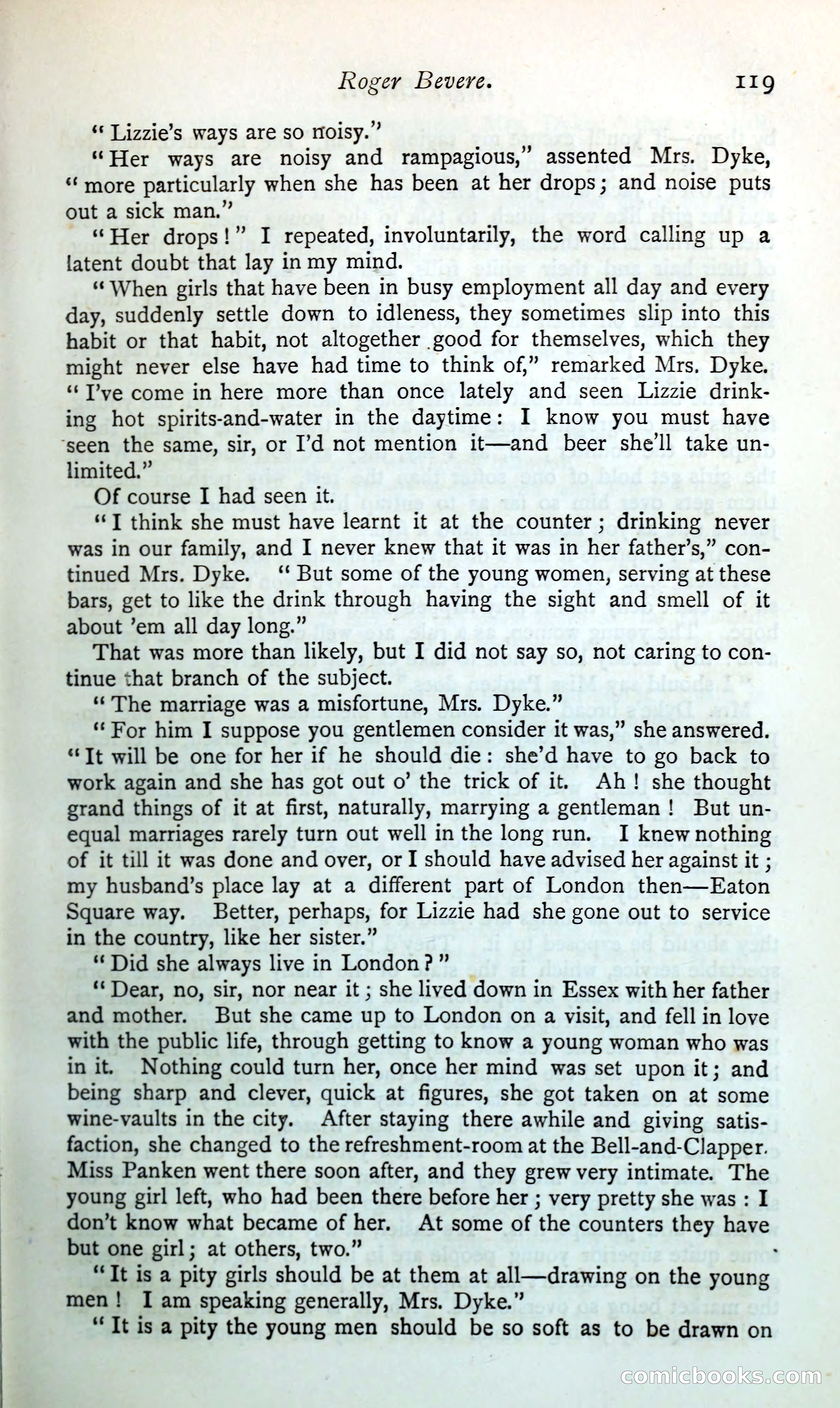
A restored page from Pulp Fiction, 1865. Page through the whole issue in the reader above.
📄 Transcribed text from this page (OCR, searchable)
Machine-transcribed from the original scan — historical spelling and the odd misread are preserved.
Roger Bevere. IIg ‘“‘ Tizzie’s ways are sO noisy.” “Her ways are noisy and rampagious,” assented Mrs. Dyke, ‘¢ more particularly when she has been at her drops; and noise puts out a sick man.” “Her drops!” I repeated, involuntarily, the word calling up a latent doubt that lay in my mind. “When girls that have been in busy employment all day and every day, suddenly settle down to idleness, they sometimes slip into this habit or that habit, not altogether good for themselves, which they might never else have had time to think of,” remarked Mrs. Dyke. ‘‘T’ye come in here more than once lately and seen Lizzie drink- ing hot spirits-and-water in the daytime: I know you must have ‘seen the same, sir, or I’d not mention it—and beer she'll take un- limited.” Of course I had seen it. ‘‘T think she must have learnt it at the counter; drinking never was in our family, and I never knew that it was in her father’s,” con- tinued Mrs. Dyke. ‘‘ But some of the young women, serving at these bars, get to like the drink through having the sight and smell of it about ’em all day long.” That was more than likely, but I did not say so, not caring to con- tinue that branch of the subject. ‘The marriage was a misfortune, Mrs. Dyke.” ‘For him I suppose you gentlemen consider it was,” she answered. “Tt will be one for her if he should die: she’d have to go back to work again and she has got out o’ the trick of it. Ah! she thought grand things of it at first, naturally, marrying a gentleman! But un- equal marriages rarely turn out well inthe long run. I knew nothing of it till it was done and over, or I should have advised her against it ; my husband’s place lay at a different part of London then—Eaton Square way. Better, perhaps, for Lizzie had she gone out to service in the country, like her sister.” ‘Did she always live in London?” ** Dear, no, sir, nor near it ; she lived down in Essex with her father and mother. But she came up to London on a visit, and fell in love with the public life, through getting to know a young woman who was in it. Nothing could turn her, once her mind was set upon it; and being sharp and clever, quick at figures, she got taken on at some wine-vaults in the city. After staying there awhile and giving satis- faction, she changed to the refreshment-room at the Bell-and-Clapper. Miss Panken went there soon after, and they grew very intimate. The young girl left, who had been there before her ; very pretty she was: I don’t know what became of her. At some of the counters they have but one girl; at others, two.” “It is a pity girls should be at them at all—drawing on the young men! I am speaking generally, Mrs. Dyke.” “It is a pity the young men should be so soft as to be drawn on EONMICIOOKS,eCO m