
Pulp Fiction, 1865 · page 131 of 400
The Argosy — page 131: what you’re looking at
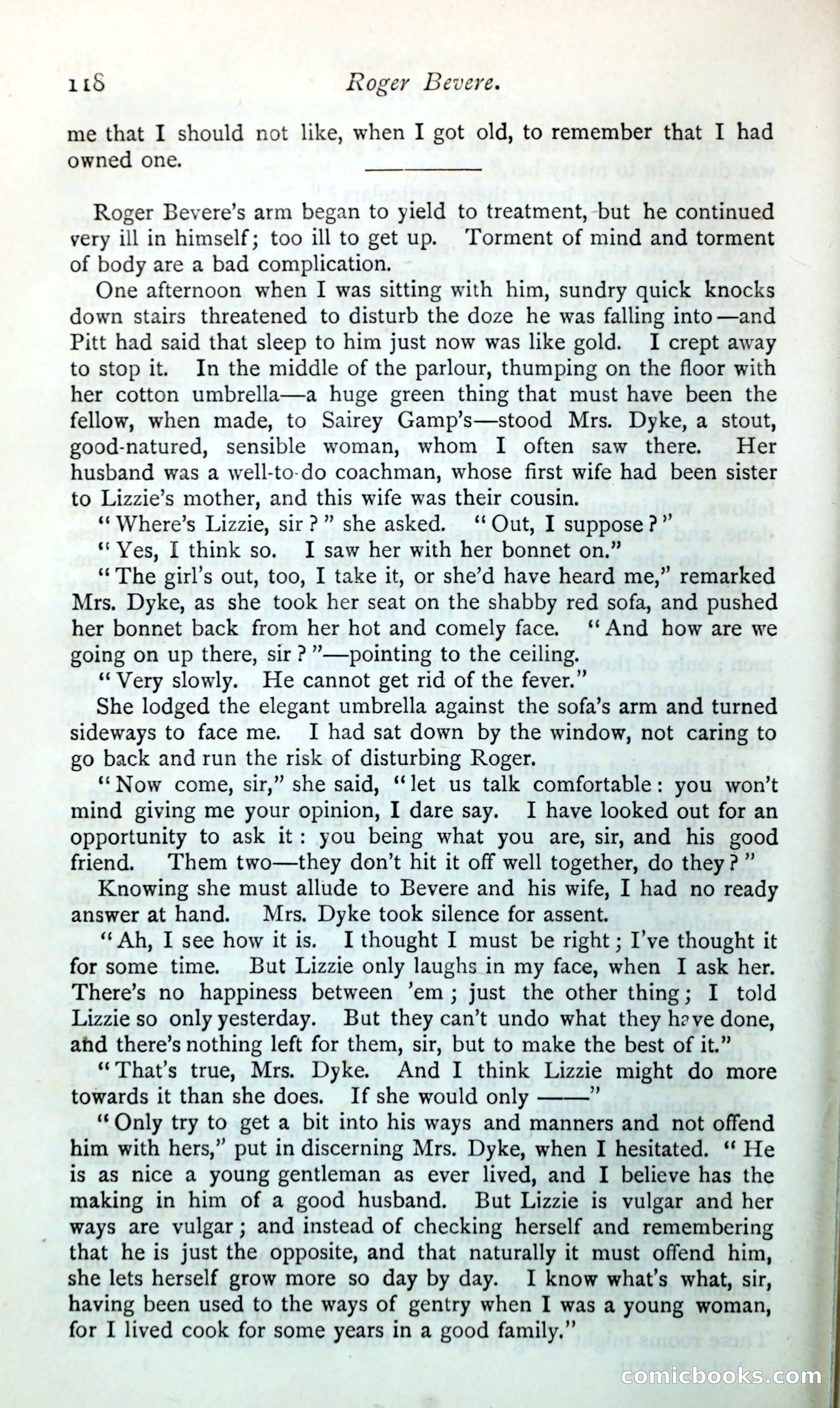
A restored page from Pulp Fiction, 1865. Page through the whole issue in the reader above.
📄 Transcribed text from this page (OCR, searchable)
Machine-transcribed from the original scan — historical spelling and the odd misread are preserved.
115 Roger Bevere. me that I should not like, when I got old, to remember that I had owned one. ———_—_ —— Roger Bevere’s arm began to yield to treatment, but he continued very ill in himself; too ill to get up. Torment of mind and torment of body are a bad complication. One afternoon when I was sitting with him, sundry quick knocks down stairs threatened to disturb the doze he was falling into—and Pitt had said that sleep to him just now was like gold. I crept away to stop it. In the middle of the parlour, thumping on the floor with her cotton umbrella—a huge green thing that must have been the fellow, when made, to Sairey Gamp’s—stood Mrs. Dyke, a stout, good-natured, sensible woman, whom I often saw there. Her husband was a well-to-do coachman, whose first wife had been sister to Lizzie’s mother, and this wife was their cousin. ‘‘Where’s Lizzie, sir?” she asked. ‘Out, I suppose?” ‘Yes, I think so. I saw her with her bonnet on.” ‘The girl’s out, too, I take it, or she’d have heard me,” remarked Mrs. Dyke, as she took her seat on the shabby red sofa, and pushed her bonnet back from her hot and comely face. ‘‘And how are we going on up there, sir ?”—pointing to the ceiling. ‘Very slowly. He cannot get rid of the fever.” She lodged the elegant umbrella against the sofa’s arm and turned sideways to face me. I had sat down by the window, not caring to go back and run the risk of disturbing Roger. ‘* Now come, sir,” she said, ‘‘let us talk comfortable: you won’t mind giving me your opinion, I dare say. I have looked out for an opportunity to ask it: you being what you are, sir, and his good friend. Them two—they don’t hit it off well together, do they ? ” Knowing she must allude to Bevere and his wife, I had no ready answer at hand. Mrs. Dyke took silence for assent. “Ah, I see how it is. Ithought I must be right; I’ve thought it forsome time. But Lizzie only laughs in my face, when I ask her. There’s no happiness between ’em ; just the other thing; I told Lizzie so only yesterday. But they can’t undo what they heve done, ahd there’s nothing left for them, sir, but to make the best of it.” “That's true, Mrs. Dyke. And I think Lizzie might do more towards it than she does. If she would only . ‘Only try to get a bit into his ways and manners and not offend him with hers,” put in discerning Mrs. Dyke, when I hesitated. ‘‘ He Is as nice a young gentleman as ever lived, and I believe has the making in him of a good husband. But Lizzie is vulgar and her ways are vulgar; and instead of checking herself and remembering that he is just the opposite, and that naturally it must offend him, she lets herself grow more so day by day. I know what’s what, sir, having been used to the ways of gentry when I was a young woman, for I lived cook for some years in a good family,” Gomigbooks.;com