
Pulp Fiction, 1865 · page 120 of 400
The Argosy — page 120: what you’re looking at
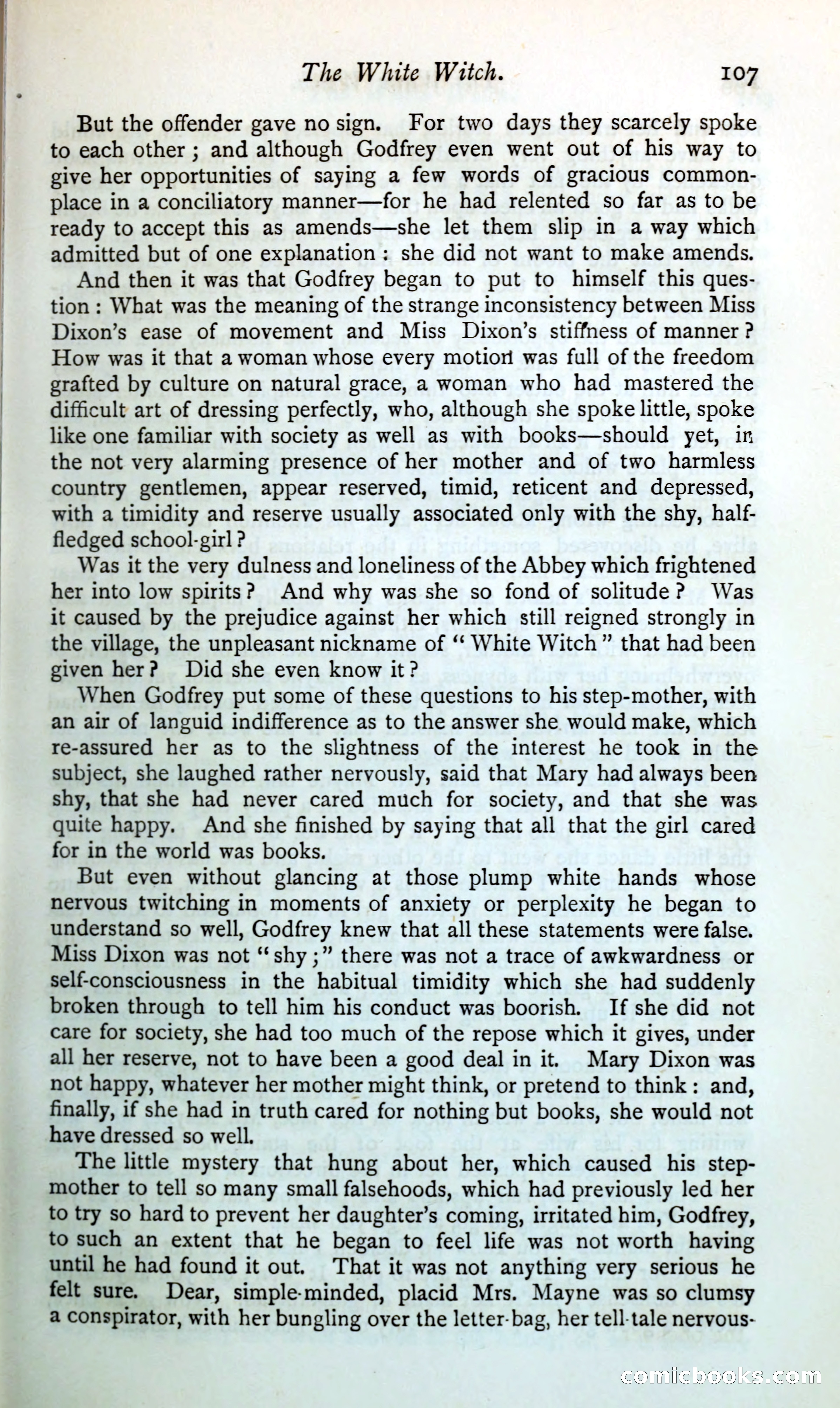
A restored page from Pulp Fiction, 1865. Page through the whole issue in the reader above.
📄 Transcribed text from this page (OCR, searchable)
Machine-transcribed from the original scan — historical spelling and the odd misread are preserved.
The White Witch. 107 But the offender gave nosign. For two days they scarcely spoke to each other ; and although Godfrey even went out of his way to give her opportunities of saying a few words of gracious common- place in a conciliatory manner—for he had relented so far as to be ready to accept this as amends—she let them slip in a way which admitted but of one explanation: she did not want to make amends. And then it was that Godfrey began to put to himself this ques- tion: What was the meaning of the strange inconsistency between Miss Dixon’s ease of movement and Miss Dixon’s stiffness of manner? How was it that a woman whose every motion was full of the freedom grafted by culture on natural grace, a woman who had mastered the difficult art of dressing perfectly, who, although she spoke little, spoke like one familiar with society as well as with books—should yet, in the not very alarming presence of her mother and of two harmless country gentlemen, appear reserved, timid, reticent and depressed, with a timidity and reserve usually associated only with the shy, half- fledged school-girl ? Was it the very dulness and loneliness of the Abbey which frightened her into low spirits? And why was she so fond of solitude? Was it caused by the prejudice against her which still reigned strongly in the village, the unpleasant nickname of ‘‘ White Witch” that had been given her? Did she even know it? When Godfrey put some of these questions to his step-mother, with an air of languid indifference as to the answer she would make, which re-assured her as to the slightness of the interest he took in the subject, she laughed rather nervously, said that Mary had always been shy, that she had never cared much for society, and that she was quite happy. And she finished by saying that all that the girl cared for in the world was books. But even without glancing at those plump white hands whose nervous twitching in moments of anxiety or perplexity he began to understand so well, Godfrey knew that all these statements were false. Miss Dixon was not “shy ;” there was not a trace of awkwardness or self-consciousness in the habitual timidity which she had suddenly broken through to tell him his conduct was boorish. If she did not care for society, she had too much of the repose which it gives, under all her reserve, not to have been a good deal in it. Mary Dixon was not happy, whatever her mother might think, or pretend to think: and, finally, if she had in truth cared for nothing but books, she would not have dressed so well. The little mystery that hung about her, which caused his step- mother to tell so many small falsehoods, which had previously led her to try so hard to prevent her daughter’s coming, irritated him, Godfrey, to such an extent that he began to feel life was not worth having until he had found it out. That it was not anything very serious he felt sure. Dear, simple-minded, placid Mrs. Mayne was so clumsy a conspirator, with her bungling over the letter-bag, her tell-tale nervous- CONMIEIOOKS (E@) m