
Pulp Fiction, 1865 · page 40 of 399
The Argosy — page 40: what you’re looking at
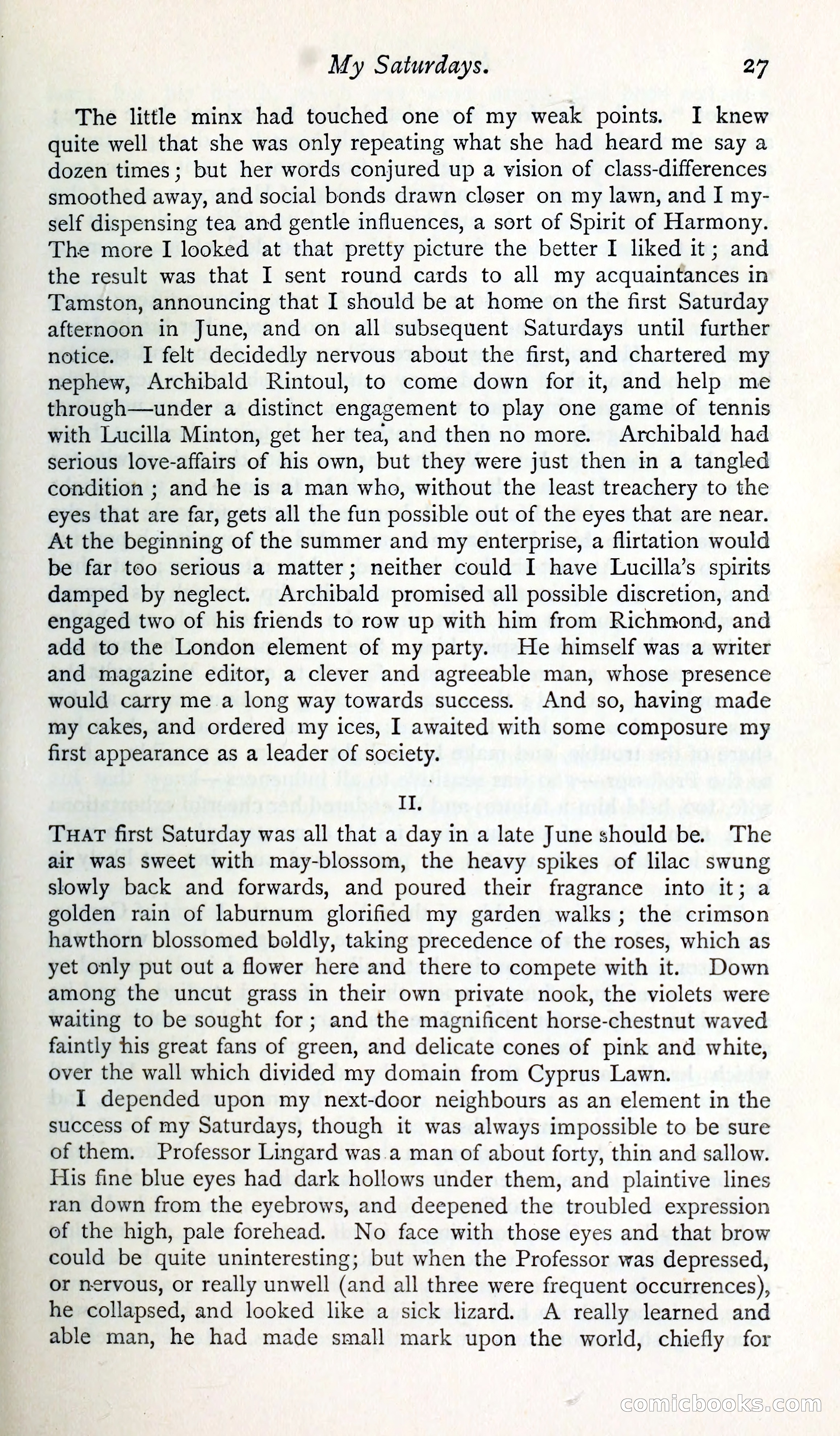
A restored page from Pulp Fiction, 1865. Page through the whole issue in the reader above.
📄 Transcribed text from this page (OCR, searchable)
Machine-transcribed from the original scan — historical spelling and the odd misread are preserved.
My Saturdays. 27 The little minx had touched one of my weak points. I knew quite well that she was only repeating what she had heard me say a dozen times; but her words conjured up a vision of class-differences smoothed away, and social bonds drawn closer on my lawn, and I my- self dispensing tea and gentle influences, a sort of Spirit of Harmony. The more I looked at that pretty picture the better I liked it; and the result was that I sent round cards to all my acquaintances in Tamston, announcing that I should be at home on the first Saturday afternoon in June, and on all subsequent Saturdays until further notice. I felt decidedly nervous about the first, and chartered my nephew, Archibald Rintoul, to come down for it, and help me through—under a distinct engagement to play one game of tennis with Lucilla Minton, get her tea, and then no more. Archibald had serious love-affairs of his own, but they were just then in a tangled condition ; and he is a man who, without the least treachery to the eyes that are far, gets all the fun possible out of the eyes that are near. At the beginning of the summer and my enterprise, a flirtation would be far too serious a matter; neither could I have Lucilla’s spirits damped by neglect. Archibald promised all possible discretion, and engaged two of his friends to row up with him from Richmond, and add to the London element of my party. He himself was a writer and magazine editor, a clever and agreeable man, whose presence would carry me a long way towards success. And so, having made my cakes, and ordered my ices, I awaited with some composure my first appearance as a leader of society. Li; Tuat first Saturday was all that a day in a late June should be. The air was sweet with may-blossom, the heavy spikes of lilac swung slowly back and forwards, and poured their fragrance into it; a golden rain of laburnum glorified my garden walks; the crimson hawthorn blossomed boldly, taking precedence of the roses, which as yet only put out a flower here and there to compete with it. Down among the uncut grass in their own private nook, the violets were waiting to be sought for; and the magnificent horse-chestnut waved faintly his great fans of green, and delicate cones of pink and white, over the wall which divided my domain from Cyprus Lawn. I depended upon my next-door neighbours as an element in the success of my Saturdays, though it was always impossible to be sure of them. Professor Lingard was.a man of about forty, thin and sallow. His fine blue eyes had dark hollows under them, and plaintive lines ran down from the eyebrows, and deepened the troubled expression of the high, pale forehead. No face with those eyes and that brow could be quite uninteresting; but when the Professor was depressed, or nervous, or really unwell (and all three were frequent occurrences), he collapsed, and looked like a sick lizard. A really learned and able man, he had made small mark upon the world, chiefly for GOnlGpoolks (CO)