
Pulp Fiction, 1865 · page 348 of 399
The Argosy — page 348: what you’re looking at
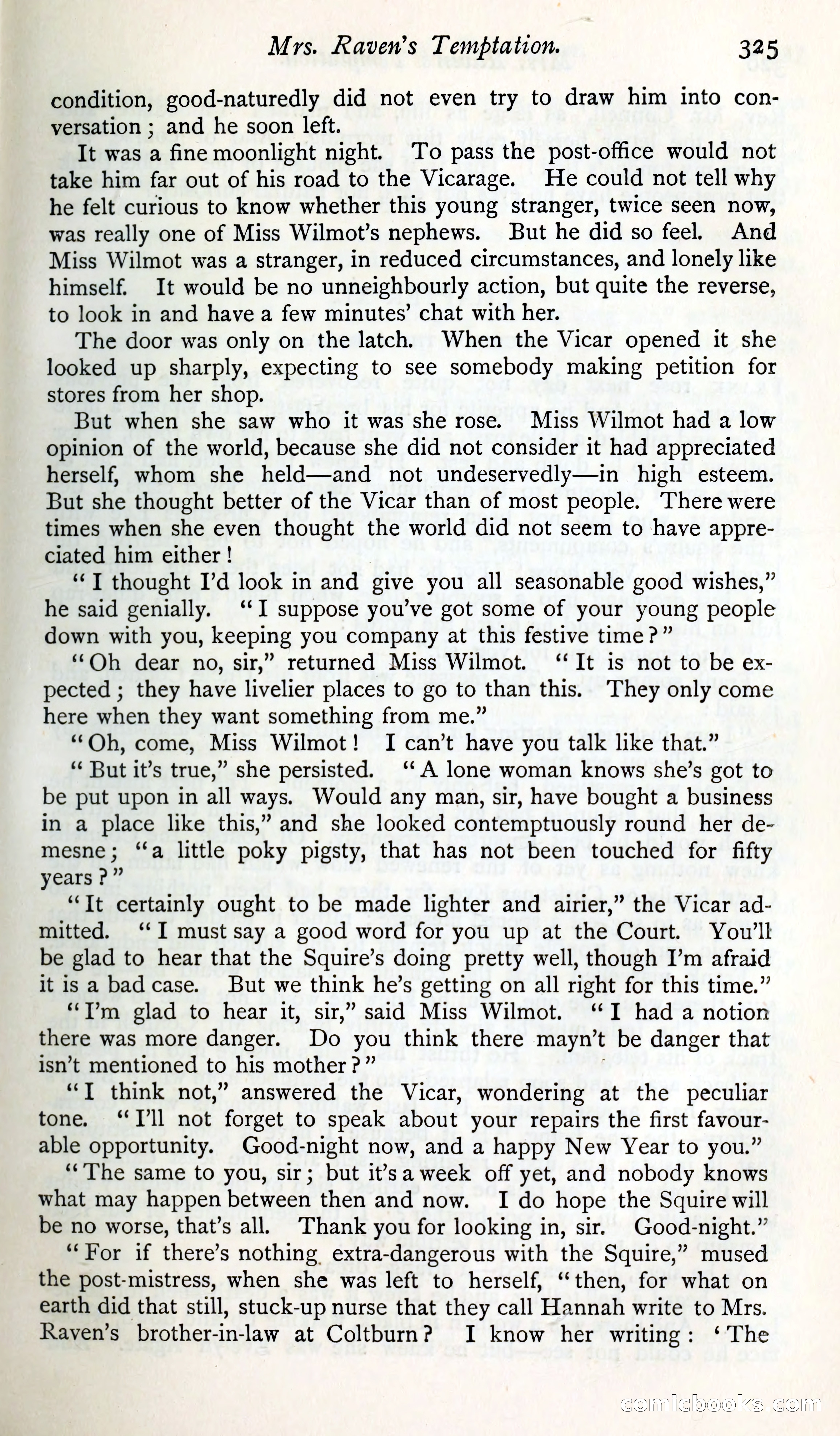
A restored page from Pulp Fiction, 1865. Page through the whole issue in the reader above.
📄 Transcribed text from this page (OCR, searchable)
Machine-transcribed from the original scan — historical spelling and the odd misread are preserved.
Mrs. Raven’s Temptation. 325 condition, good-naturedly did not even try to draw him into con- versation ; and he soon left. It was a fine moonlight night. ‘To pass the post-office would not take him far out of his road to the Vicarage. He could not tell why he felt curious to know whether this young stranger, twice seen now, was really one of Miss Wilmot’s nephews. But he did so feel. And Miss Wilmot was a stranger, in reduced circumstances, and lonely like himself. It would be no unneighbourly action, but quite the reverse, to look in and have a few minutes’ chat with her. The door was only on the latch. When the Vicar opened it she looked up sharply, expecting to see somebody making petition for stores from her shop. But when she saw who it was she rose. Miss Wilmot had a low opinion of the world, because she did not consider it had appreciated herself, whom she held—and not undeservedly—in high esteem. But she thought better of the Vicar than of most people. There were times when she even thought the world did not seem to have appre- ciated him either! ‘¢T thought I’d look in and give you all seasonable good wishes,” he said genially. ‘‘I suppose you’ve got some of your young people down with you, keeping you company at this festive time?” ‘Oh dear no, sir,” returned Miss Wilmot. ‘It is not to be ex- pected ; they have livelier places to go to than this. They only come here when they want something from me.” ‘Oh, come, Miss Wilmot! I can’t have you talk like that.” ‘‘ But it’s true,” she persisted. ‘‘A lone woman knows she’s got to be put upon in all ways. Would any man, sir, have bought a business in a place like this,” and she looked contemptuously round her de- mesne; ‘“‘a little poky pigsty, that has not been touched for fifty years P” “Tt certainly ought to be made lighter and airier,” the Vicar ad- mitted. ‘‘I must say a good word for you up at the Court. You'll be glad to hear that the Squire’s doing pretty well, though I’m afraid itis a badcase. But we think he’s getting on all right for this time.” “T’m glad to hear it, sir,” said Miss Wilmot. “TI had a notion there was more danger. Do you think there mayn’t be danger that isn’t mentioned to his mother ?” | “T think not,” answered the Vicar, wondering at the peculiar tone. “I'll not forget to speak about your repairs the first favour- able opportunity. Good-night now, and a happy New Year to you.” ‘““The same to you, sir; but it’sa week off yet, and nobody knows what may happen between then and now. I do hope the Squire will be no worse, that’s all. Thank you for looking in, sir. Good-night.” “For if there’s nothing extra-dangerous with the Squire,” mused the post-mistress, when she was left to herself, “then, for what on earth did that still, stuck-up nurse that they call Hannah write to Mrs. Kaven’s brother-in-law at Coltburn? I know her writing: ‘The GOnlGaooks (GO mn