
Pulp Fiction, 1865 · page 347 of 399
The Argosy — page 347: what you’re looking at
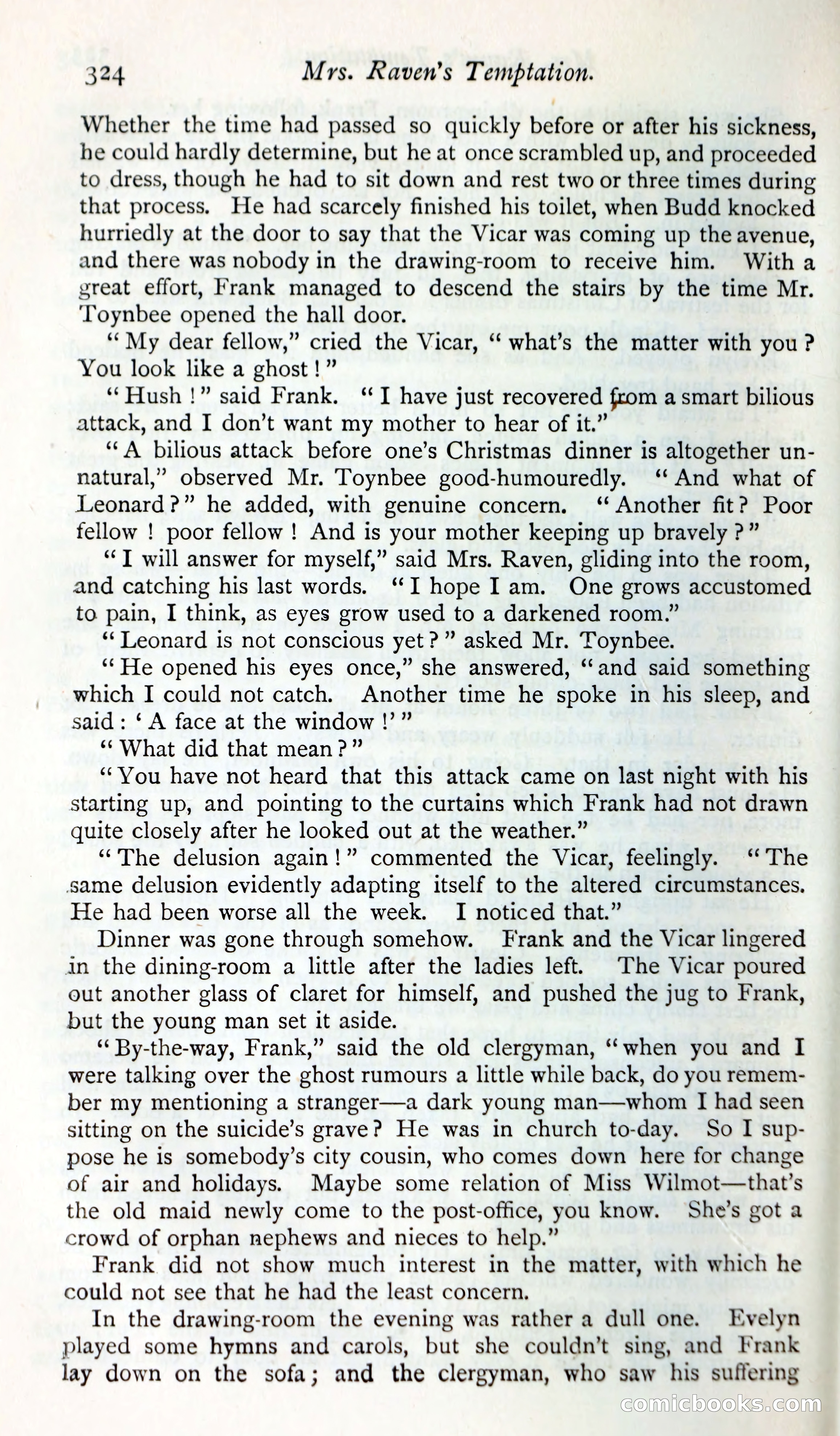
A restored page from Pulp Fiction, 1865. Page through the whole issue in the reader above.
📄 Transcribed text from this page (OCR, searchable)
Machine-transcribed from the original scan — historical spelling and the odd misread are preserved.
324 Mrs. Raven’s Temptation. Whether the time had passed so quickly before or after his sickness, he could hardly determine, but he at once scrambled up, and proceeded to dress, though he had to sit down and rest two or three times during that process. He had scarcely finished his toilet, when Budd knocked hurriedly at the door to say that the Vicar was coming up the avenue, and there was nobody in the drawing-room to receive him. With a great effort, Frank managed to descend the stairs by the time Mr. ‘Toynbee opened the hall door. ‘My dear fellow,” cried the Vicar, ‘‘ what’s the matter with you P You look like a ghost!” ‘Hush !” said Frank. ‘I have just recovered from a smart bilious attack, and I don’t want my mother to hear of it.” ‘‘A bilious attack before one’s Christmas dinner is altogether un- natural,” observed Mr. Toynbee good-humouredly. ‘‘ And what of Leonard?” he added, with genuine concern. ‘ Another fit? Poor fellow ! poor fellow! And is your mother keeping up bravely ?” “‘T will answer for myself,” said Mrs. Raven, gliding into the room, and catching his last words. ‘I hope Iam. One grows accustomed to pain, I think, as eyes grow used to a darkened room.” ‘Leonard is not conscious yet ?” asked Mr. Toynbee. ‘““He opened his eyes once,” she answered, ‘‘and said something which I could not catch. Another time he spoke in his sleep, and said: ‘ A face at the window !’” | ‘What did that mean?” ‘You have not heard that this attack came on last night with his starting up, and pointing to the curtains which Frank had not drawn quite closely after he looked out at the weather.” “The delusion again!” commented the Vicar, feelingly. ‘‘ The same delusion evidently adapting itself to the altered circumstances. He had been worse all the week. I noticed that.” Dinner was gone through somehow. Frank and the Vicar lingered in the dining-room a little after the ladies left. The Vicar poured out another glass of claret for himself, and pushed the jug to Frank, but the young man set it aside. ‘“‘ By-the-way, Frank,” said the old clergyman, “when you and I were talking over the ghost rumours a little while back, do you remem- ber my mentioning a stranger—a dark young man—whom I had seen sitting on the suicide’s grave? He was in church to-day. So I sup- pose he is somebody’s city cousin, who comes down here for change of air and holidays. Maybe some relation of Miss Wilmot—that’s the old maid newly come to the post-office, you know. She’s got a crowd of orphan nephews and nieces to help.” Frank did not show much interest in the matter, with which he could not see that he had the least concern. In the drawing-room the evening was rather a dull one. Evelyn played some hymns and carols, but she couldn’t sing, and Frank lay down on the sofa; and the clergyman, who saw his suffering ECOPMICMDOO; KS, EO)