
Pulp Fiction, 1865 · page 317 of 400
The Argosy — page 317: what you’re looking at
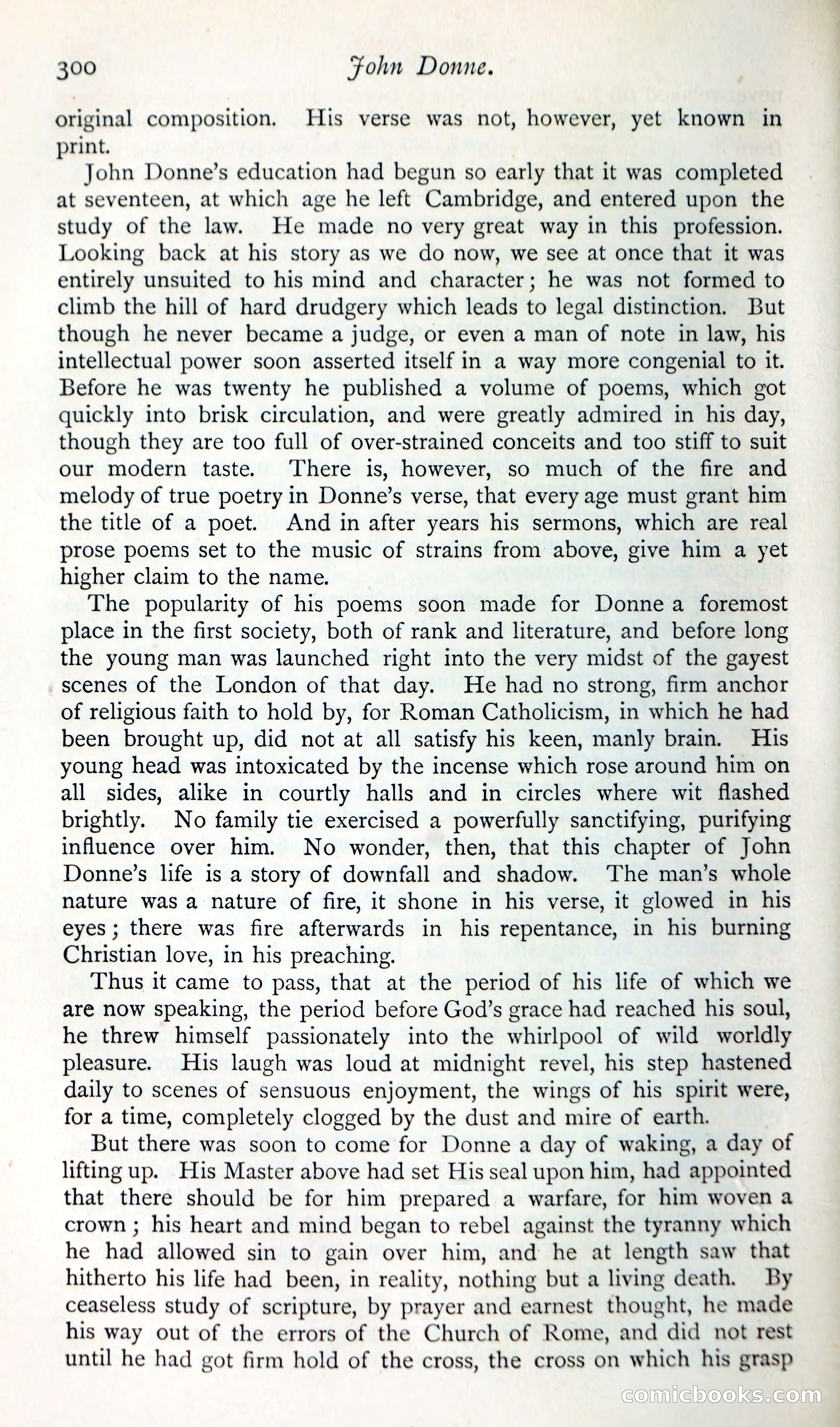
A restored page from Pulp Fiction, 1865. Page through the whole issue in the reader above.
📄 Transcribed text from this page (OCR, searchable)
Machine-transcribed from the original scan — historical spelling and the odd misread are preserved.
300 Fohn Donne. original composition. His verse was not, however, yet known in print. John Donne’s education had begun so early that it was completed at seventeen, at which age he left Cambridge, and entered upon the study of the law. He made no very great way in this profession. Looking back at his story as we do now, we see at once that it was entirely unsuited to his mind and character; he was not formed to climb the hill of hard drudgery which leads to legal distinction. But though he never became a judge, or even a man of note in law, his intellectual power soon asserted itself in a way more congenial to it. Before he was twenty he published a volume of poems, which got quickly into brisk circulation, and were greatly admired in his day, though they are too full of over-strained conceits and too stiff to suit our modern taste. There is, however, so much of the fire and melody of true poetry in Donne’s verse, that every age must grant him the title of a poet. And in after years his sermons, which are real prose poems set to the music of strains from above, give him a yet higher claim to the name. The popularity of his poems soon made for Donne a foremost place in the first society, both of rank and literature, and before long the young man was launched right into the very midst of the gayest scenes of the London of that day. He had no strong, firm anchor of religious faith to hold by, for Roman Catholicism, in which he had been brought up, did not at all satisfy his keen, manly brain. His young head was intoxicated by the incense which rose around him on all sides, alike in courtly halls and in circles where wit flashed brightly. No family tie exercised a powerfully sanctifying, purifying influence over him. No wonder, then, that this chapter of John Donne’s life is a story of downfall and shadow. ‘The man’s whole nature was a nature of fire, it shone in his verse, it glowed in his eyes; there was fire afterwards in his repentance, in his burning Christian love, in his preaching. Thus it came to pass, that at the period of his life of which we are now speaking, the period before God’s grace had reached his soul, he threw himself passionately into the whirlpool of wild worldly pleasure. His laugh was loud at midnight revel, his step hastened daily to scenes of sensuous enjoyment, the wings of his spirit were, for a time, completely clogged by the dust and mire of earth. But there was soon to come for Donne a day of waking, a day of lifting up. His Master above had set His seal upon him, had appointed that there should be for him prepared a warfare, for him woven a crown ; his heart and mind began to rebel against the tyranny which he had allowed sin to gain over him, and he at length saw that hitherto his life had been, in reality, nothing but a living death. By ceaseless study of scripture, by prayer and earnest thought, he made his way out of the errors of the Church of Rome, and did not rest until he had got firm hold of the cross, the cross on which his grasp COMIC MOO; KS, (E00)