
Pulp Fiction, 1865 · page 316 of 400
The Argosy — page 316: what you’re looking at
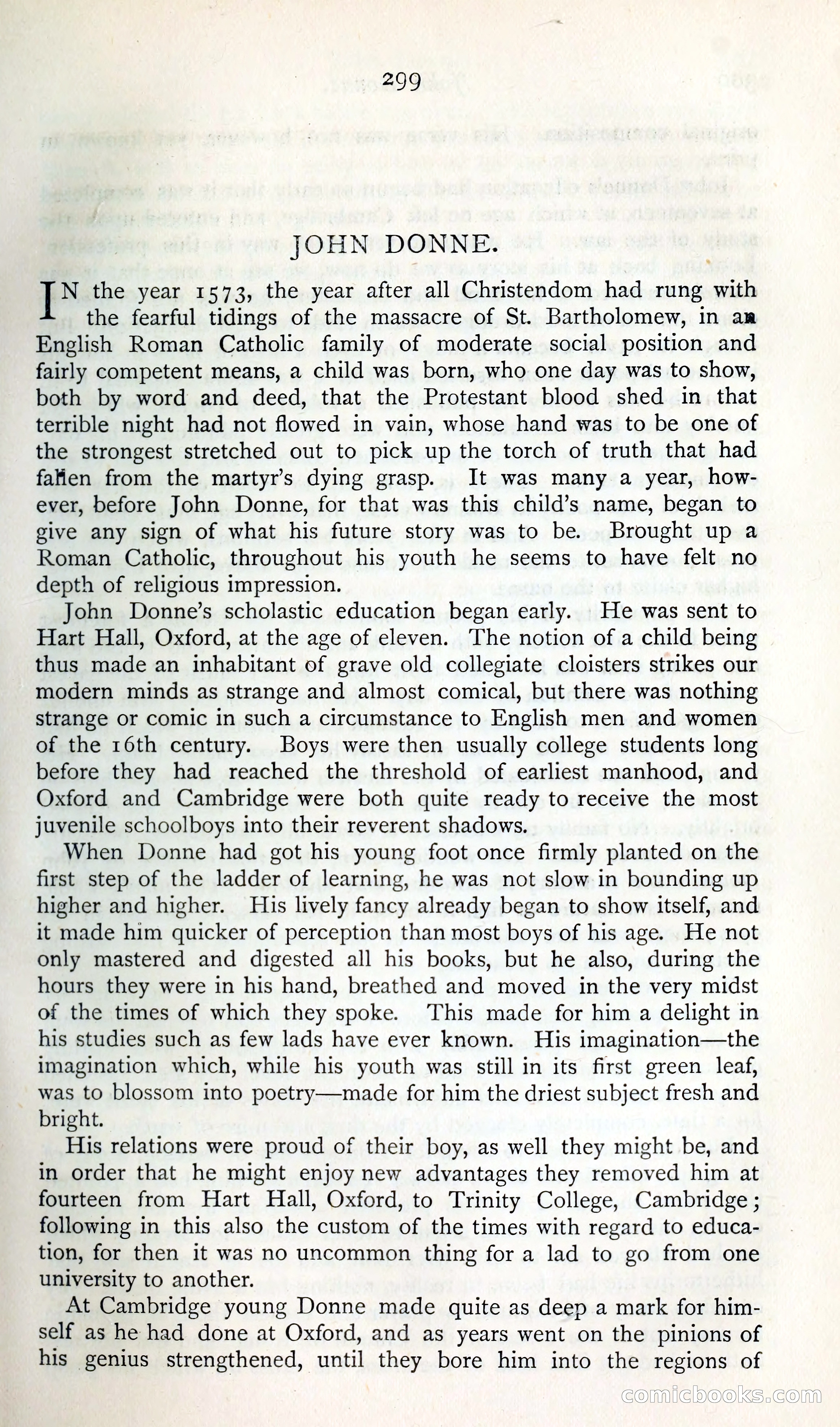
A restored page from Pulp Fiction, 1865. Page through the whole issue in the reader above.
📄 Transcribed text from this page (OCR, searchable)
Machine-transcribed from the original scan — historical spelling and the odd misread are preserved.
299 JOHN DONNE. i the year 1573, the year after all Christendom had rung with the fearful tidings of the massacre of St. Bartholomew, in an English Roman Catholic family of moderate social position and fairly competent means, a child was born, who one day was to show, both by word and deed, that the Protestant blood shed in that terrible night had not flowed in vain, whose hand was to be one of the strongest stretched out to pick up the torch of truth that had fafien from the martyr’s dying grasp. It was many a year, how- ever, before John Donne, for that was this child’s name, began to give any sign of what his future story was to be. Brought up a Roman Catholic, throughout his youth he seems to have felt no depth of religious impression. John Donne’s scholastic education began early. He was sent to Hart Hall, Oxford, at the age of eleven. The notion of a child being thus made an inhabitant of grave old collegiate cloisters strikes our modern minds as strange and almost comical, but there was nothing strange or comic in such a circumstance to English men and women of the 16th century. Boys were then usually college students long before they had reached the threshold of earliest manhood, and Oxford and Cambridge were both quite ready to receive the most juvenile schoolboys into their reverent shadows. When Donne had got his young foot once firmly planted on the first step of the ladder of learning, he was not slow in bounding up higher and higher. His lively fancy already began to show itself, and it made him quicker of perception than most boys of his age. He not only mastered and digested all his books, but he also, during the hours they were in his hand, breathed and moved in the very midst of the times of which they spoke. This made for him a delight in his studies such as few lads have ever known. His imagination—the imagination which, while his youth was still in its first green leaf, was to blossom into poetry—made for him the driest subject fresh and bright. His relations were proud of their boy, as well they might be, and in order that he might enjoy new advantages they removed him at fourteen from Hart Hall, Oxford, to Trinity College, Cambridge ; following in this also the custom of the times with regard to educa- tion, for then it was no uncommon thing for a lad to go from one university to another. At Cambridge young Donne made quite as deep a mark for him- self as he had done at Oxford, and as years went on the pinions of his genius strengthened, until they bore him into the regions of ECORnNIClOOkKS (CO)