
Pulp Fiction, 1865 · page 157 of 400
The Argosy — page 157: what you’re looking at
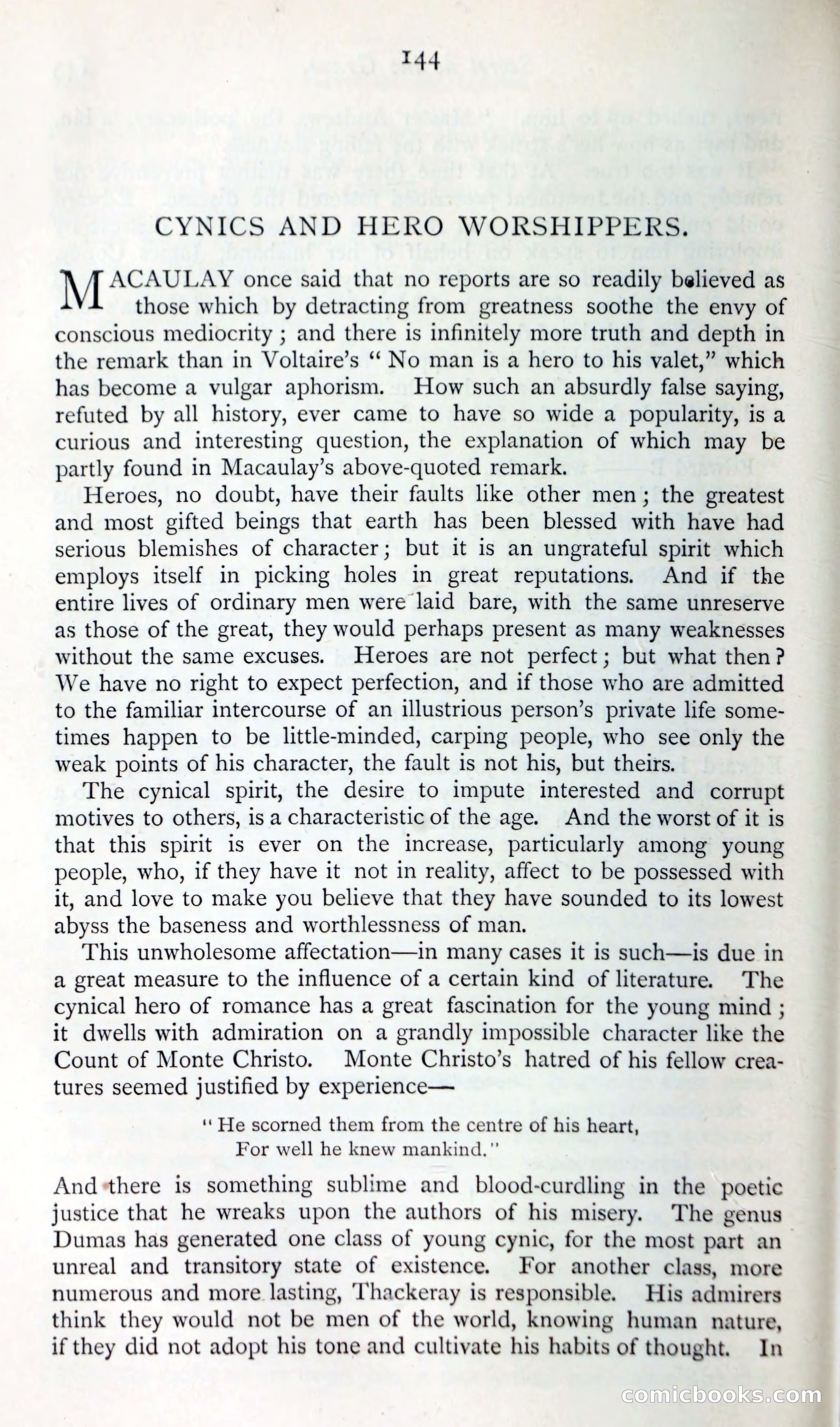
A restored page from Pulp Fiction, 1865. Page through the whole issue in the reader above.
📄 Transcribed text from this page (OCR, searchable)
Machine-transcribed from the original scan — historical spelling and the odd misread are preserved.
144 CYNICS AND HERO WORSHIPPERS. ANY Reppricte ty ore once said that no reports are so readily believed as those which by detracting from greatness soothe the envy of conscious mediocrity ; and there is infinitely more truth and depth in the remark than in Voltaire’s ‘‘ No man is a hero to his valet,” which has become a vulgar aphorism. How such an absurdly false saying, refuted by all history, ever came to have so wide a popularity, is a curious and interesting question, the explanation of which may be partly found in Macaulay’s above-quoted remark. Heroes, no doubt, have their faults like other men; the greatest and most gifted beings that earth has been blessed with have had serious blemishes of character; but it 1s an ungrateful spirit which employs itself in picking holes in great reputations. And if the entire lives of ordinary men were laid bare, with the same unreserve as those of the great, they would perhaps present as many weaknesses without the same excuses. Heroes are not perfect; but what then? We have no right to expect perfection, and if those who are admitted to the familiar intercourse of an illustrious person’s private life some- times happen to be little-minded, carping people, who see only the weak points of his character, the fault is not his, but theirs. The cynical spirit, the desire to impute interested and corrupt motives to others, is a characteristic of the age. And the worst of it is that this spirit is ever on the increase, particularly among young people, who, if they have it not in reality, affect to be possessed with it, and love to make you believe that they have sounded to its lowest abyss the baseness and worthlessness of man. This unwholesome affectation—in many cases it is such—is due in a great measure to the influence of a certain kind of literature. The cynical hero of romance has a great fascination for the young mind ; it dwells with admiration on a grandly impossible character like the Count of Monte Christo. Monte Christo’s hatred of his fellow crea- tures seemed justified by experience— ‘‘He scorned them from the centre of his heart, For well he knew mankind.” And there is something sublime and blood-curdling in the poetic justice that he wreaks upon the authors of his misery. The genus Dumas has generated one class of young cynic, for the most part an unreal and transitory state of existence. For another class, more numerous and more lasting, Thackeray is responsible. His admirers think they would not be men of the world, knowing human nature, if they did not adopt his tone and cultivate his habits of thought. In EMMI KS, (E00)