
Pulp Fiction, 1865 · page 158 of 400
The Argosy — page 158: what you’re looking at
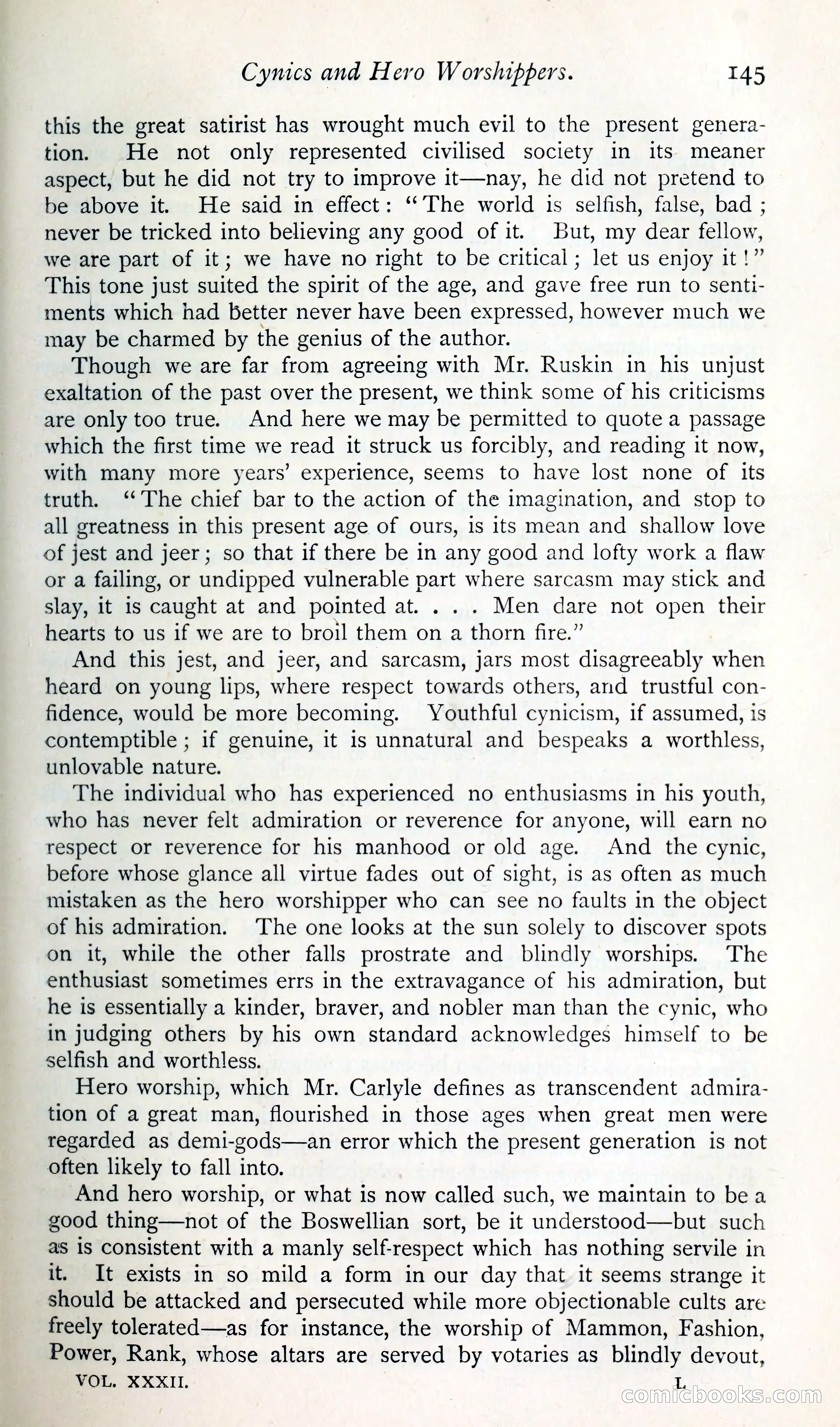
A restored page from Pulp Fiction, 1865. Page through the whole issue in the reader above.
📄 Transcribed text from this page (OCR, searchable)
Machine-transcribed from the original scan — historical spelling and the odd misread are preserved.
Cynics and Hero Worshippers. I45 this the great satirist has wrought much evil to the present genera- tion. He not only represented civilised society in its meaner aspect, but he did not try to improve it—nay, he did not pretend to be above it. He said in effect: ‘‘ The world 1s selfish, false, bad ; never be tricked into believing any good of it. But, my dear fellow, we are part of it; we have no right to be critical; let us enjoy it!” This tone just suited the spirit of the age, and gave free run to senti- ments which had better never have been expressed, however much we may be charmed by the genius of the author. Though we are far from agreeing with Mr. Ruskin in his unjust exaltation of the past over the present, we think some of his criticisms are only too true. And here we may be permitted to quote a passage which the first time we read it struck us forcibly, and reading it now, with many more years’ experience, seems to have lost none of its truth. ‘‘‘The chief bar to the action of the imagination, and stop to all greatness in this present age of ours, 1s its mean and shallow love of jest and jeer; so that if there be in any good and lofty work a flaw or a failing, or undipped vulnerable part where sarcasm may stick and slay, it 1s caught at and pointed at... . Men dare not open their hearts to us if we are to broil them on a thorn fire.” And this jest, and jeer, and sarcasm, jars most disagreeably when heard on young lips, where respect towards others, and trustful con- fidence, would be more becoming. Youthful cynicism, if assumed, is contemptible ; if genuine, it 1s unnatural and bespeaks a worthless, unlovable nature. The individual who has experienced no enthusiasms in his youth, who has never felt admiration or reverence for anyone, will earn no respect or reverence for his manhood or old age. And the cynic, before whose glance all virtue fades out of sight, 1s as often as much mistaken as the hero worshipper who can see no faults in the object of his admiration. ‘The one looks at the sun solely to discover spots on it, while the other falls prostrate and blindly worships. The enthusiast sometimes errs in the extravagance of his admiration, but he is essentially a kinder, braver, and nobler man than the cynic, who in judging others by his own standard acknowledges himself to be selfish and worthless. Hero worship, which Mr. Carlyle defines as transcendent admira- tion of a great man, flourished in those ages when great men were regarded as demi-gods—an error which the present generation is not often likely to fall into. And hero worship, or what is now called such, we maintain to be a good thing—not of the Boswellian sort, be it understood—but such as is consistent with a manly self-respect which has nothing servile in it. It exists in so mild a form in our day that it seems strange it should be attacked and persecuted while more objectionable cults are freely tolerated—as for instance, the worship of Mammon, Fashion, Power, Rank, whose altars are served by votaries as blindly devout, VOL. XXXII. . GOnlGaoOoks mn