
Pulp Fiction, 1865 · page 98 of 400
The Argosy — page 98: what you’re looking at
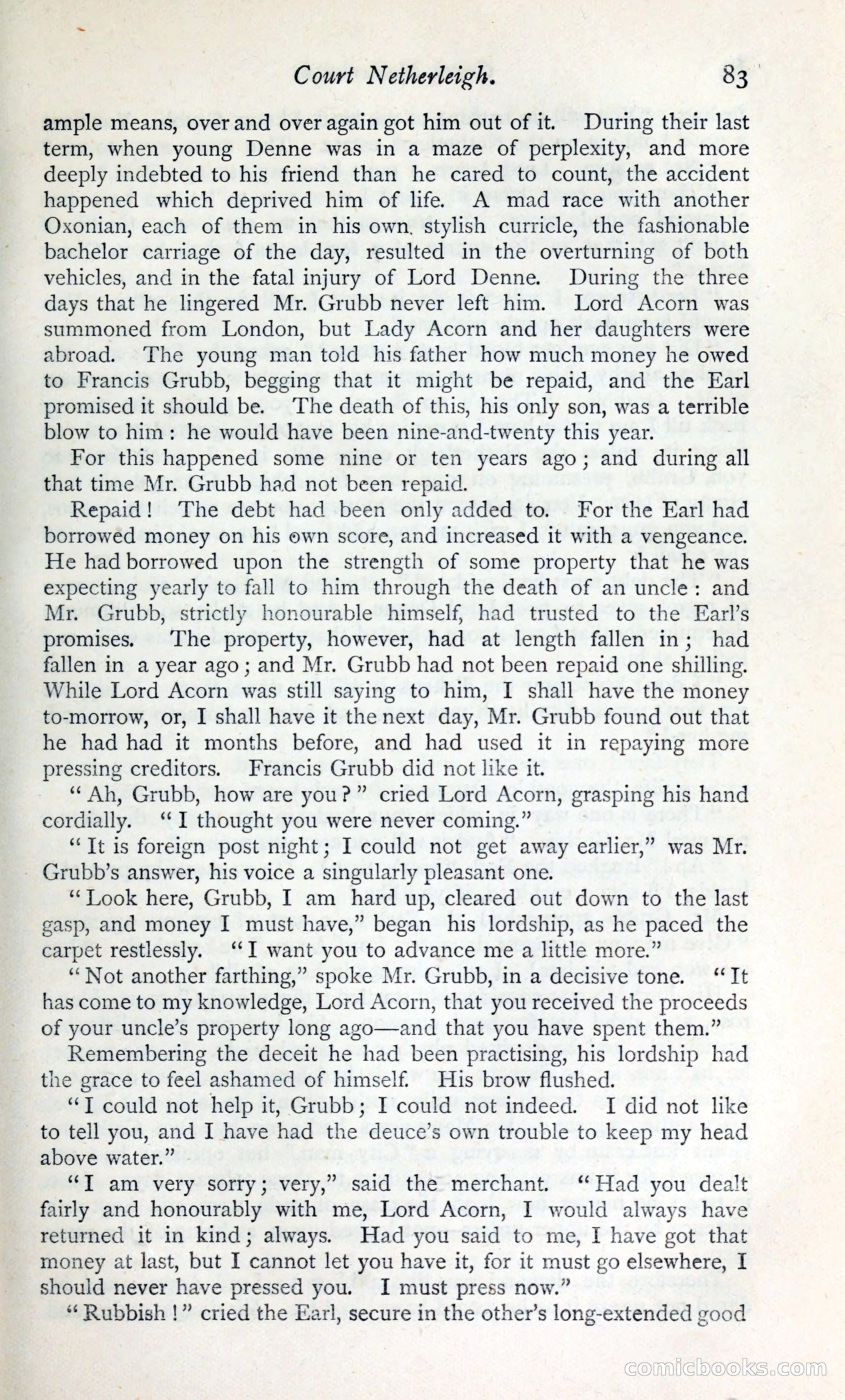
A restored page from Pulp Fiction, 1865. Page through the whole issue in the reader above.
📄 Transcribed text from this page (OCR, searchable)
Machine-transcribed from the original scan — historical spelling and the odd misread are preserved.
Court Netherleigh. 83 ample means, over and over again got him out of it. During their last term, when young Denne was in a maze of perplexity, and more deeply indebted to his friend than he cared to count, the accident happened which deprived him of life. A mad race with another Oxonian, each of them in his own, stylish curricle, the fashionable bachelor carriage of the day, resulted in the overturning of both vehicles, and in the fatal injury of Lord Denne. JDuring the three days that he lingered Mr. Grubb never left him. Lord Acorn was summoned from London, but Lady Acorn and her daughters were abroad. ‘The young man told his father how much money he owed to Francis Grubb, begging that it might be repaid, and the Earl promised it should be. ‘The death of this, his only son, was a terrible blow to him: he would have been nine-and-twenty this year. For this happened some nine or ten years ago; and during all that time Mr. Grubb had not been repaid. Repaid! The debt had been only added to. For the Earl had borrowed money on his own score, and increased it with a vengeance. He had borrowed upon the strength of some property that he was expecting yearly to fall to him through the death of an uncle: and Mr. Grubb, strictly honourable himself, had trusted to the Earl’s promises. The property, however, had at length fallen in; had fallen in a year ago; and Mr. Grubb had not been repaid one shilling. While Lord Acorn was still saying to him, I shall have the money to-morrow, or, I shall have it the next day, Mr. Grubb found out that he had had it months before, and had used it in repaying more pressing creditors. Francis Grubb did not like it. ‘Ah, Grubb, how are you?” cried Lord Acorn, grasping his hand cordially. ‘‘I thought you were never coming.” “Tt is foreign post night; I could not get away earlier,” was Mr. _ Grubb’s answer, his voice a singularly pleasant one. “Look here, Grubb, I am hard up, cleared out down to the last gasp, and money I must have,” began his lordship, as he paced the carpet restlessly. ‘‘I want you to advance me a little more.” “Not another farthing,” spoke Mr. Grubb, in a decisive tone. “It has come to my knowledge, Lord Acorn, that you received the proceeds of your uncle’s property long ago—and that you have spent them.” Remembering the deceit he had been practising, his lordship had the grace to feel ashamed of himself. His brow flushed. “T could not help it, Grubb; I could not indeed. I did not like to tell you, and I have had the deuce’s own trouble to keep my head above water.” “TI am very sorry; very,” said the merchant. ‘Had you dealt fairly and honourably with me, Lord Acorn, I would always have returned it in kind; always. Had you said to me, I have got that money at last, but I cannot let you have it, for it must go elsewhere, I should never have pressed you. I must press now.” * Rubbish !” cried the Earl, secure in the other’s long-extended good COMIC OOO SS (C(O)