
Pulp Fiction, 1865 · page 97 of 400
The Argosy — page 97: what you’re looking at
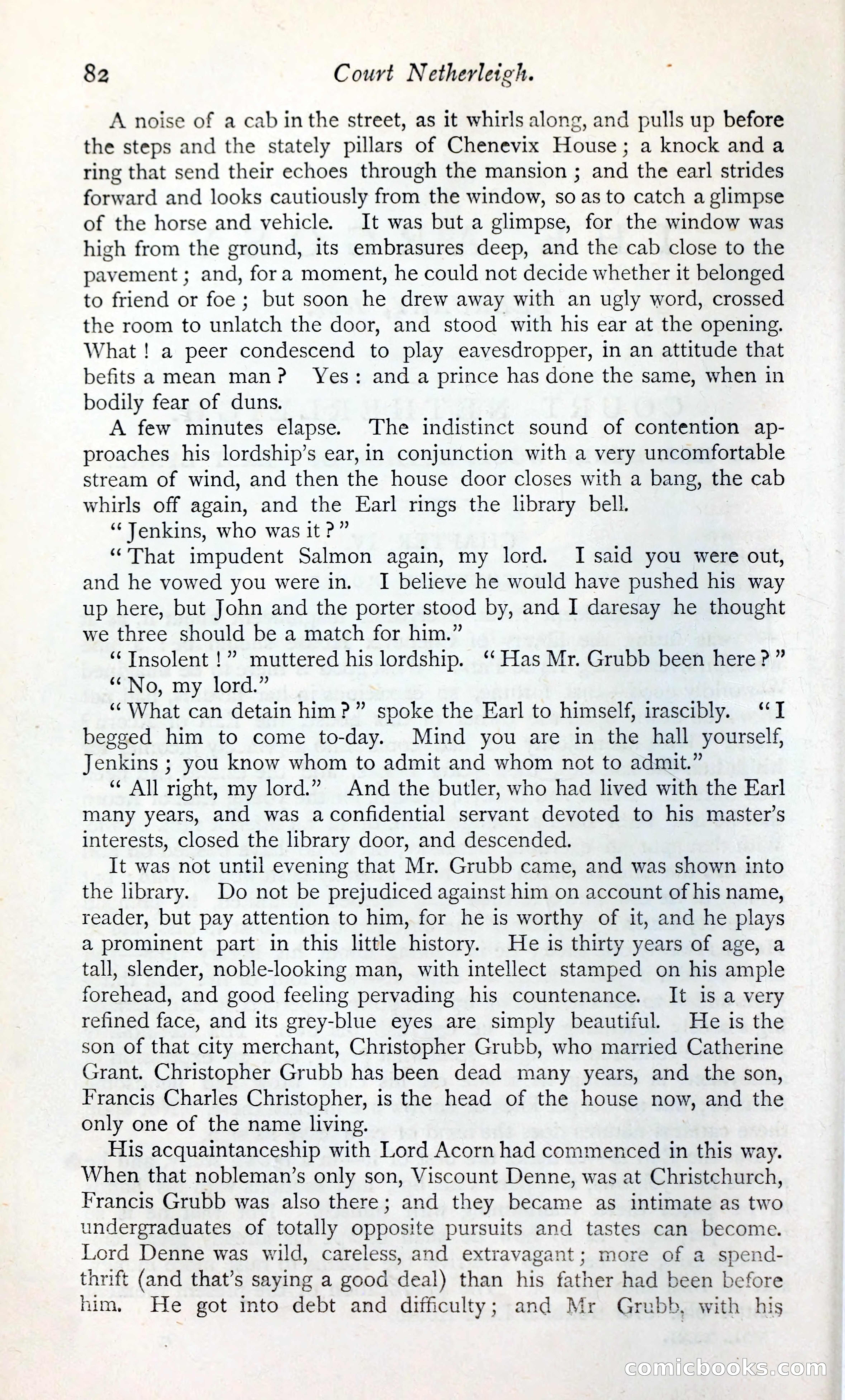
A restored page from Pulp Fiction, 1865. Page through the whole issue in the reader above.
📄 Transcribed text from this page (OCR, searchable)
Machine-transcribed from the original scan — historical spelling and the odd misread are preserved.
82 Court Netherletgh. A noise of a cab inthe street, as it whirls along, and pulls up before the steps and the stately pillars of Chenevix House; a knock and a ring that send their echoes through the mansion ; and the earl strides forward and looks cautiously from the window, so as to catch a glimpse of the horse and vehicle. It was but a glimpse, for the window was high from the ground, its embrasures deep, and the cab close to the pavement ; and, fora moment, he could not decide whether it belonged to friend or foe; but soon he drew away with an ugly word, crossed the room to unlatch the door, and stood with his ear at the opening. What! a peer condescend to play eavesdropper, in an attitude that befits a mean manP Yes: and a prince has done the same, when in bodily fear of duns. A few minutes elapse. The indistinct sound of contention ap- proaches his lordship’s ear, in conjunction with a very uncomfortable stream of wind, and then the house door closes with a bang, the cab whirls off again, and the Earl rings the library bell. “ Jenkins, who was it ?” “That impudent Salmon again, my lord. I said you were out, and he vowed you were in. I believe he would have pushed his way up here, but John and the porter stood by, and I daresay he thought we three should be a match for him.” “ Tnsolent !” muttered his lordship. ‘‘ Has Mr. Grubb been here?” “No, my lord.” “What can detain him?” spoke the Earl to himself, irascibly. ‘I begged him to come to-day. Mind you are in the hall yourself, Jenkins ; you know whom to admit and whom not to admit.” “All right, my lord.” And the butler, who had lived with the Earl many years, and was aconfidential servant devoted to his master’s interests, closed the library door, and descended. It was not until evening that Mr. Grubb came, and was shown into the library. Do not be prejudiced against him on account of his name, reader, but pay attention to him, for he is worthy of it, and he plays a prominent part in this little history. He is thirty years of age, a tall, slender, noble-looking man, with intellect stamped on his ample forehead, and good feeling pervading his countenance. It 1s a very refined face, and its grey-blue eyes are simply beautiful. He is the son of that city merchant, Christopher Grubb, who married Catherine Grant. Christopher Grubb has been dead many years, and the son, Francis Charles Christopher, is the head of the house now, and the only one of the name living. His acquaintanceship with Lord Acorn had commenced in this way. When that nobleman’s only son, Viscount Denne, was at Christchurch, Francis Grubb was also there; and they became as intimate as two undergraduates of totally opposite pursuits and tastes can become. Lord Denne was wild, careless, and extravagant; more of a spend- thrift (and that’s saying a good deal) than his father had been before him. He got into debt and difficulty; and Mr Grubb, with his EOmMmiGhbooksrco im