
Pulp Fiction, 1865 · page 88 of 400
The Argosy — page 88: what you’re looking at
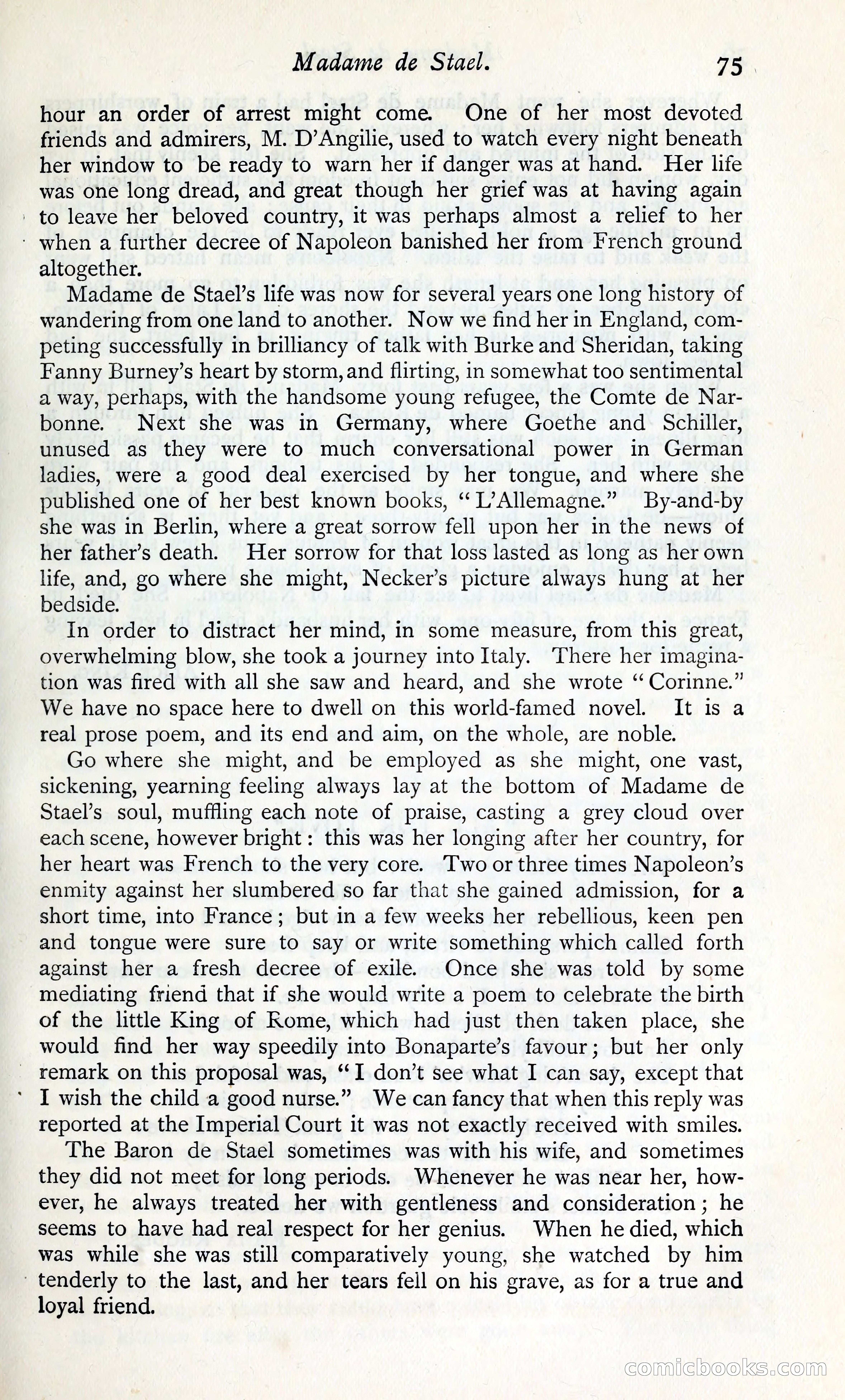
A restored page from Pulp Fiction, 1865. Page through the whole issue in the reader above.
📄 Transcribed text from this page (OCR, searchable)
Machine-transcribed from the original scan — historical spelling and the odd misread are preserved.
Madame de Stael. 75 hour an order of arrest might come. One of her most devoted friends and admirers, M. D’Angilie, used to watch every night beneath her window to be ready to warn her if danger was at hand. Her life was one long dread, and great though her grief was at having again - to leave her beloved country, it was perhaps almost a relief to her ' when a further decree of Napoleon banished her from French ground altogether. | Madame de Stael’s life was now for several years one long history of wandering from one land to another. Now we find her in England, com- peting successfully in brilliancy of talk with Burke and Sheridan, taking Fanny Burney’s heart by storm, and flirting, in somewhat too sentimental a way, perhaps, with the handsome young refugee, the Comte de Nar- bonne. Next she was in Germany, where Goethe and Schiller, unused as they were to much conversational power in German ladies, were a good deal exercised by her tongue, and where she published one of her best known books, ‘‘L’Allemagne.” By-and-by she was in Berlin, where a great sorrow fell upon her in the news of her father’s death. Her sorrow for that loss lasted as long as her own life, and, go where she might, Necker’s picture always hung at her bedside. In order to distract her mind, in some measure, from this great, overwhelming blow, she took a journey into Italy. ‘There her imagina- tion was fired with all she saw and heard, and she wrote ‘ Corinne.” We have no space here to dwell on this world-famed novel. It is a real prose poem, and its end and aim, on the whole, are noble. Go where she might, and be employed as she might, one vast, sickening, yearning feeling always lay at the bottom of Madame de Stael’s soul, muffling each note of praise, casting a grey cloud over each scene, however bright: this was her longing after her country, for her heart was French to the very core. Two or three times Napoleon’s enmity against her slumbered so far that she gained admission, for a short time, into France; but in a few weeks her rebellious, keen pen and tongue were sure to say or write something which called forth against her a fresh decree of exile. Once she was told by some mediating friend that if she would write a poem to celebrate the birth of the little King of Kome, which had just then taken place, she would find her way speedily into Bonaparte’s favour; but her only _ remark on this proposal was, ‘‘I don’t see what I can say, except that ‘ J wish the child a good nurse.” We can fancy that when this reply was reported at the Imperial Court it was not exactly received with smiles. The Baron de Stael sometimes was with his wife, and sometimes they did not meet for long periods. Whenever he was near her, how- ever, he always treated her with gentleness and consideration ; he seems to have had real respect for her genius. When he died, which was while she was still comparatively young, she watched by him tenderly to the last, and her tears fell on his grave, as for a true and loyal friend. COMIC OOO SS (C(O)