
Pulp Fiction, 1865 · page 87 of 400
The Argosy — page 87: what you’re looking at
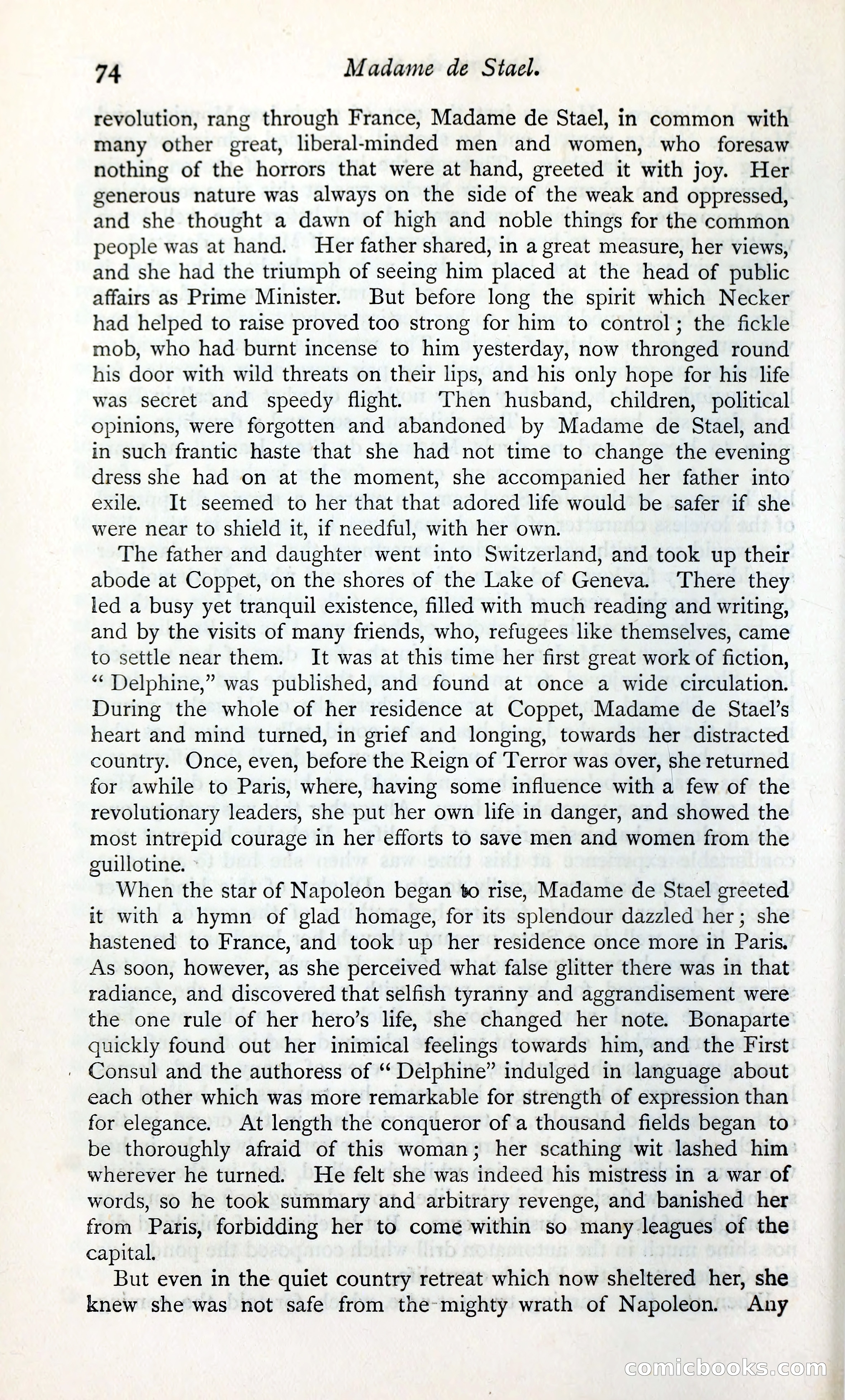
A restored page from Pulp Fiction, 1865. Page through the whole issue in the reader above.
📄 Transcribed text from this page (OCR, searchable)
Machine-transcribed from the original scan — historical spelling and the odd misread are preserved.
74 Madame de Stael. revolution, rang through France, Madame de Stael, in common with many other great, liberal-minded men and women, who foresaw nothing of the horrors that were at hand, greeted it with joy. Her generous nature was always on the side of the weak and oppressed, and she thought a dawn of high and noble things for the common people was at hand. Her father shared, in a great measure, her views, and she had the triumph of seeing him placed at the head of public affairs as Prime Minister. But before long the spirit which Necker had helped to raise proved too strong for him to control; the fickle mob, who had burnt incense to him yesterday, now thronged round his door with wild threats on their lips, and his only hope for his life was secret and speedy flight. Then husband, children, political opinions, were forgotten and abandoned by Madame de Stael, and in such frantic haste that she had not time to change the evening dress she had on at the moment, she accompanied her father into exile. It seemed to her that that adored life would be safer if she were near to shield it, if needful, with her own. The father and daughter went into Switzerland, and took up their abode at Coppet, on the shores of the Lake of Geneva. ‘There they led a busy yet tranquil existence, filled with much reading and writing, and by the visits of many friends, who, refugees like themselves, came to settle near them. It was at this time her first great work of fiction, “Delphine,” was published, and found at once a wide circulation. During the whole of her residence at Coppet, Madame de Stael’s heart and mind turned, in grief and longing, towards her distracted country. Once, even, before the Reign of Terror was over, she returned for awhile to Paris, where, having some influence with a few of the revolutionary leaders, she put her own life in danger, and showed the most intrepid courage in her efforts to save men and women from the guillotine. When the star of Napoleon began to rise, Madame de Stael greeted it with a hymn of glad homage, for its splendour dazzled her; she hastened to France, and took up her residence once more in Paris, As soon, however, as she perceived what false glitter there was in that radiance, and discovered that selfish tyranny and aggrandisement were the one rule of her hero’s life, she changed her note. Bonaparte quickly found out her inimical feelings towards him, and the First . Consul and the authoress of ‘ Delphine” indulged in language about each other which was more remarkable for strength of expression than for elegance. At length the conqueror of a thousand fields began to be thoroughly afraid of this woman; her scathing wit lashed him wherever he turned. He felt she was indeed his mistress in a war of words, so he took summary and arbitrary revenge, and banished her from Paris, forbidding her to come within so many leagues of the capital. But even in the quiet country retreat which now sheltered her, she knew she was not safe from the mighty wrath of Napoleon. Any ECORNIELOOOKS .E©