
Pulp Fiction, 1865 · page 64 of 400
The Argosy — page 64: what you’re looking at
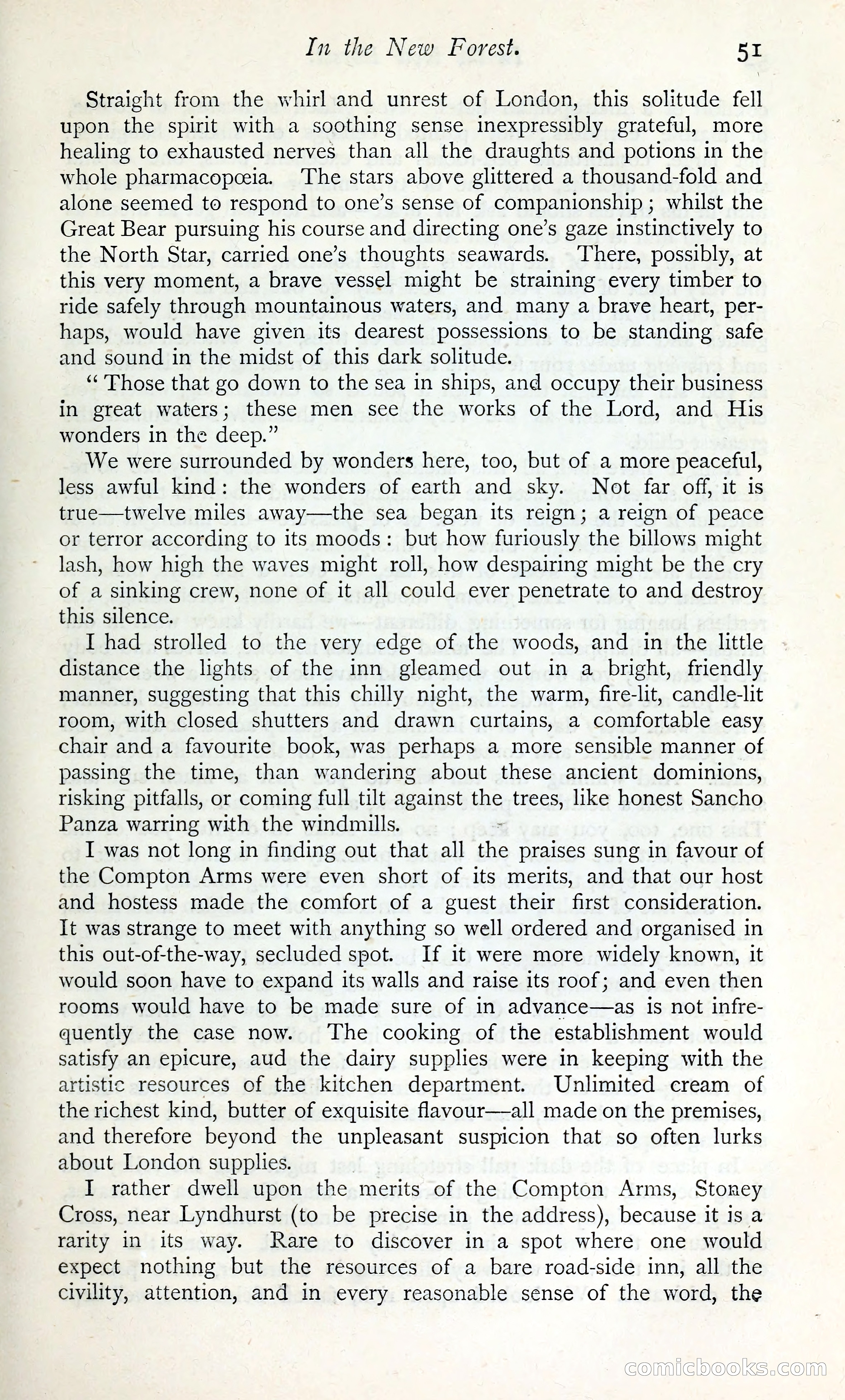
A restored page from Pulp Fiction, 1865. Page through the whole issue in the reader above.
📄 Transcribed text from this page (OCR, searchable)
Machine-transcribed from the original scan — historical spelling and the odd misread are preserved.
In the New Forest. 51 Straight from the whirl and unrest of London, this solitude fell upon the spirit with a soothing sense inexpressibly grateful, more healing to exhausted nerves than all the draughts and potions in the whole pharmacopceia. ‘The stars above glittered a thousand-fold and alone seemed to respond to one’s sense of companionship ; whilst the Great Bear pursuing his course and directing one’s gaze instinctively to the North Star, carried one’s thoughts seawards. ‘There, possibly, at this very moment, a brave vessel might be straining every timber to ride safely through mountainous waters, and many a brave heart, per- haps, would have given its dearest possessions to be standing safe and sound in the midst of this dark solitude. ‘“‘ Those that go down to the sea in ships, and occupy their business in great waters; these men see the works of the Lord, and Huis wonders in the deep.” We were surrounded by wonders here, too, but of a more peaceful, less awful kind: the wonders of earth and sky. Not far off, it 1s true—twelve miles away—the sea began its reign; a reign of peace or terror according to its moods: but how furiously the billows might lash, how high the waves might roll, how despairing might be the cry of a sinking crew, none of it all could ever penetrate to and destroy this silence. I had strolled to the very edge of the woods, and in the little distance the lights of the inn gleamed out in a bright, friendly manner, suggesting that this chilly night, the warm, fire-lit, candle-lit room, with closed shutters and drawn curtains, a comfortable easy chair and a favourite book, was perhaps a more sensible manner of passing the time, than wandering about these ancient dominions, risking pitfalls, or coming full tilt against the trees, like honest Sancho Panza warring with the windmills. , I was not long in finding out that all the praises sung in favour of the Compton Arms were even short of its merits, and that our host and hostess made the comfort of a guest their first consideration. It was strange to meet with anything so well ordered and organised in this out-of-the-way, secluded spot. If it were more widely known, it would soon have to expand its walls and raise its roof; and even then rooms would have to be made sure of in advance—as is not infre- quently the case now. The cooking of the establishment would satisfy an epicure, aud the dairy supplies were in keeping with the artistic resources of the kitchen department. Unlimited cream of the richest kind, butter of exquisite flavour—all made on the premises, and therefore beyond the unpleasant suspicion that so often lurks about London supplies. I rather dwell upon the merits of the Compton Arms, Stoney Cross, near Lyndhurst (to be precise in the address), because it is a rarity in its way. Rare to discover in a spot where one would expect nothing but the resources of a bare road-side inn, all the civility, attention, and in every reasonable sense of the word, the conniclooolkks (C(O)